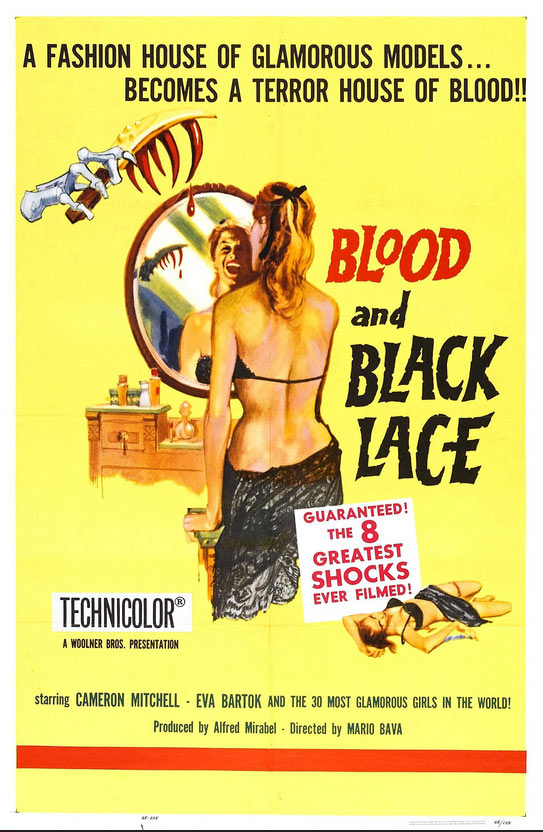
Formalist Violence in the Roman Atelier
Mario Bava abandoned the monochrome palette of his previous thriller for a saturated, predatory use of color. He utilized primary reds and greens to puncture the darkness of the Roman fashion house. These tones do not decorate the frame. They define the physical space. The artificial lighting creates a hyper-real environment where shadows possess a thick, ink-like density. Every interior becomes a stage for high-contrast violence.
The Masked Entity
The antagonist lacks a face and a voice. A featureless felt mask and a trench coat reduce the killer to a silhouette. This visual erasure shifts the focus from psychological motive to the mechanics of the assault. The killer moves with a stiff, industrial efficiency. There is no attempt to humanize the threat. The mask functions as a void within the ornate scenery of the atelier.
Tactile Brutality
The violence emphasizes the resistance of flesh against metal and wood. A spiked glove tears through skin with a jagged, audible friction. Bava lingers on the weight of the objects used to kill. The camera remains close to the struggle to capture the frantic movement of fabric and limbs. Death occurs in environments filled with velvet, glass, and polished timber. These textures heighten the sensory impact of the physical trauma.
Narrative Nihilism
The plot functions as a delivery system for a series of elaborate executions. Characters exist as mere targets within a corrupt social hierarchy. The missing journal serves as a catalyst for a chain of betrayals. Greed motivates every action within the fashion house. The film rejects moral resolution in favor of a cold, cyclical cruelty. Each murder occurs with increasing technical complexity and visual flair.