How a slave’s testimony uncovered the first criminal inquiry into poisoning in Roman history
According to Livy, in the year 331 BC the city of Rome was gripped by a wave of sudden deaths among its leading men, an epidemic that seemed to strike down consuls and senators with the same symptoms, one after another, until an enslaved woman came forward with an accusation that led to the largest criminal trial the young Republic had yet seen. What followed was Rome’s first recorded prosecution for poisoning, a case that implicated, by the end, some of the most prominent women in the city.
This is the second entry in Weird Italy’s True Crime: Ancient Rome series. The first, on the murder of Pedanius Secundus and the mass execution of his household, examined a killing under Nero. This case predates it by almost four hundred years, back when Rome was still a regional power confined to central Italy, not yet the empire it would become.
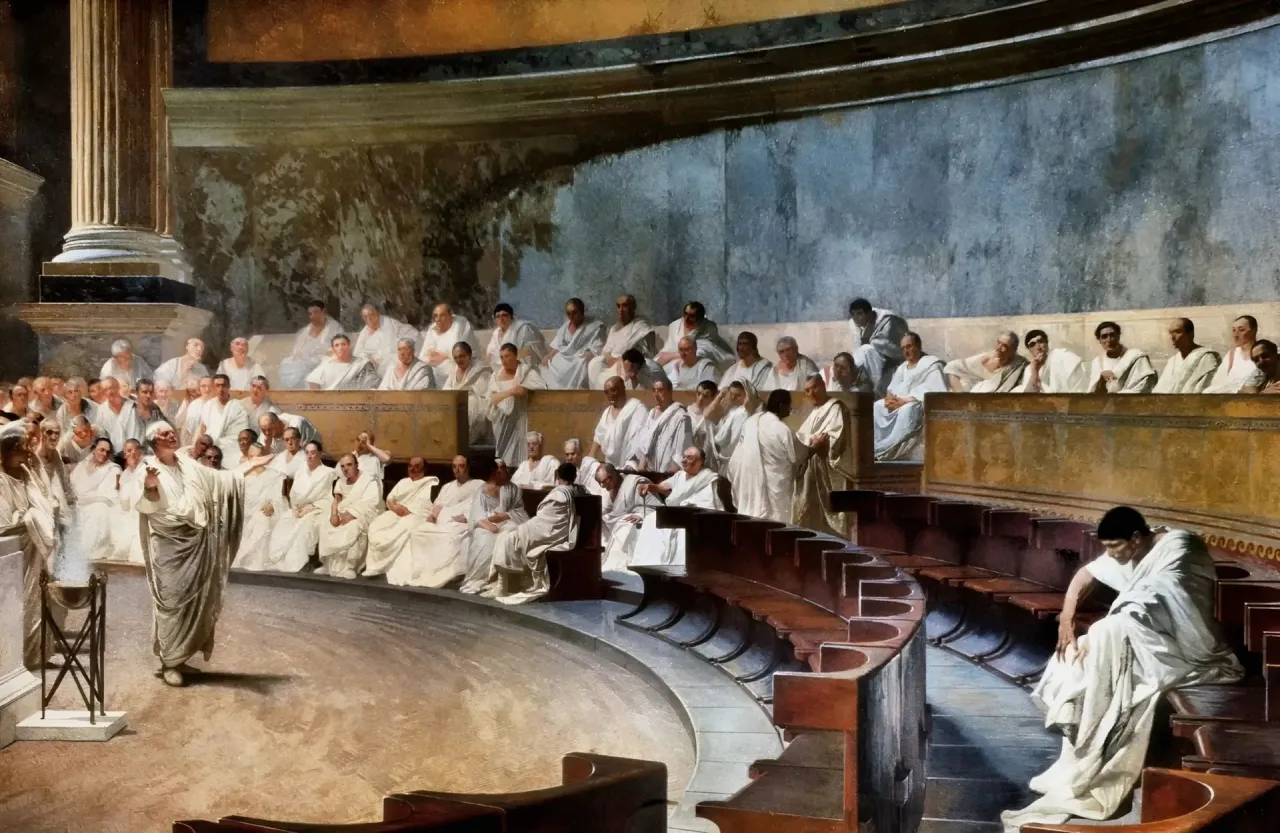
Featured image: Cicero Denounces Catiline in the Roman Senate by Cesare Maccari
A City Struck by Sudden Deaths
In the consulship of Marcus Claudius Marcellus and Gaius Valerius Potitus, an unusual number of leading citizens fell ill and died within a short span of time, all showing the same pattern of symptoms. Rome in 331 BC had no professional medicine in the modern sense and no concept of contagion as we understand it today. Illness, especially illness that struck the powerful in clusters, was generally read through a religious lens, as a prodigium, a sign that the gods were displeased or that something unnatural had disturbed the order of things. The idea that a wave of deaths might have a human, deliberate cause, rather than a divine one, was not the first explanation Romans reached for.
An Enslaved Woman’s Bargain
The case broke open when a female slave approached Quintus Fabius Maximus, one of that year’s curule aediles. The aedileship was a Roman public office with responsibility for the city’s markets, public order, and religious festivals, roughly the closest Republican equivalent to a city commissioner. It made Fabius a logical person for someone to approach with information about a public danger. The slave offered to reveal the cause of the deaths in exchange for a guarantee that she would not be prosecuted for whatever she was about to disclose. Fabius brought the matter to the consuls, who in turn referred it to the Senate, and the Senate granted the immunity she had asked for. Only then did she state that the city was suffering from the criminal practices of a number of Roman matrons, a term used for married women of respectable Roman families, who were preparing poisons themselves inside their own homes. She offered to lead officials to catch them in the act.
Twenty Women in the Forum
Following her directions, officials found a group of women brewing substances and storing away others already prepared. These were seized and brought into the Forum, the open square at the center of Rome that served as its marketplace, courtroom, and stage for public life all at once. Roughly twenty matrons, in whose houses the poisons had been discovered, were summoned there. Two of them, Cornelia and Sergia, both from patrician families, meaning they belonged to Rome’s oldest and most privileged hereditary aristocracy, insisted the preparations were medicinal remedies rather than poisons. When their accuser challenged them to drink the substances themselves and prove her wrong in front of the assembled crowd, the women asked for time to confer. After the crowd was dismissed, they discussed the matter among themselves and, according to Livy, agreed that none of them would refuse the drink. All of them drank the poison and died by what Livy calls their own wicked design.
The List Grows to One Hundred and Seventy
The attendants of the dead women, who in a Roman household would typically have been enslaved themselves and privy to their mistresses’ daily activities, were arrested immediately. Under questioning they named a far larger number of matrons involved in the same practices. Of those named, one hundred and seventy were found guilty. Livy notes explicitly that no public inquiry into poisoning had ever taken place in Rome before that day, which is what makes this episode Rome’s first documented veneficii quaestio, literally an inquiry into poisoning, a legal category that would recur throughout Roman history as later scandals involving Locusta and other notorious poisoners under the empire made clear. Writing more than a century later, Valerius Maximus recorded the same figure of one hundred and seventy convictions in his own collection of historical anecdotes, giving the episode a second, if likely dependent, place in Roman literary memory.
Livy’s Own Doubts
Livy, composing his history some three centuries after the events he describes, does not present the story without reservation. He remarks that he would be glad to believe the whole affair had been falsely handed down to him, and he notes that contemporaries treated it as a prodigy, a sign that the women’s minds had been seized by some form of madness rather than ordinary criminal intent, the same religious framework discussed in Weird Italy’s feature on Roman magic and superstition. What became of the wider group of one hundred and seventy women beyond their conviction, Livy does not say.
The case of 331 BC endures less for the certainty of what happened than for what it reveals about how Rome chose to explain a crisis it had no framework for understanding. A city accustomed to reading plague and misfortune as messages from the gods found itself, for the first time on record, treating sudden death as a matter for human investigation, and it settled on collective female guilt as the answer with a speed that left even its own chronicler uneasy. It stands as one of the earliest illustrations of a pattern that would recur throughout Roman history: an unexplained public crisis, a single informant granted immunity in exchange for names, and a widening net of accusation that outran the evidence supporting it.
A Modern Reading: Panic Before Poison
Modern historians reading the episode from outside Livy’s own framework have proposed a different explanation for what happened in 331 BC. In a study on poison and poisoning in ancient Rome, researchers L. Cilliers and F. P. Retief describe the case as a community overreaction during a period of collective stress, in a society that had no scientific means of telling an epidemic apart from deliberate poisoning and that reached for a human culprit once an explanation was needed. Under this reading, the accused women may have simply been the household healers of their day, the only people in a Roman family with practical knowledge of herbs and remedies, and their ordinary domestic role became a liability at the exact moment fear was looking for a target. Historian Richard Bauman has situated the case within a broader climate of gender-related political tension in the Roman Republic of that period, alongside other episodes of protest and legal conflict involving women, though the precise motive behind the poisonings, if any existed at all, remains unrecoverable from the sources.
None of these readings can be proven from the text Livy left behind, but together they point to the same pattern recognizable across many later witch panics and poisoning scares: an unexplained cluster of deaths, an accusation that offers a simple villain, and a legal response that expands far faster than the evidence behind it.
Source: Livy, Ab Urbe Condita, VIII, 18 ; Valerius Maximus, Facta et Dicta Memorabilia, II, 5, 3 ; The Art of Poison in the Roman Empire
Topics: ancient Roman poisoning case, Livy 331 BC trial, Roman Republic criminal law, veneficii quaestio Rome, Roman women poison scandal, first poisoning trial history, Roman Forum trial

Weird Italy, Guide to Unusual & Amazing Places to see in Italy. Italy’s news in English: Art, History & Facts