
How the Raeti, the Romans and the Bavarian Settlers Shaped a Territory That Still Defies Easy Categories
The autonomous province of Bolzano sits at Italy’s northernmost tip, wedged between Austria, Switzerland and the Veneto in a wholly mountainous territory spanning the Central and Eastern Alps, with significant extensions into the Dolomites, declared a UNESCO World Heritage Site in 2009.

Its very name is a political matter: official provincial documents use the dual designation “Provincia Autonoma di Bolzano – Alto Adige” alongside the German “Autonome Provinz Bozen – Südtirol”, while most of the German-speaking population simply calls it Südtirol. Three linguistic communities, German, Italian and Ladin, share approximately 7,400 square kilometres where road signs change language with every valley and cultural boundaries run far deeper than anything visible on a map.
Featured image: Lake Pragser Wildsee Seekofel seen from the bay, source

Layers of Time: From Prehistory to Italian Annexation
The earliest human traces in the territory date back around 12,000 years, to the period following the last glaciation. Artefacts from the Alpe di Siusi can be attributed to the Lower Palaeolithic, making these mountains one of the oldest sites of continuous human habitation on the continent. But the figure that brought worldwide fame to the region is a mummy: Ötzi, the Iceman of the Similaun glacier, found in 1991 on the border between Italy and Austria. He is approximately 5,300 years old, belongs to the Copper Age, and is now kept in a refrigerated cell at -6°C in the South Tyrol Museum of Archaeology in Bolzano. His presence on these mountains was no accident: the territory was already a well-travelled crossroads, and the manner of his death (he was killed by an arrow) points to conflict and tension between human groups competing for alpine resources.


Around 500 BC, the Fritzens-Sanzeno culture emerged, better known as the culture of the Raeti. Pliny the Elder considered them of Etruscan ethnicity, and recent linguistic research has indeed confirmed a relationship between the Raetic and Etruscan languages. The Raeti inhabited the alpine valleys with settlements at altitude, leaving inscriptions on ritual and votive objects that linguists still struggle to interpret fully.

The decisive turn came in 16–15 BC, when the Roman generals Drusus and Tiberius, Augustus’s adopted son, conquered the alpine territory and pushed north to the Danube. The northern part of today’s Alto Adige was incorporated into the Roman provinces of Raetia and Noricum; the southern part, including the Adige valley up to Merano, into Regio X Venetia et Histria. Five centuries of Roman presence left deep marks: the region was largely Latinised, and local populations developed a Neo-Latin vernacular with Raetic-Celtic substrate, Rhaeto-Romance, from which Ladin would later evolve in the Dolomite valleys.
With the decline of the Western Roman Empire and the barbarian invasions, the territory passed through centuries of instability. Lombards, Franks and then the Counts of Tyrol succeeded one another in controlling the region. From the thirteenth century onwards the Habsburg dynasty extended its grip over Tyrol, incorporating it definitively in 1363. For over five hundred years, until 1918, the territory was an integral part of the Austro-Hungarian Empire, and this belonging shaped its cultural, architectural and linguistic identity far more durably than the Italian period that followed.
The First World War shattered that equilibrium. Under the Treaty of Saint-Germain in 1919, the territory south of the Brenner Pass was assigned to Italy. The natural border so fervently invoked by Italian irredentists came with an almost entirely German- and Ladin-speaking population that nobody had consulted. Fascism worsened the situation through forced Italianisation: German place names were replaced with Italian equivalents invented by Ettore Tolomei, German-language teaching was banned in schools, and Germanic surnames were Italianised. In 1939, the Mussolini and Nazi regimes presented the South Tyrolean population with a traumatic choice: either opt for Germany (relocating to the Reich) or remain in Italy and accept definitive assimilation. Around 86% of the German-speaking population chose Germany, but the Second World War interrupted the plan before the transfers were complete. Many optants stayed, carrying a wound that poisoned inter-community relations for generations.
The postwar period did not immediately settle these accounts. The De Gasperi-Gruber Agreement of 1946 formally guaranteed protection for the German-speaking minority, but its implementation was slow and contentious. In the 1960s, tensions erupted in a series of bomb attacks carried out by South Tyrolean groups demanding self-determination or reunion with Austria. That period of armed conflict wound down gradually through political negotiation, leading to the Second Statute of Autonomy in 1972 and the full implementation of the so-called “Package” of protective measures, completed in 1992, when Austria and Italy issued a joint declaration formally closing the international dispute.


Three Languages, Three Worlds
The province’s linguistic structure is officially trilingual. At the 2011 census, approximately 69% of the population declared German as their mother tongue, 26% Italian and 4% Ladin. These figures, significant on their own, conceal a far more fractured geographical reality: in the lateral valleys and many smaller towns, the Italian-speaking presence is minimal or absent, while in the cities, above all in Bolzano, the two main communities coexist with varying degrees of mutual integration.
Ladin deserves separate attention. It is a Romance language descended directly from Latin as spoken in the Roman period, which survived in isolated Dolomite valleys precisely because their remoteness shielded the population from the Germanic colonisation that swept the main valleys from the early Middle Ages onwards. Today it is spoken primarily in Val Gardena, Val Badia, the Fassa valley (in Trentino), and some communities around Cortina d’Ampezzo. It is not a dialect of Italian, nor of German; it is a language in its own right, with its own literature, grammar and institutional recognition, taught in schools alongside the other two official languages of the province.
This trilingualism generates a social and bureaucratic complexity that has no real parallel elsewhere in Italy. Public employees in the province must pass certification exams in both German and Italian. Schools are separated by language group. Even the proportional system for public sector jobs, the so-called Proporz, allocates positions according to the declared linguistic affiliation of applicants, a mechanism designed to prevent either community from monopolising the state apparatus and which still generates periodic controversy.
Folklore Between Mountains and Memory
Related article: Monsters, Demons, and Mythical Creatures of Italy
South Tyrolean folklore is rooted in the Alpine Germanic tradition but has absorbed, over centuries, elements from Ladin mythology and occasional Italian influences. The most tenacious figures in local popular imagination are the Perchten, demonic masked creatures linked to the winter solstice and the dead season. Perchten processions, in which participants wear enormous carved wooden masks with exaggerated or terrifying features, take place in the days between the winter solstice and Epiphany. The tradition is pre-Christian in its origins and belongs to a broader Alpine cycle of rituals designed to drive away evil spirits, illness and the darkness of winter. These are not picturesque folkloric reconstructions for tourists: in many communities they retain a genuinely unsettling character, with the masked figures running through the streets at night and the sounds of bells and horns meant to replicate the chaos of forces outside human control.

Equally central is the Krampus, the horned companion of Saint Nicholas who punishes naughty children. While the figure has become increasingly commercialised across Central Europe, in South Tyrol it maintains something of its original menace: in the weeks before 6 December, Krampus parades draw crowds in the main towns, and handcrafted Krampus masks from local workshops are considered objects of genuine artisanal value.

Val Gardena’s woodcarving tradition had a stranger edge than most visitors realise: from the early nineteenth century until the Second World War, a handful of families in the valley produced skull-headed puppet faces sold to travelling vendors across Europe.
The region’s sacred art is another area of remarkable depth. Romanesque and Gothic churches are scattered across the valleys in concentrations that seem improbable given the sparse mountain populations that built them. The frescoes of the Abbey of Monte Maria (Marienberg) in Val Venosta, founded in the twelfth century, are among the finest Romanesque wall paintings north of the Alps. The church of St. John in Ranui, in Val di Funes, set against the backdrop of the Odle group, is perhaps the most photographed building in the entire province, though its interior frescoes and the quietude of its position in a high meadow make it far more than a postcard subject.


Places Worth Knowing
The landscape of South Tyrol resists summary. The Dolomites alone, with their vertical pale limestone towers turning amber and pink at sunset in the phenomenon known as enrosadira, would justify a lengthy account on their own. The Tre Cime di Lavaredo in the Sesto Dolomites, three separate rock towers rising over 2,900 metres, have been a reference point for alpine climbing since the nineteenth century and retain a visual drama that photographs consistently fail to capture at scale.
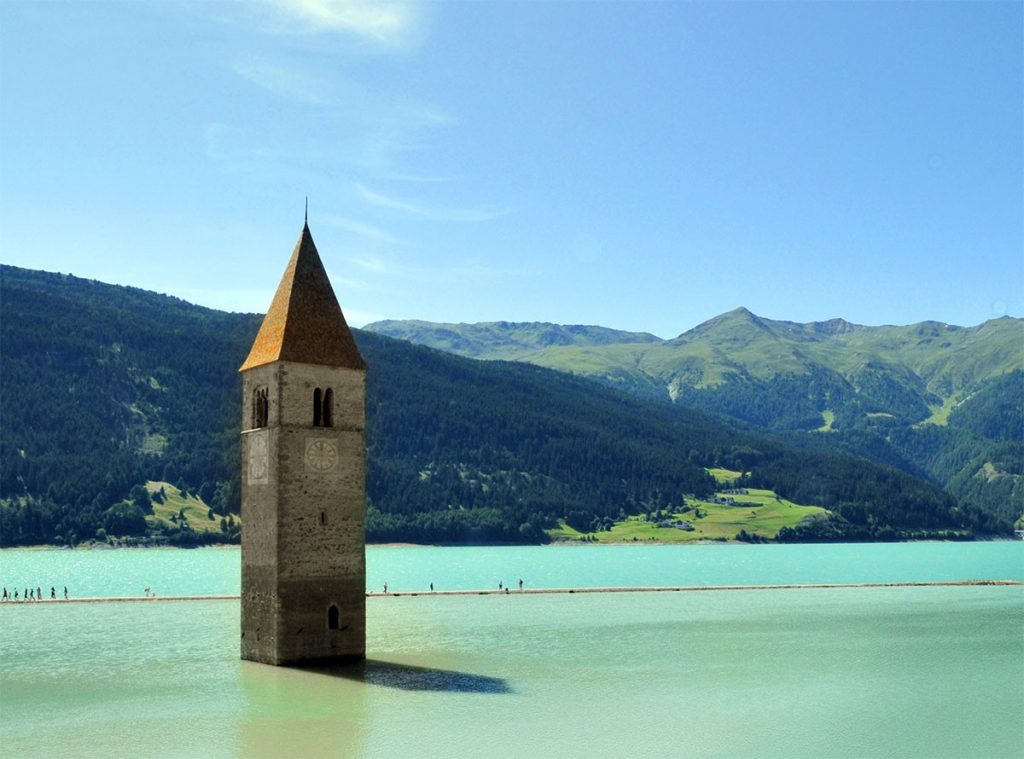
Less visited, and stranger, is the Lago di Resia in Val Venosta, an artificial reservoir created in the 1950s by flooding the old villages of Resia, Curon and Resia Vecchia. The medieval bell tower of the submerged church of Curon still protrudes from the water, surrounded by ice in winter and open water in summer, an image at once melancholy and surreal that has entered the collective imagination of the region. The village was rebuilt higher up; the tower remained where it stood.
The Renon earth pyramids, near Bolzano, are geological formations created by erosion: columns of compressed gravel and clay, each capped by a protective boulder that shields the softer material beneath from rain. They grow and eventually collapse over decades. Walking among them on the plateau of Renon, accessible by a narrow-gauge railway from Bolzano, is one of the genuinely strange experiences the province offers.

The Bletterbach gorge near Aldino, cut through 250 million years of sedimentary rock, is both a geological museum and a hiking destination of considerable drama. The exposed rock walls show Permian and Triassic strata in uninterrupted sequence, complete with fossil evidence of the mass extinction that ended the Permian period. It carries UNESCO designation as a Global Geopark.

Bolzano itself is worth more time than most visitors give it. The old town, with its arcaded streets and the Gothic cathedral, has a weight of civic history that sits awkwardly with its relatively modest size. The Walther Platz, named after the medieval Minnesingers poet Walther von der Vogelweide, who may have been born in the region, is the social centre of the German-speaking city. A few hundred metres away, the Mussolini-era Victory Monument, erected in 1928 to celebrate Italian annexation, generated decades of controversy before a 2014 installation converted its base into a documentation space contextualising the monument within the history of fascist occupation: a solution that satisfied nobody entirely, which perhaps means it was the right one.
Merano, further west along the Passirio river, was a fashionable health resort in the late Habsburg period, favoured by the Empress Elisabeth of Austria (Sisi) and by European aristocracy seeking mountain air and thermal cures. Its palm-lined promenades and the eclectic architecture of its thermal baths still carry the faded elegance of that era. The surrounding vineyards produce some of Italy’s most prized white wines, the Rieslings and Gewürztraminers of the Adige valley earning consistent international recognition.
In the far northeast, the Val Fiscalina near Sesto offers access to the Sesto Dolomites through a narrow valley that becomes increasingly spectacular the further one walks from the road. The silence in the upper valley, away from the rifugio and the summer hikers, has the quality that these mountains have always offered to those willing to go a few hundred metres further than the crowd.


An Autonomy That Still Asks Questions
South Tyrol’s model of ethnic autonomy is frequently cited in European debates on minority rights and territorial self-government as an example of a conflict successfully managed, if not fully resolved. The province is among the wealthiest in Italy by per capita income, with a GDP significantly above the national average and unemployment rates that consistently rank among the lowest in the country. The institutions function with an efficiency that visitors from other Italian regions tend to find startling.
Yet the question of identity remains open in ways that statistics cannot capture. The younger generations, particularly in Bolzano, increasingly identify with a South Tyrolean or simply an alpine identity that cuts across the old German-Italian fracture; intercommunity marriages and bilingualism are more common than they were a generation ago. At the same time, the formal structures of separation, separate schools, the Proporz, the linguistic censuses, continue to exist and to shape daily life in ways that keep the communities institutionally distinct even as they grow culturally closer. Whether this represents a stable equilibrium or a transitional state toward something else is a question the province is slowly and quietly working through, on its own terms and at its own pace.

Weird Italy, Guide to Unusual & Amazing Places to see in Italy. Italy’s news in English: Art, History & Facts