
A guide to the lagoon city’s history, architecture, islands, and the peculiar institutions that kept it independent for over a millennium
- A near-independent world built on water, with its own laws, customs, and ecosystem
Few cities have written their own conditions as completely as Venice. For more than a thousand years it was a sovereign state that ran its own navy, minted its own coin, kept its own calendar, policed itself through institutions designed with almost paranoid care, and treated the sea as the front door of every house. That habit of self-containment outlived the Republic. The city still measures its streets in a vocabulary no one else uses, numbers its houses by a logic that defeats most visitors, floods and drains on the rhythm of the Adriatic, and sits inside a lagoon that behaves as a near-independent ecosystem, separate enough from the open sea to keep its own balance of salt, sediment, and life. To describe Venice is to describe a world that set its own terms and, to a surprising degree, still does.

The city occupies the central and northern part of the Venice Lagoon, around four kilometres from the mainland and two from the open sea. The lagoon has to come first, because the city is a consequence of the water and not the reverse. What follows moves through the founding of the settlement, the long life of the Republic, the machinery of laws and customs that set the city apart, the fabric of the streets and the great monuments, the institutions of spectacle and industry, and then out across the islands and the open water, ending with the pressures that now bear on the lagoon, from rising tides to the return of wildlife the local dialect never had a word for.


A city built on water
The lagoon as it exists today is geologically young. It formed roughly six thousand years ago, after a marine ingression at the end of the last glacial period flooded what had been a river and marsh landscape. For a long time it was unstable, with the sea level and the line of the shore shifting continually; this mobility helped erase most traces of early human presence, which remains controversial and supported mostly by scattered flint tools and arrowheads, some dating to the second millennium before the common era. The immediate hinterland tells a clearer story, with the remains of actual villages, which suggests that the early lagoon was used as a place to hunt, fish, and gather, but not yet to live in permanently.

After about a thousand years before the common era the climate turned colder and wetter, the lagoon stabilised, and human settlement intensified. Roman writers noticed it. Strabo described villages raised on piles and linked to the sea by canals; Vitruvius praised the healthy air; Pliny the Elder recorded the artificial transverse channels cut to ease navigation; Martial compared the shores of nearby Altino to Baiae, then one of the most fashionable resorts in the Roman world. Archaeology fills in the rest, with amphorae, pottery shards, traces of salt pans and mills, and even fragments of villas near Torcello, evidence of a populated, working landscape and not an empty one.

The decisive shift came in the fifth and sixth centuries. As Rome’s infrastructure decayed and the Italian mainland was repeatedly overrun, the lagoon became a refuge. The waves of invasion that mattered most were those of the Huns in 452 and the Lombards in 568; people fleeing the terraferma carried their settlements, and their bishops, into the water. The bishop of Altino moved to Torcello, which together with Ammiana and Metamauco became one of the early centres of lagoon life. The islands that would later form Venice itself, including the high ground of Rialto, existed in this period but were overshadowed by these older, larger communities. The flood of 589 known as the Rotta della Cucca, which redirected the Brenta and the Sile and probably submerged the watersheds dividing the basin, helped fuse four separate stretches of water into the single lagoon recognisable now.


From duchy to Serenissima
The name itself records this layered origin. In Roman times Venetia denoted the whole northeastern region, the Regio X Venetia et Histria. As the Lombards took the interior and the coast stayed under Byzantine control, the term narrowed to the maritime fringe, the Venetia maritima. A peculiarity of the Latin name survives in the way the city was always written in the plural, Venetiae and never Venetia, as though it were understood from the beginning as a union of many small places fused into one: Venetiarum Civitas, Venetiarum Respublica.
Venetia maritima was raised to a duchy in 697, dependent on the Exarchate of Ravenna, with its capital first at Eraclea and then at Malamocco. After a failed Frankish attempt at invasion under Pepin, in 821 the safer islands of Rialto became the capital, and over time took on the name of the whole territory and state, becoming definitively Venice. Caught between the Frankish empire on one side and Byzantium on the other, yet distant from Constantinople, the settlement turned its position into leverage. Over roughly four centuries a sharp, mobile merchant class transformed a remote imperial outpost into a sea power that owed allegiance to no one. The most famous of those merchants, Marco Polo, left in the thirteenth century for the court of Kublai Khan and returned with an account, dictated as Il Milione, that opened much of Asia to the European imagination.
The Republic’s head of state was the Doge, from the Latin dux, though the office grew steadily more constrained by new institutions designed to check it. The relationship between the city and its rulers could be brutal. Before the year 1000 several doges judged too hungry for power were forced to take holy orders; others were killed, or blinded. The emblem that came to stand for the whole state was the winged lion of Saint Mark, holding the open book inscribed Pax tibi Marce, Evangelista meus. As one of the four medieval maritime republics, alongside Genoa, Pisa, and Amalfi, Venice still appears in that lion on the naval insignia of the modern Italian flag.

The reach of the Republic and its long decline
At its height in the thirteenth century the Republic controlled much of the Adriatic coast, including Dalmatia and Istria, along with many of the Aegean islands, Crete, Cyprus, and Corfu, and ranked as the leading military power and one of the principal trading forces in the eastern Mediterranean and the Middle East. By the fifteenth century its land territory ran from the Adda to Istria. The same century marked the beginning of the end of that primacy, as Ottoman power grew and the discovery of the Americas shifted the centre of gravity of European trade westward, away from the maritime routes on which the city had been built.

The response was a turn inland. Agriculture and stable mainland interests gained weight, expressed in the construction of the great Palladian villas, and the lifestyle of the ruling class changed with them. By the eighteenth century Venice was among the most important cities in Europe, with an outsized influence on art, architecture, and letters. This was the age of the playwright Carlo Goldoni, whose reform of the commedia dell’arte gave the stage works such as La locandiera and Il servitore di due padroni, and of the composer Antonio Vivaldi, whose Le quattro stagioni carried the sound of the city across the continent. It was also the Venice of Giacomo Casanova, whose famous escape from the prison cells known as the Piombi, in the roof of the Doge’s Palace, remains one of the more theatrical episodes in the city’s history.
Independence ended abruptly. On 12 May 1797 the last doge, Ludovico Manin, and the Great Council were forced by Napoleon to abdicate and proclaim a provisional municipal government. Within months the Treaty of Campoformio handed the Veneto, Istria, Dalmatia, and the Bocche di Cattaro to Austria. The city passed back to French control, then again to Austria, until the unification of Italy. In 1848 it rose during the revolutionary wave and, under Daniele Manin, declared the short-lived Republic of San Marco, which held out under siege for a year before surrendering in August 1849. Venice joined the Kingdom of Italy in 1866, confirmed by a plebiscite that recorded almost unanimous approval.
A world apart: the city’s own laws and institutions
What made Venice a world unto itself was less its position than its constitution. The Republic was governed by a structure built around a single fixed idea: no individual should ever gather enough power to become a prince. The sovereign body was the Maggior Consiglio, the Great Council, open in principle to the adult male patriciate. In 1297 the so-called Serrata, the closing of the Council, fixed membership in a defined set of noble families and made the ruling class hereditary, turning the state into a tightly controlled aristocratic oligarchy that would hold its shape for five centuries. Below it sat the Senate, which directed foreign policy and finance, and a web of magistracies that distributed authority so widely that it was difficult to concentrate.
The doge embodied the principle in person. Elected for life through a deliberately convoluted sequence of lotteries and ballots designed to frustrate any faction, he was bound on taking office by a promissione, a written oath enumerating what he could not do; he could not open his own correspondence unwatched, conduct private diplomacy, or pass the office to his heirs. The most feared organ was the Council of Ten, created in 1310 after a conspiracy against the state, which handled security and intelligence and could move in secret and at speed. Around it worked the three State Inquisitors, running surveillance and counter-espionage. Citizens could feed the system directly through the bocche di leone, stone letter-slots carved as lions’ mouths and set into walls, including one inside the Doge’s Palace, into which denunciations could be dropped against anyone suspected of wrongdoing.
Even time ran on local rules. The Venetian year began on the first of March, the more veneto, so that a document dated in the city’s January or February falls, by the common calendar, in the following year, a quirk that still trips up readers of the archives. The Republic kept its own weights and measures, its own coinage in the gold ducat and the silver grosso, and its own working language in the Venetian tongue, which it used for law and administration alongside Latin. Taken together these were the instruments of a state that governed itself as a closed machine, suspicious of heroes and of crowds in equal measure, and the residue of that machine is still legible in the stones of the city.

The shape of the city: sestieri, canals, and a vocabulary of its own
The historic centre is divided into six districts, the sestieri: Cannaregio, Castello, Dorsoduro, San Marco, San Polo, and Santa Croce. Their boundaries follow the logic of water, not the grid of a planned town, and the vocabulary of the streets reflects this. There is only one piazza in the whole city, Piazza San Marco; every other open space is a campo or a smaller campiello. A lane is a calle, a main paved street a salizada, a shopping street a ruga, a filled-in former canal a rio terà. A walkway along the water is a fondamenta, a broader waterfront a riva, a passage tunnelled under a building a sotoportego, an enclosed courtyard a corte. Only two waterways carry the title canale, the Canal Grande and the Canale della Giudecca; every other channel is a rio.


The address system follows the same inward logic. Houses are numbered continuously within each sestiere and not along individual streets, so a single sestiere runs to several thousand consecutive numbers and a bare address tells a stranger almost nothing about where to go. Finding a door means knowing the campo or the calle, and often asking. Movement through the city has its own grammar as well. The gondola, once ordinary transport, is now mostly ceremonial, still built and repaired in the few surviving boatyards called squeri, among them the Squero di San Trovaso; the everyday work of the canals is done by motor launches and the public vaporetti. Out in the open lagoon the channels are marked by the bricole, rows of wooden piles driven into the mud that tell a boat where the water is deep enough to pass.


Four bridges cross the Grand Canal. The oldest and most familiar is the Rialto, a single stone span lined with shops at the commercial heart of the old city, near the site of the mythical first settlement. The others are the Ponte dell’Accademia, the Ponte degli Scalzi by the railway station, and the Ponte della Costituzione, the contemporary glass and steel structure designed by Santiago Calatrava. Smaller bridges are numberless, and among them one carries a weight out of all proportion to its size: the Ponte dei Sospiri, the covered bridge linking the Doge’s Palace to the prisons, named for the prisoners who crossed it on the way to confinement.

Piazza San Marco and its monuments
The single piazza is the ceremonial centre of the city. At its heart stands the Basilica di San Marco, sheathed in gold and covered with mosaics that recount the history of Venice, its facade carved with reliefs of the months of the year. Above the main door stand four bronze horses brought from the imperial palace in Constantinople after the Fourth Crusade of 1204, on the order of the doge Dandolo, who commanded the expedition. Built on a Greek cross plan beneath five domes, the present basilica is the third church on the site, modelled on the Church of the Holy Apostles in Constantinople, and was originally the private chapel of the doges, not the city’s cathedral.


Beside it rises the Palazzo Ducale, the seat of government of the Republic, linked to the basilica by the Porta della Carta, the work of Bartolomeo Bono. Built in the fifteenth century from Istrian marble, on the site of an earlier castle that was burned during a revolt, the palace holds the Sala del Maggior Consiglio, for centuries the largest seat of government in the world, along with the prison cells and the leads of the Piombi. Facing it stands the Campanile di San Marco, first raised in 1173 as a lighthouse for sailors. It collapsed entirely on 14 July 1902 and was rebuilt exactly as it had stood, a reconstruction that became a point of civic pride.


The square is also the home of the city’s historic coffee houses. Coffee arrived from the Ottoman Empire around 1615, and cafés spread quickly through the city from the 1680s onward. The Caffè Florian opened under the Procuratie Nuove in December 1720 and is still in business, joined later in the century by the Caffè Quadri on the opposite side of the piazza. Nearby, the Peggy Guggenheim Collection holds a concentration of twentieth-century work by Ernst, Modigliani, Picasso, Miró, Pollock, and Kandinsky, a counterweight of modernism within a fabric that is mostly medieval and Renaissance (read Why did the Renaissance start in Italy?).


Churches, palaces, scuole, and the opera house
Venice carries an extraordinary density of churches, and several rank among the most significant buildings in the city for their architecture and the art they contain. The octagonal Basilica di Santa Maria della Salute dominates the entrance to the Grand Canal with its great dome, built as a votive offering after a plague. The vast Gothic Basilica di Santa Maria Gloriosa dei Frari holds major works of painting and sculpture, while the small Renaissance Chiesa di Santa Maria dei Miracoli, faced in coloured marble, is a jewel of a different scale. Across the water on the Giudecca stands the Chiesa del Redentore, the work of Andrea Palladio, another plague church and the focus of one of the city’s oldest festivals. Other major religious buildings include the Basilica dei Santi Giovanni e Paolo, the burial place of many doges, the Chiesa di San Zaccaria, and the Basilica di San Pietro di Castello, which served as the city’s cathedral until 1807 and holds two chapels by Veronese.


Much of the city’s painting hangs not in churches but in the scuole, the confraternities that combined charity, devotion, and mutual aid. The Scuola Grande di San Rocco holds a cycle of canvases by Tintoretto that he worked on for more than two decades, a room-by-room scheme that ranks among the great painted interiors of Europe; the smaller Scuola di San Giorgio degli Schiavoni keeps a cycle by Carpaccio painted for the city’s Dalmatian community. The principal collection of Venetian painting, from Bellini and Giorgione to Titian, Veronese, and Tintoretto, is gathered in the Gallerie dell’Accademia. The palaces hold their own museums: the Gothic Ca’ d’Oro, once gilded across its facade, and Ca’ Rezzonico, given over to the eighteenth-century city. Along the Grand Canal the trading past survives in the old merchant warehouses, the Fondaco dei Tedeschi of the German community and the Fondaco dei Turchi of the Ottoman one, their architecture turned toward the water that carried the goods.


The city’s musical life centred on the Teatro La Fenice, opened in 1792 and named, with grim accuracy, for the phoenix. It burned down in 1836 and was rebuilt; it gave the premieres of Verdi operas including Rigoletto and La traviata; and it burned again in 1996, this time by arson, before being reconstructed as it had been and reopening in 2003. The pattern of destruction and faithful rebuilding, shared with the campanile, is itself characteristic of a city that has chosen, again and again, to restore what it loses exactly where and as it stood.


The Arsenale: a factory before factories
If the scuole and the opera house show the city at leisure, the Arsenale shows it at work, and at war. Set in the sestiere of Castello and walled off behind a perimeter that runs for kilometres, the Arsenale was the shipyard and arms factory of the Republic, founded by convention in 1104 and expanded over the following centuries into one of the largest industrial complexes anywhere in the pre-modern world. Its name passed into Italian, and from there into much of Europe, by way of the Arabic dar as-sina’ah, the house of industry, picked up through Venetian trade with the Muslim world and worn down through the Venetian arzanà, a word Dante borrowed for a simile in the Inferno.


What made the Arsenale extraordinary was its organisation. Timber floated down from the forests of the Cadore and the Montello on the spring waters of the Piave; inside the walls, specialised crews performed their operations in sequence on hulls moving through the yard, an arrangement that anticipated the assembly line and the modern factory by centuries. At its peak the workforce, the arsenalotti, could fit out and launch a war galley in a single day, a feat used to impress visiting heads of state. The monumental land gate, raised across the fifteenth and sixteenth centuries, was among the first works of Renaissance architecture in the city; the marble lions that guard it were carried home as spoils after the conquest of Athens in 1687, and one of them still bears runic graffiti cut by Scandinavian warriors who had served the Byzantine emperor. The complex kept the same function for seven centuries. Ownership of most of it passed to the city in 2013, with the Navy retaining a part for its naval history museum, and roughly a quarter of the site now serves as exhibition space for the Biennale.

Masks, gambling, and the theatre of the Republic
Two Venetian inventions still travel under the city’s name, and both grew out of the same season of licensed disorder. The first is the Carnival. The tradition of the carnival and the masks of Venice reaches back through the centuries of the Republic, when the mask served a social function as much as a festive one, flattening rank and identity for a season and licensing behaviour that the rigid hierarchy of the city otherwise forbade. The classic forms, the white volto, the long-nosed plague doctor, the half-mask of the bauta worn with a tricorn and cloak, are not decorative inventions but objects with histories tied to law, theatre, and daily life. Suppressed under foreign rule and revived in the late twentieth century, the carnival now functions partly as spectacle, but its origins lie in the specific social machinery of the old city.
The second is the public casino. The Casinò di Venezia, founded in 1638 as the Ridotto di San Moisè, is recognised as the oldest gaming house in the world. It opened precisely to bring the gambling that flourished during Carnival under state supervision, in rooms attached to a theatre where masked players could meet on equal terms. The Council of Ten closed the Ridotto in 1774, on the grounds that it was ruining the nobility, an instructive verdict from a state that licensed the vice in order to watch it. The institution survived the Republic; in the twentieth century it moved to a summer seat at the Lido and then to its present home at Ca’ Vendramin Calergi, the Renaissance palace on the Grand Canal where the composer Richard Wagner died in 1883, with a modern branch at Ca’ Noghera on the mainland near the airport.


The ghetto: a word born in Venice
Another Venetian institution gave a word to the rest of the world, and a darker one. The Venetian Ghetto, established in the sestiere of Cannaregio in 1516, was the first ghetto in the world, the enclosed quarter where the Republic compelled its Jewish residents to live. The name itself is Venetian in origin, taken from the geto, the foundry that had once occupied the site, and from there it passed into nearly every European language as the general term for a segregated urban district. The area, split into the Ghetto Nuovo and the older Ghetto Vecchio, still holds the city’s synagogues, built tall and inward because the population could expand only upward within fixed walls. It is a reminder that the same instinct for order and control that produced the city’s elegant institutions also produced its instruments of exclusion.


Secrets written in stone
Beneath the official record of doges and councils runs another history, scratched directly into the walls. In an interview about Venetian graffiti, the writer Alberto Toso Fei and the scholar Desi Marangon, authors of I Graffiti di Venezia, describe the inscriptions, marks, and etchings scattered across the city as a kind of alternative historiography. These signs record the lives of ordinary citizens, merchants, and workers, not only the ruling elite, and they document concrete events: lagoons frozen solid, naval engagements, the collapse of the San Marco bell tower. The highest concentration survives around the Doge’s Palace and the area surrounding the basilica, where centuries of foot traffic met surfaces durable enough to keep the record. Read closely, the stones turn the monumental city into a populated one.

The Biennale and the Film Festival
Venice reinvented itself as a capital of culture at the moment its political power was long gone. The Biennale began in 1895 with the first International Art Exhibition, and the name records the two-year rhythm of the event. Its permanent home is in the Giardini, the public gardens laid out under Napoleon, where the participating nations built their own pavilions; because of their status these pavilions are treated, in legal terms, as something close to foreign delegations, small pieces of extraterritorial ground scattered through a Venetian park, which suits a city long accustomed to housing the whole world inside its own perimeter. Over the following century the institution grew to cover architecture, with the International Architecture Exhibition founded in 1980, along with theatre, music, and dance, and it spread from the Giardini into the recovered halls of the Arsenale.


The most glamorous of its offshoots is the Mostra Internazionale d’Arte Cinematografica, the Venice Film Festival, the oldest film festival in the world. It was conceived by Giuseppe Volpi, then president of the Biennale, with the sculptor Antonio Maraini and Luciano De Feo, and the first edition ran from the sixth to the twenty-first of August 1932 on the terrace of the Hotel Excelsior at the Lido, the long sandbar that doubles as the city’s beach resort. That first programme, not yet competitive, screened films that became classics; the festival turned competitive in 1934 and annual in 1935. Its top award, the Golden Lion, takes its name from the same winged lion that the Republic stamped on its ships, so that the city’s oldest symbol now presides over its most modern festival.


The lagoon: an engineered wilderness
Stepping back from the streets, the lagoon is the largest in the Mediterranean, covering roughly 550 square kilometres. Only about eight percent of that surface is solid ground, including the city and the smaller islands; some eleven percent is permanent open water or dredged channels, and the remaining eighty percent is intertidal flat. It was added to the UNESCO World Heritage list in 1987, together with the city. The whole system connects to the Adriatic through three inlets, or bocche di porto, at the Lido, at Malamocco, and at Chioggia, and because it lies at the head of an enclosed sea it is subject to large swings in water level.
Centuries of human work shaped its present form. The inlets, originally more numerous, were reduced to three; the sandy littoral strips that separate the lagoon from the open sea were reinforced with the Murazzi, the long eighteenth-century sea walls of Istrian stone; and the mouths of the Sile, the Piave, and the Brenta were diverted outside the basin to stop it silting up. These interventions repeatedly disturbed an old equilibrium and contributed to the decay of once-important centres such as Torcello, Costanziaco, and Ammiana, which faded as Venice rose. The typical dwellings of the working lagoon were the casoni, huts of timber and marsh reed used by the fishermen who once lived among the channels.
Ecologically the lagoon remains a complex and partly self-contained system, separate enough from the open sea to surprise observers when a dolphin occasionally wanders in. The fish diversity is unusually high for a shallow, sandy-bottomed basin, a product of the variety of habitats, including river mouths, shallows, the salt marshes called barene, the islands, the artificial channels, and the inlets themselves. That richness is under pressure. Erosion has stripped wide areas of barene and velme, lowered the bottom, and flattened the internal differences in the terrain, while the deepening of the inlets and the excavation of the Malamocco to Marghera canal have increased the currents and carried sediment out to sea faster than the basin can replace it. The salt marshes that once covered close to half the lagoon now occupy barely seven percent.


The islands
The lagoon is studded with islands, each with its own character and history. Murano, a short distance north of the city, has been the centre of Venetian glassmaking since the Republic concentrated the furnaces there to reduce the risk of fire in the city. Burano, further out, is known for its lacework and for the saturated colours of its fishermen’s houses, painted in strong blocks so that they could be told apart across the water and the fog. Torcello, the oldest centre of all and once the most populous, is now nearly empty, its history compressed into a handful of buildings, including the cathedral that descended from the first refuge of the bishop of Altino, while neighbouring Mazzorbo and Sant’Erasmo, the largest island after the city itself, keep the lagoon’s old agricultural life of vineyards and market gardens.

Other islands carry specialised roles. San Giorgio Maggiore, facing the piazza across the water, holds a Palladian church and a foundation devoted to culture. San Lazzaro degli Armeni has been an Armenian monastery for centuries, a working centre of scholarship and not a museum. San Michele is the city cemetery, an island wholly given over to the dead. San Francesco del Deserto keeps a Franciscan community in near silence among its cypresses, while La Certosa and Le Vignole have returned to green use as park and garden. The old monastery island of San Servolo, once a psychiatric hospital, now houses a university campus; San Clemente, La Grazia, and other small islands that served as hospitals have been turned into hotels. Guarding the Lido inlet stands the fortress of Sant’Andrea, the work of the military architect Sanmicheli, which once trained its guns on any ship presuming to enter without leave.


A cluster of islands carries the memory of disease and a word the city gave the world. The Lazzaretto Vecchio and the Lazzaretto Nuovo were among the first permanent quarantine stations ever built, where ships, crews, and goods suspected of carrying plague were held in isolation; the very term quarantine comes from the Venetian quaranta giorni, the forty days of confinement the Republic imposed.
Poveglia, now uninhabited, accumulated a history as a quarantine and asylum island that has made it a fixture of the city’s grimmer legends. Beyond these lie the still-inhabited fishing communities of the southern littoral, Pellestrina, and at the far end of the basin Chioggia, a working port and fishing town that is in many ways a smaller, harder-edged echo of Venice itself, complete with its own canals and its own dialect.
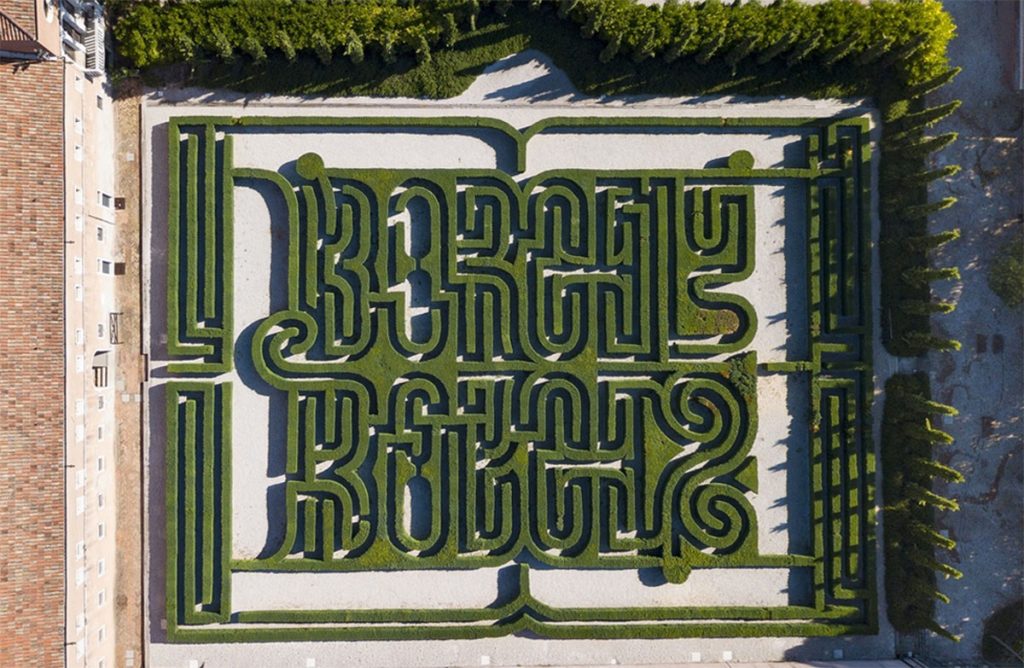
The Borges labyrinth on San Giorgio
San Giorgio Maggiore holds one of the city’s stranger recent additions. The Borges labyrinth is a hedge maze built to honour the Argentine writer Jorge Luis Borges, designed by the English diplomat and self-described labyrinthologist Randoll Coate and realised by the Cini Foundation at the wish of Maria Kodama, the writer’s widow. It opened to the public in June 2021. Some 3,200 box plants are arranged so that, seen from above, they spell the name Borges and form a series of symbols drawn from his work and inspired by the story Il giardino dei sentieri che si biforcano: a walking stick, mirrors, two hourglasses, a question mark, a tiger, and the writer’s first names. It is a literary idea made physical, a text that has to be walked instead of read, and a fitting emblem for a city that has always been easier to lose oneself in than to map.


Acqua alta and the MOSE
The defining hazard of the lagoon city is the acqua alta, the exceptionally high tide that periodically floods the lower parts of the city. The tide at Venice is the sum of three components: the astronomical tide driven by the moon and sun, a meteorological contribution from atmospheric pressure and wind, and the oscillations of the Adriatic itself. High water alone does not cause flooding; it is the overlap of these factors, in particular a sustained scirocco pushing the length of the Adriatic against an already high tide, that drives the level beyond the thresholds at which the city floods. A tide above 80 centimetres begins to trouble the lowest pavements; at 140 centimetres well over half the city goes under.

The disasters are part of living memory. The flood of 4 November 1966 reached 1.94 metres in the city and forced evacuations, exposing how vulnerable the ground floors of Venice had become and accelerating the abandonment of the historic centre for the mainland. On 12 November 2019 the tide peaked at 1.87 metres, again causing widespread damage. To defend against these extremes, the MOSE project, under construction since 2003, installed mobile barriers at the three inlets, rows of hinged gates that rest on the seabed and rise to block the incoming sea when the tide is forecast to exceed a set level. The barriers were raised in full for the first time in the summer of 2020, a test watched closely after decades of cost and controversy. The system carries its own environmental risk, since closing the inlets limits the exchange of oxygen in a body of water that is already poorly flushed; protecting the city and preserving the lagoon are not always the same goal.

Flamingos and the return of wildlife
If the tide is the lagoon’s oldest story, one of its newest is unfolding on the same mudflats. For most of the twentieth century the flamingo was a postcard image of the Camargue or the marshes of Andalusia, not of the foggy channels of the northern Adriatic. That has changed with remarkable speed. The most recent census recorded nearly 24,000 wintering flamingos in 2025, around six thousand more than the year before, making the lagoon one of the most important flamingo sites in the Mediterranean basin. A single detail captures how new the phenomenon is: the Venetian dialect, normally precise about local wildlife, has no traditional word for the bird, because the first meaningful sightings date only to the early 2000s.
The lagoon suits the species almost exactly. Brackish water, shallow tidal flats, the natural sandbanks of the barene, and the centuries-old enclosed fishing basins known as valli da pesca form a feeding table that the tide replenishes through the day, rich in the small crustaceans and molluscs whose carotenoids produce the birds’ pink colour. European wetland recovery work has reinforced these natural advantages; the WaterLANDS project is reconstructing barene in the eroded southern lagoon, repositioning sediment and replanting native vegetation, and flamingo flocks there have grown from isolated individuals to groups of several hundred. The settlement of Lio Piccolo, near Cavallino-Treporti in the northern lagoon, has become the reference point for watching them, best in the first and last light of the day, and at a distance that does not flush the flock.
A city still becoming
It is tempting to treat Venice as a finished object, a museum held in place against the water. The lagoon refuses that reading. It was assembled over six thousand years by rivers, tides, and human engineering, and it is still moving: salt marshes lost and partly rebuilt, tides rising against barriers that rise to meet them, birds arriving for which there is not yet a word. The city on top of it has always lived by negotiation with this instability, raising its campanile and its opera house twice when they fell, walling its sea and diverting its rivers, governing itself through a machine built to outlast any single ruler, and writing its private history into the stone when the official version had no room for it. To read Venice well is to hold both at once, the monuments and the mud, the closed constitution and the open lagoon, and to understand that the second was always the condition of the first.

Weird Italy, Guide to Unusual & Amazing Places to see in Italy. Italy’s news in English: Art, History & Facts