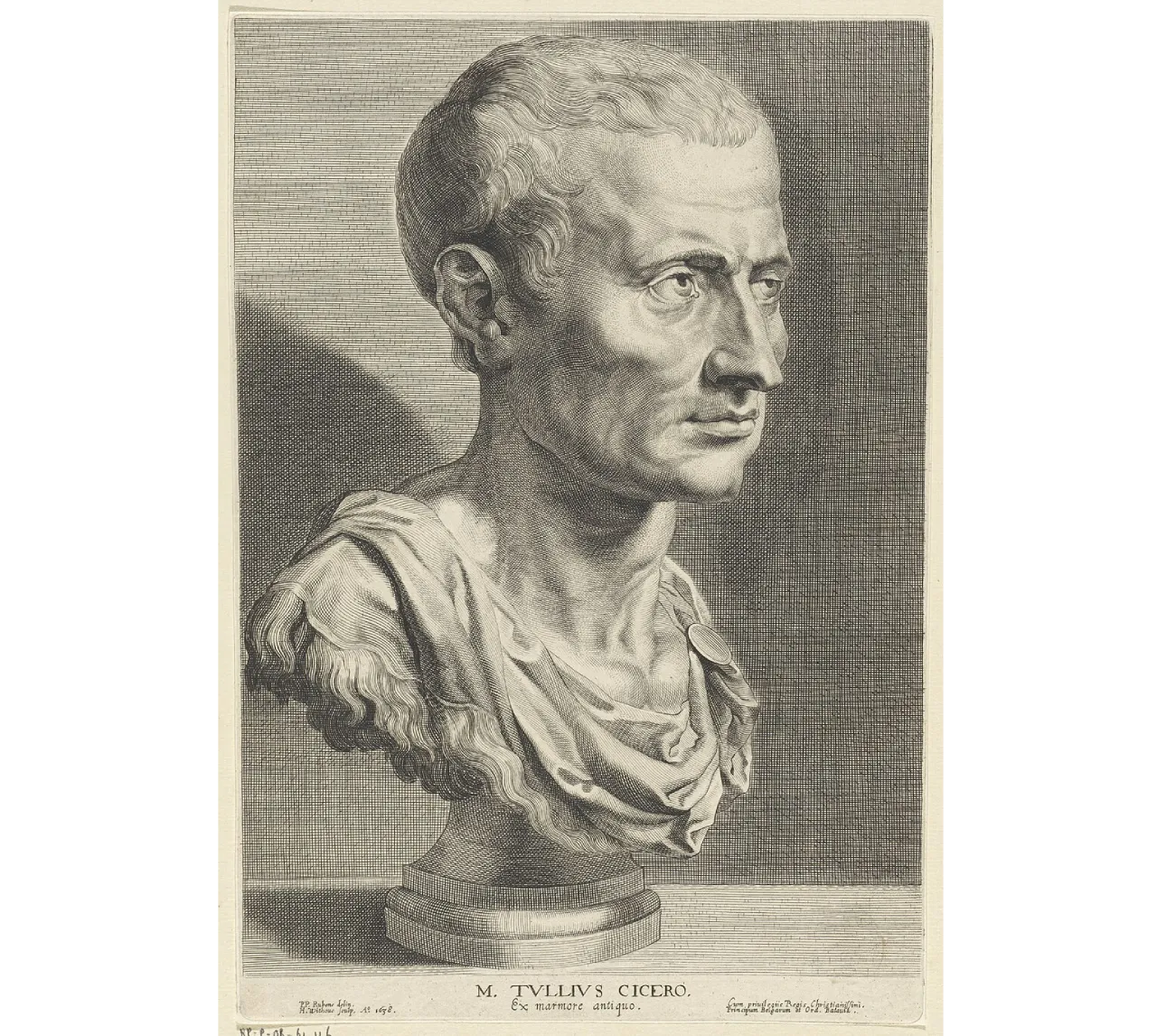
Cicero’s defense exposed a scheme built on proscription lists and a freedman’s influence.
According to Cicero, in September of 81 BC a wealthy landowner from the Umbrian town of Ameria was killed in the streets of Rome on his way home from dinner. Within days, the men who stood to profit from his death had his name added to a proscription list that had already been closed. What followed was the first criminal case argued by the young Cicero: a trial for parricide in which the accused was the victim’s own son, and in which the real culprits were the powerful men who had acquired an estate worth six million sesterces for two thousand.
This is the third entry in Weird Italy’s True Crime: Ancient Rome series. The first examined the murder of Pedanius Secundus and the execution of his household under Nero, and the second the poison ring of 331 BC, the first recorded Roman inquiry into poisoning. This case sits between them, in the last convulsions of the civil wars that ended the old Republic.
A Republic at War With Itself
The trial of Sextus Roscius cannot be understood without the political earthquake that preceded it. In 88 BC Lucius Cornelius Sulla was consul and by right should have received command of the first war against Mithridates. Gaius Marius, his rival, maneuvered to take the command for himself, and Sulla answered with an act that left an indelible mark on Roman history: he marched on the capital at the head of his legions. The civil war that followed ended with Sulla’s victory.
Sulla then set out to restore the authority of the Senate, which had been steadily eroded since the era of the Gracchi by the equestrian order and by the populares, the politicians who appealed directly to the people. His program was meant to revive an aristocratic republic. In practice it slid quickly into a personal dictatorship.
The Proscriptions and the Men Who Profited
The most notorious instrument of that dictatorship was the proscription list. The first was published in 82 BC and named those who had sided with the Marian faction during the war. Sulla closed the lists on June 1, 81 BC, and soon afterwards laid down his dictatorship, apparently satisfied that the republican state had been rebuilt.
Historians have long debated why he stepped aside. One possibility is the growing hostility of the very aristocrats he believed he had been serving. That tension runs through the Roscius case, because the proscription system had created a class of opportunists who could turn a name on a list into a fortune. The most powerful of them was Lucius Cornelius Chrysogonus, a freedman of Sulla.
A Murder Near the Pallacine Baths
Sextus Roscius the elder was, by Cicero’s account, the leading man of Ameria, modern Amelia in the province of Terni. He was rich, noble, and tied by bonds of hospitality to some of the most prominent families of Rome, among them the Metelli, the Servilii and the Scipios. These families sympathized with Sulla’s faction, and Roscius shared their allegiance. He also had a long-standing quarrel with two relatives, Titus Roscius Capito and Titus Roscius Magnus.
One night in September of 81 BC, returning from a banquet, the elder Roscius was killed near the Pallacine Baths, close to the Forum Flaminium. Cicero points to a detail that, in his telling, exposes the plot. The first person to carry the news to Ameria was a freedman and client of Magnus named Mallius Glaucia. He did not bring it to the victim’s son, but to the house of Capito, the dead man’s enemy. Roscius had been killed in the first hour of the night, yet the messenger reached Ameria by first light, covering fifty-six miles in about ten hours in a light carriage.
Thirteen Farms for Two Thousand Sesterces
Four days after the murder, Cicero says, word of it reached Chrysogonus at Sulla’s camp at Volaterrae. The dead man had left thirteen farms, nearly all bordering the Tiber, and a son who was an unpolished countryman with no connections in the capital. A conspiracy took shape.
The legal mechanism was grimly simple. A man killed before the lists closed could be listed retroactively, which meant his property would be confiscated and sold at auction. The lists had been closed for months, but Chrysogonus saw to it that the name of Sextus Roscius appeared on one anyway. The estate, worth six million sesterces, was bought by Chrysogonus himself for two thousand. Capito received three of the farms outright, and Magnus took charge of the remainder as Chrysogonus’s agent.
The Man Left Without a Home
The legitimate heir was the dead man’s son, also named Sextus Roscius, who had spent his adult life farming the family land at Ameria. Magnus arrived there as Chrysogonus’s agent and drove him out of his home before he had finished the funeral rites for his father. According to Cicero, the citizens of Ameria were so scandalized that the whole town was filled with weeping and lamentation.
The town council voted to send a delegation of ten leading men to Sulla to plead for the dead man’s reputation and the son’s property. Chrysogonus intercepted them. He promised to have the name struck from the list and the farms returned, and Capito, who was himself one of the ten envoys, added his own assurances. The delegates went home without ever seeing Sulla. Delay followed delay, and then the conspirators began to plot against the young man’s life.
Roscius fled to Rome and took refuge with Caecilia Metella, a noblewoman of the family that had been a friend of his father. She sheltered him and protected him with such care that, in Cicero’s words, he could now be counted among the living accused rather than among the dead proscribed.
An Accusation of Parricide
Unable to reach him by violence, the conspirators chose a different weapon, the courts. They would accuse Roscius of murdering his own father, a crime so shocking to Roman sensibilities that the mere name of it, they reckoned, would condemn him. The penalty for parricide was to be sewn into a sack and drowned. They also calculated that no advocate would dare to defend him against a man with Chrysogonus’s influence, and that nobody would raise the subject of the sale of the estate. A man named Gaius Erucius was engaged to act as the formal accuser, and the case came before the praetor Fannius in 80 BC under the Lex Cornelia de sicariis et veneficis, the law on assassins and poisoners that Sulla had introduced the year before.
Cicero Takes the Case
Nobody wanted the brief. Defending Roscius meant attacking a freedman of the dictator, and the great aristocratic families, who might have been expected to support their old friend’s son, had no wish to expose themselves publicly against the abuses of Sulla’s regime. The task fell to a young orator in his mid-twenties who had no political weight yet and therefore, he argued, little to lose. This was the first criminal case of his career.
Cicero was candid about his position from the opening lines. He had been chosen, he told the court, not as the one who could plead with the greatest ability, but as the one left of the whole body who could do so with the least danger. His aim was not to give Roscius a brilliant defense, only to ensure he was not wholly abandoned.
The Speech
The defense that followed, known as the Pro Roscio Amerino, turned the trial inside out. Cicero devoted the first part to dismantling the charge. A son who kills his father needs a motive, and Erucius had none to offer. Roscius, Cicero noted, was more than forty years old, not a corrupted youth. He was no practiced killer. He lived in the country and worked his land, a life Cicero called far removed from covetousness. Even the accuser admitted he was scarcely ever seen at a banquet, and he owed no debts. The suggestion that his father meant to disinherit him collapsed for lack of any reason why a father would hate such a son.
Then Cicero turned the case around. If Roscius had no reason to kill his father, who did? The men who had taken thirteen farms. The accusation, he argued, existed for one purpose: to crown the plunder with the condemnation of the only man who could demand it back. Their case against Roscius, he said in one of the speech’s sharpest lines, amounted to this: he had escaped from their hands, and he had refused to let himself be murdered.
Cicero’s handling of Sulla himself was a masterpiece of calculation. He attacked Chrysogonus and the two Roscii without mercy, while insisting that all of it had happened without the dictator’s knowledge. Sulla, he argued, was overwhelmed by the business of governing, and no man, however fortunate, could have a household so vast that it contained no worthless slave or freedman. The speech separates the guilt of the three conspirators from the responsibility of the regime, and it gave Sulla a way to abandon his freedman without admitting anything.
Verdict and Aftermath
Roscius was acquitted. Cicero could not have known whether Sulla would back his freedman to protect his faction or sacrifice him to placate the aristocrats, who would never accept a freedman’s interests placed ahead of their own. The outcome probably owed something to the evident honesty of Cicero’s case, and perhaps also to the fact that Sulla left the judges and public opinion to carry the responsibility for condemning his freedman, washing his hands of the affair.
The speech made Cicero’s name. Although he belonged to the party of the optimates, it brought him considerable favor among the opposing democratic camp. Its style, full of rapid, rhetorically charged sentences and mounting intensity, belongs to what is usually called the Asiatic manner. Between 79 and 77 BC Cicero studied rhetoric at Rhodes and afterwards moved toward a more measured eloquence, in part because the earlier style demanded an exhausting physical effort that his slight frame could not sustain over the long run.
Why the Case Matters
The decision to take this case reached beyond the courtroom. Cicero did not reject Sulla’s aristocratic program or the traditions of the mos maiorum on which it rested. What he wanted was a ruling class that governed within the law, since legality, in his view, was meant to be an inherent quality of that class. A freedman looting an estate through forged lists was the opposite of that ideal, and Sulla could not keep backing him without losing the support of the very families who had sheltered the younger Roscius.
For modern readers the case remains a textbook illustration of how a political purge becomes a machine for private enrichment, how a legal system can be bent to finish what a murder began, and how one young lawyer’s willingness to name the guilty parties, while carefully sparing the man above them, could win a case that looked unwinnable.
Source: Cicero, Pro Sexto Roscio Amerino, in The Orations of Marcus Tullius Cicero, vol. 1, translated by C. D. Yonge (London: Bell, 1903), available at Perseids
Featured image: Wikimedia

Topics: Sextus Roscius of Ameria, Cicero Pro Roscio Amerino, Sulla proscriptions, Chrysogonus, ancient Roman trial, parricide in ancient Rome, Roman Republic criminal law, Amelia Umbria history

Weird Italy, Guide to Unusual & Amazing Places to see in Italy. Italy’s news in English: Art, History & Facts