
Technical disruption and agricultural engineering of an improvised Venetian army
In the belfry of St Mark’s Campanile, a hundred meters above the lagoon, the air is thick with dust and engine grease. It is the morning of May 9, 1997. Below, the most famous square in the world is an empty stage, cordoned off by men in dark uniforms. At the summit, a handful of individuals in mismatched camouflage—the Serenissimi—are hoisting a flag of the winged lion. They have arrived with an improvised radio transmitter, rations for a week, and a functional World War II-era Beretta MAB 38 submachine gun. They believe they have restored the Republic of Venice, two hundred years after its fall to Napoleon. For the world watching the live feed, the scene sits uncomfortably between a coup d’état and a historical re-enactment descending into farce.
Related article: The True Story of Rose Island: Italy’s Forgotten Utopia

The ascent to the belfry began hours earlier in the industrial hinterland of Padua. The logistics involved a stolen camper and a truck carrying the Tanko Marcantonio Bragadin 007. The vehicle was the centerpiece of the Veneto Serenissimo Governo, an organization led by Luigi Faccia and Flavio Contin. The Tanko was not a tank in any conventional sense; it was an agricultural truck encased in welded steel plates with a PVC plumbing pipe serving as a dummy cannon. It was a piece of rural engineering intended for urban warfare—a motorized contradiction that lacked the mechanical capacity for combat but possessed enough visual weight to trigger a national security crisis.
Shortly after midnight on May 8, the group reached the Tronchetto terminal and drove the Tanko onto a public ACTV ferry. Mid-transit, the commando moved to the bridge. Under the threat of the Beretta MAB 38, the captain was instructed to ignore the standard route and steer the vessel directly into the heart of the city. The landing at Piazza San Marco was a surreal sequence: a homemade armored vehicle rolling off a public transport ferry and onto the Istrian stone of the square. While a few members remained with the Tanko to hold the perimeter, the rest—including Gilberto Buson and Moreno Menini—broke the tower’s doors and began the long climb.
This physical assault was the final stage of a campaign fought through the airwaves. The group’s intellectual architect, Giuseppe “Bepin” Segato, had envisioned a revolution powered by “technical interference.” Throughout early 1997, the group had engaged in electronic hide-and-seek with the authorities, using mobile transmitters hidden in the woods of the Belluno and Verona provinces, sometimes attaching antennas to helium-filled balloons. On March 17, at 20:00, they successfully hijacked the audio signal of the national news on Raiuno. As the anchors spoke on screen, the voices of the Serenissimi echoed in living rooms across the region, calling for an uprising against the Italian state.
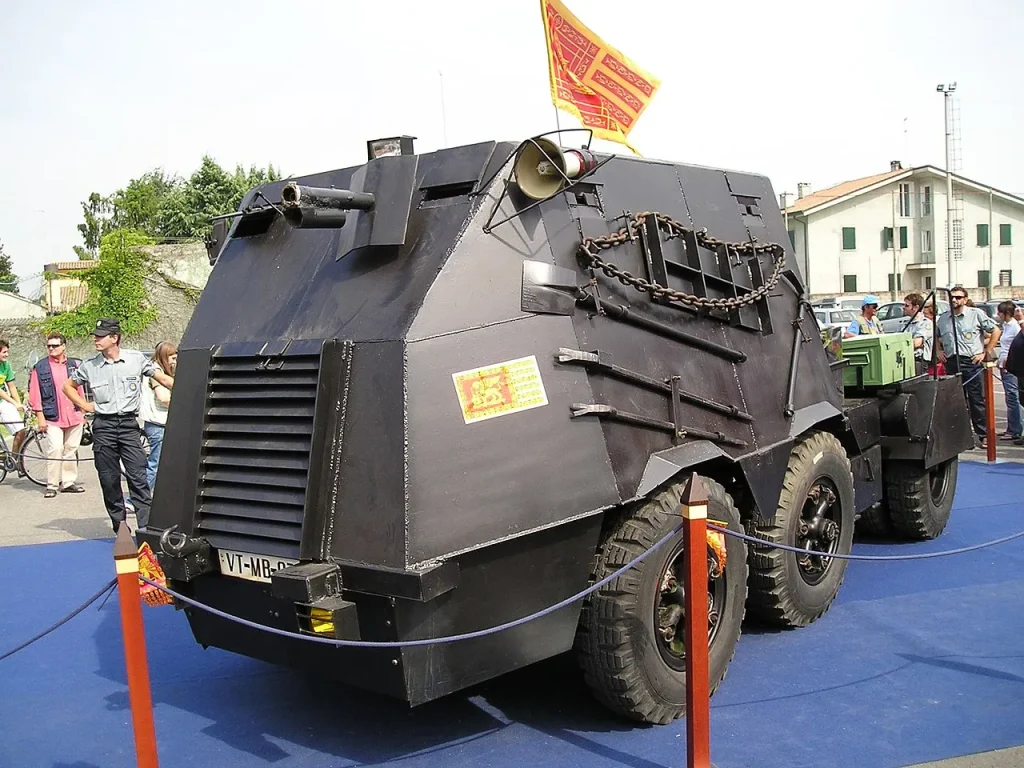

As the sun rose on May 9, the situation reached a static climax. Mayor Massimo Cacciari stood at the base of the tower, shouting up at the belfry in an attempt to negotiate. The response from the top was firm: they would stay until May 12, the anniversary of the 1797 abdication of the last Doge. The standoff lasted only until 08:15. The GIS (Gruppo di Intervento Speciale), the elite unit of the Carabinieri led by Comandante Alfa, executed a rapid clearing. Commandos scaled the exterior restoration scaffolding while others breached the interior. The “army” was neutralized within minutes without a single shot fired.
The aftermath shifted to the courtroom. Luigi Faccia was sentenced to over five years, while Giuseppe Segato received three years and seven months for eversion; he died in 2006 shortly after leaving prison. In 2011, the Court of Cassation finally resolved the legal status of the event. It acquitted Flavio Contin, Cristian Contin, and Gilberto Buson of the most serious charges of terrorism and armed band. The court’s reasoning provided the final commentary on the group’s hardware: the Tanko was deemed so structurally inadequate and fundamentally flawed that it could never have actually threatened the democratic order of the state.
Source: Wikipedia

Weird Italy, Guide to Unusual & Amazing Places to see in Italy. Italy’s news in English: Art, History & Facts