
The Golpe Borghese: The Judicial Fallout from Italy’s Infamous Coup Attempt
The Golpe Borghese, also known as the Golpe dei forestali or Golpe dell’Immacolata, and informally as the Night of Tora Tora, referring to the Japanese attack on Pearl Harbor on December 7, 1941, was an attempted coup d’état in Italy during the night between December 7 and 8, 1970. It was organized by Junio Valerio Borghese, leader of the Fronte Nazionale, in cooperation with the neo-fascist organization Avanguardia Nazionale. The coup was aborted by Borghese himself while in execution, for reasons that remain unclear.
To avoid arrest, Borghese fled to Spain, where he remained until his death in Cádiz on August 26, 1974, never returning to Italy despite the arrest warrant being lifted in 1973. Initially, numerous conspirators were convicted on July 14, 1978. However, an appeal on November 27, 1984, acquitted all accused, a verdict confirmed by the Supreme Court on March 25, 1986.

Background and Planning
The coup was planned from 1969 by Borghese under the Fronte Nazionale, closely linked to neo-fascist groups Ordine Nuovo and Avanguardia Nazionale, which played central roles in Italy’s extremist far-right scene during that period. On July 4, 1970, a formal “National Junta” was established, composed of influential figures from military, political, and economic circles sympathetic to Borghese’s cause. Borghese, previously commander of the Xª Flottiglia MAS during World War II and later aligned with the fascist regime of the Italian Social Republic, aimed at dismantling Italy’s parliamentary democracy and establishing an authoritarian regime with strong military influence.
The detailed operational plan included coordination of armed paramilitary groups with elements of the Italian armed forces, police, and governmental officials. Key strategic objectives were the seizure of major governmental institutions, notably the Ministry of the Interior, Ministry of Defense, and critical infrastructure such as RAI television and radio broadcasting centers, to control communications nationwide. Prominent political opponents and potential resistors were targeted for immediate arrest and detention. Borghese intended to personally deliver a pre-written proclamation from the occupied RAI headquarters, declaring the establishment of a new government dedicated to restoring national order and sovereignty. The manifesto outlined explicit support for NATO alliances and strategic alignments with authoritarian regimes in Spain, Portugal, and Greece, nations then governed by military or authoritarian regimes. Furthermore, Borghese’s government planned diplomatic recognition of controversial states such as Rhodesia and South Africa. In exchange for significant financial support from the United States to address Italy’s ongoing economic crisis, the new government would commit Italian military forces to actively participate in the Vietnam War and broader military engagements in Southeast Asia.
Execution of the Coup
On the night of December 7, 1970, hundreds of conspirators converged on Rome, executing well-coordinated operations aimed at critical institutions. Militants led by neo-fascist leader Stefano Delle Chiaie infiltrated the Ministry of the Interior, successfully accessing and distributing stolen weapons and ammunition from the ministry’s armory to awaiting conspirators. Simultaneously, another group assembled in a gymnasium on Via Eleniana, awaiting further instructions from parachute lieutenant Sandro Saccucci and General Ugo Ricci. Among these conspirators were also officers from the Carabinieri, already armed and prepared for subsequent actions.
At the Ministry of Defense, Air Force General Giuseppe Casero and Colonel Giuseppe Lo Vecchio, both clandestine members of the secretive P2 Masonic Lodge, had strategically positioned themselves to support the coup operations internally. Concurrently, a significant force consisting of 187 armed members of the State Forestry Corps, under the command of Major Luciano Berti, mobilized from their training school in Cittaducale towards Rome, taking positions near the strategic RAI television and radio broadcasting centers to control national communications.
Licio Gelli, who would later emerge as the influential leader of the P2 lodge, was specifically assigned the crucial task of capturing President Giuseppe Saragat, leveraging his extensive connections within Italy’s political and military circles, notably facilitated by General Vito Miceli, another prominent P2 figure who provided strategic access to the presidential palace.
In northern Italy, Army Major Amos Spiazzi led his military unit towards the suburbs of Milan under ostensibly legitimate operational pretexts, carefully masking his true intent. Additional organized groups across various regions—including Venice, Verona, Tuscany, Umbria, and Reggio Calabria—prepared meticulously coordinated actions, involving the planned distribution of military-grade weapons, uniforms, and other logistical supplies to consolidate control swiftly and efficiently.
Sudden Abortion of the Coup
At 01:49, Borghese abruptly ordered the coup’s cancellation, instructing all conspirators to immediately stand down and return the stolen weapons to the Ministry of the Interior. The precise reasons for this sudden reversal remain unclear, as Borghese himself never publicly explained his decision, even to close associates. Several theories have since emerged attempting to explain the cancellation. Some speculate that anticipated critical support from influential sectors of the Italian armed forces, particularly the Carabinieri, unexpectedly failed to materialize. Others suggest that the United States, initially thought to be quietly supportive, withdrew their implicit endorsement at the last moment. According to credible sources, including Fabio De Felice and Andrea Brogi, the cancellation decision may have been influenced or directly ordered by Licio Gelli, who recognized that the absence of concrete backing from the Carabinieri and the United States rendered the coup doomed to failure. Gelli allegedly leveraged the event strategically, using the threat of a coup as political pressure rather than genuinely intending its execution.

Investigations and Judicial Proceedings
The coup attempt remained hidden until revealed by the newspaper Paese Sera on March 17, 1971, creating widespread public alarm and prompting political controversy. The exposure triggered an immediate investigation led by prosecutor Claudio Vitalone, which resulted initially in six arrests, including prominent figures connected to Borghese and various branches of the military and security services. However, despite accumulating evidence implicating Borghese and his associates, including documented connections and witness testimonies, the initial charges were dismissed due to insufficient evidence and potential interference from powerful political figures and intelligence agencies.
In 1972, a more thorough investigation conducted by SID (Servizio Informazioni Difesa) officers Gian Adelio Maletti and Antonio Labruna brought to light deeper and more troubling connections. These included involvement by influential figures such as Licio Gelli, future leader of the clandestine P2 Masonic Lodge, and pointed towards possible complicity by international actors, notably the United States. Crucially, parts of these investigative findings, which provided detailed accounts of clandestine meetings, financial transactions, and international communications, were censored and withheld by Defense Minister Giulio Andreotti, significantly weakening the judicial proceedings and obstructing full accountability.
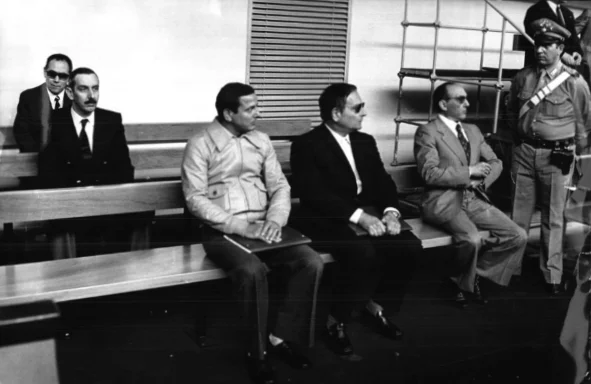
The first trial commenced in May 1977, culminating in 1978 with convictions of 46 individuals, found guilty of forming a subversive association aimed at conspiring against the state, although the charges of armed insurrection were dismissed. Convicted individuals received sentences ranging from two to ten years. However, an appeal in 1984 dramatically overturned these verdicts, absolving all major defendants by classifying the coup as ineffective and insignificant, describing it derogatorily as a mere “geriatric fantasy.” The Supreme Court upheld these controversial acquittals on March 25, 1986, cementing judicial closure while leaving unresolved numerous lingering questions regarding accountability and governmental transparency.
Further Revelations and Connections
The parliamentary commission investigating the P2 Masonic Lodge in the early 1980s highlighted significant involvement and extensive contacts between Licio Gelli and Junio Valerio Borghese, suggesting a coordinated effort between the coup plotters and influential clandestine networks. The commission’s findings pointed to Gelli’s central role, noting his influence in various sectors of the state, military, and intelligence apparatus, positioning him as a pivotal figure in orchestrating or manipulating the political dynamics surrounding the attempted coup.
In the 1990s, additional revelations emerged through testimonies from mafia informants, notably Tommaso Buscetta and Antonino Calderone. Buscetta, a high-ranking member of Cosa Nostra turned informant, disclosed detailed information about planned mafia support, including logistical preparations to assassinate key figures opposed to the coup. Calderone corroborated this narrative, further elaborating on the complicity of organized crime networks in both Sicily and Calabria, highlighting their readiness to exploit the anticipated power vacuum.
Moreover, declassified U.S. documents released in 2004 revealed the American government’s prior awareness of the coup preparations. These documents confirmed that U.S. Ambassador Graham Martin, along with intermediaries such as Hugh Hammond Fenwick, a high-ranking executive at the Italian defense company Selenia, and Adriano Monti, an operative linked to neo-fascist circles and German intelligence networks, were aware of Borghese’s plot months before its execution date. Although these records demonstrated clear U.S. foreknowledge, the exact extent of American involvement or tacit approval remains a subject of historical debate and investigation, with some analysts suggesting that U.S. interests at the time might have favored political stability, even if under an authoritarian regime, to counteract growing leftist influences in Italy.
Cultural References
The Golpe Borghese inspired various films, literary works, and other cultural references that reflect the intense political climate in Italy during the 1970s. Notably, it was satirized in Mario Monicelli’s critically acclaimed film Vogliamo i colonnelli (1973), a comedic yet incisive critique portraying a group of inept conspirators attempting a similarly misguided coup. The event was also referenced in dramatic cinema, such as the films All’onorevole piacciono le donne by Lucio Fulci (1972), and Il generale dorme in piedi by Francesco Massaro (1972), both exploring the potential dangers and absurdities associated with political coups. In the music scene, Italian singer-songwriter Rino Gaetano referenced the event in his song Scusa Mary from the album E io ci sto (1980), reflecting ongoing public memory of the incident. Additionally, the attempted coup has been depicted in modern television series, including the 2023 miniseries Non ci resta che il crimine – La serie, produced by SKY Italia, which offers an alternative historical narrative exploring the implications had the coup succeeded.
Sources

Weird Italy, Guide to Unusual & Amazing Places to see in Italy. Italy’s news in English: Art, History & Facts