
Vinegar Offered on the Cross and Its Connection to Roman Practices
Posca was a drink commonly consumed in ancient Rome. Made by mixing water and wine vinegar, it was a cheap and readily available beverage, particularly popular among soldiers, the lower classes, and slaves. While less nutritious and palatable than wine, its acidic nature offered certain benefits in the Roman context.
Featured image: A delicate glass bottle, dating back to the 3rd century AD and discovered in El Jem, was preserved within a woven straw casing. A matching glass cup was found alongside it
The word “posca” likely originates from either the Latin “potor” (“to drink”) or the Greek “epoxos” (“very sharp”). Interestingly, Greek texts like the Gospels and Plutarch’s writings use “oxos” (vinegar) to refer to this drink, as they lacked a specific term for “posca”. This is often translated as “acetum” in the Vulgate Bible. Around the 6th century AD, the word “phouska” appears in Greek, likely absorbed from the Roman tradition by the Byzantine army. Though “phouska” could sometimes refer to beer, its original meaning was a vinegar-water mixture, similar to the Roman posca.
Medical writers like Aëtius and Paul of Aegina provide a recipe for a more palatable “phouska” that includes ingredients like cumin, fennel seed, pennyroyal, celery seed, anise, thyme, scammony, and salt added to the vinegar-water base, highlighting the potential for variations in its preparation.
Posca’s availability for Roman soldiers and laborers
Posca was widely consumed in Roman society, as evidenced by its frequent mention in various sources, from Pliny the Elder‘s Natural History to the comedies of Plautus.
Generals and emperors sometimes drank posca to demonstrate solidarity with their troops. Cato the Elder and Emperor Hadrian were known to partake in this beverage. A decree from 360 AD even mandated that lower-ranking soldiers alternate between drinking posca and wine.
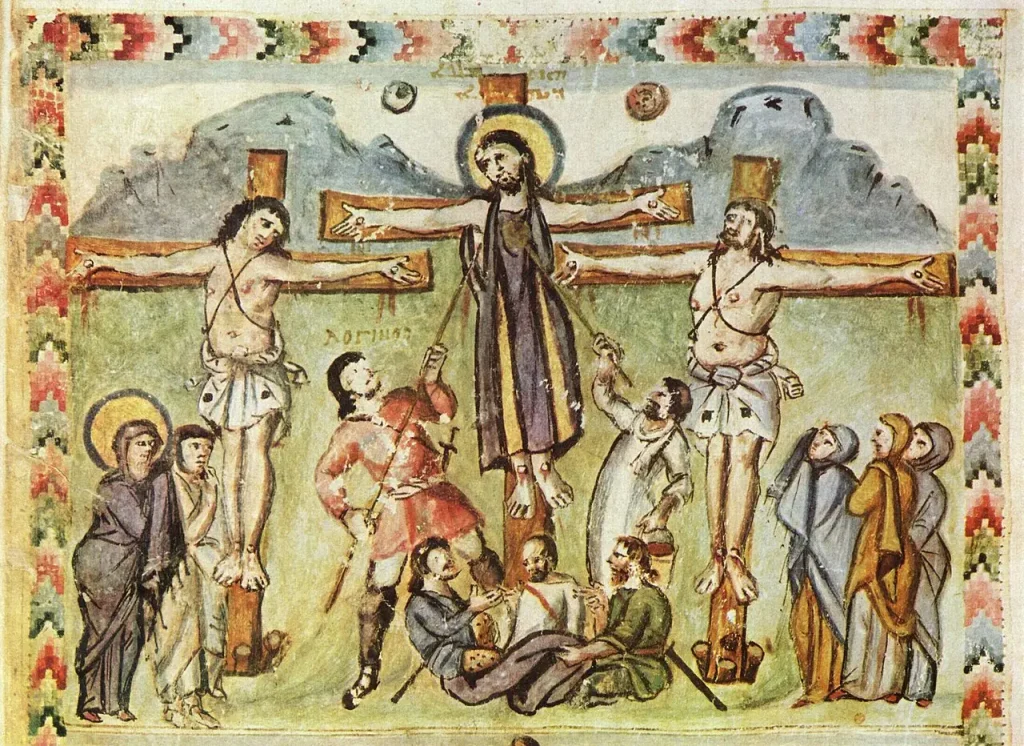

One of the most well-known references to posca appears in the Gospels. During the crucifixion of Jesus, he is offered a sponge soaked in “oxos” (often translated as vinegar), which was likely posca. This act, often misinterpreted, was likely an act of mercy, as posca was a common drink for soldiers and could offer some relief to the crucified.
After this, Jesus, knowing that all was now finished, said (to fulfill the Scripture), “I thirst.” A jar full of sour wine stood there, so they put a sponge full of the sour wine on a hyssop branch and held it to his mouth. When Jesus had received the sour wine, he said, “It is finished,” and he bowed his head and gave up his spirit. [The Holy Bible, English Standard Version (ESV)]
Beyond its use as a beverage, vinegar-based drinks with herbs were also employed for medicinal purposes. Recipes for such concoctions can be found in ancient medical texts like the P. Oxy. 1384.
Posca’s role in Roman cuisine
Apicius, author of the famous Roman cookbook De re coquinaria, uses posca as an ingredient in some of his recipes, including those for “sala cattabia,” a salad dish. He specifically mentions soaking bread in posca, which suggests its use for adding flavor and acidity to dishes.
Girolamo Cardano (1501-1577), a Milanese physician and philosopher, suggested that posca might have contributed to the strength and resilience of the Roman people. He noted its potential health benefits in his work Neronis Encomium (1562), alongside other factors like the consumption of salted meat and the favorable environment of the Italian peninsula.
Cardano’s intuition is remarkable considering that the concept of microbes and bacteria was unknown at the time. The slightly acidic nature of posca could have provided a degree of antibacterial protection, contributing to the overall health of those who consumed it. Furthermore, when heated with honey and spices, as was sometimes done, the drink may have undergone a form of pasteurization, further enhancing its safety.
Sources:


Weird Italy, Guide to Unusual & Amazing Places to see in Italy. Italy’s news in English: Art, History & Facts