
How Italy’s Most Ambitious Polar Expedition Became a Survival Story
The Italia airship Arctic expedition was an Italian polar exploration mission conducted in 1928, led by aeronautical engineer and explorer Umberto Nobile. This venture aimed to conduct scientific research and geographical exploration in the Arctic using the N4 Italia, a semi-rigid dirigible designed by Nobile himself. The expedition was conceived as a follow-up to Nobile’s successful 1926 transpolar flight with the Norge airship, which he had conducted alongside Norwegian explorer Roald Amundsen.
Related articles: The story of Felice Benuzzi who escaped from a POW camp in WWII to climb Mt Kenya and broke back 18 days later
Background and Preparation
While the 1926 flight had demonstrated the effectiveness of airships for polar exploration, it had yielded limited scientific results. Nobile’s goal was to explore the approximately 4 million square kilometers of uncharted Arctic regions. However, he initially faced challenges in securing funding and authorization for the expedition. The Italian military was shifting focus from airships to airplanes due to the vulnerabilities of dirigibles demonstrated during World War I.
Eventually, a compromise was reached: the expedition would be conducted under the auspices of the Royal Geographical Society of Italy, with support from the Italian Royal Air Force and Navy. Funding came from various sources, including private industrialists, the city of Milan, and even Pope Pius XI. The expedition had an extensive communication plan, with exclusive contracts signed with major international press agencies to exploit the news value of the mission.
The Airship and Crew
The N4 Italia was an improved version of the Norge airship used in the 1926 expedition. It featured increased lift capacity, reinforced rubberized fabric covering, a double-layered metal frame for protection against “ice bullets,” an observation dome, and a special chain of bronze balls weighing about 400 kg for use as an anchor.
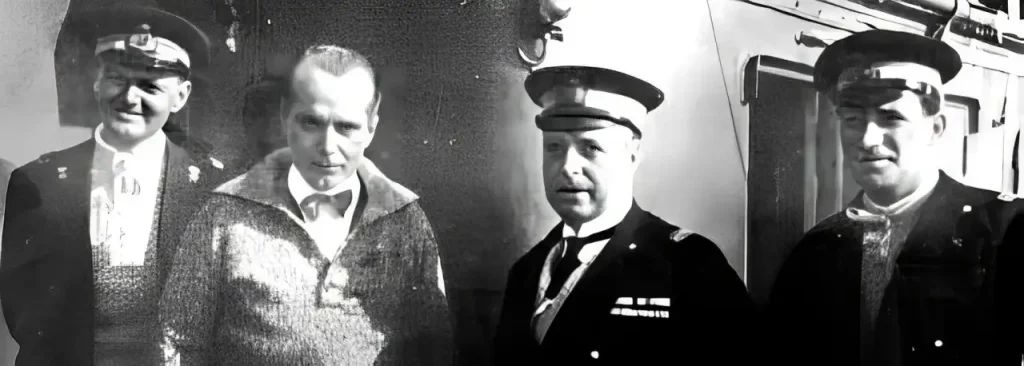
The expedition team consisted of 16 men, including Nobile as commander, Adalberto Mariano as second-in-command, and a mix of military personnel and scientists. Notable among the scientific team were physicist František Běhounek, meteorologist and geophysicist Finn Malmgren, and professor of experimental and theoretical physics Aldo Pontremoli.
The Arctic Mission
The mission’s primary objectives were to conduct at least three exploratory flights for scientific and geographical purposes, reach the North Pole and land a team on the ice for scientific measurements, and explore unknown regions of the Arctic Ocean and pack ice.
The first two flights of the expedition were relatively successful. The first flight on May 11, 1928, lasted 8 hours and 25 minutes but was cut short due to bad weather and equipment issues. The second flight, from May 15-18, 1928, lasted about three days, covering 4000 km and exploring 48,000 km² of unknown regions.
The Final Flight and Incident
The third and final flight began on May 23, 1928, at 4:28 AM, with the primary goal of reaching the North Pole. After a 19-hour and 52-minute flight, the Italia reached the North Pole on May 24. The crew celebrated by dropping an Italian flag, a Milan city banner, a wooden cross from Pope Pius XI, and other items onto the ice. However, worsening weather prevented the planned landing of a scientific team.
The return journey began at 2:20 AM on May 24, facing strong headwinds that significantly slowed progress. The situation deteriorated rapidly on May 25. At 9:25 AM, the altitude rudder froze in a descent position, causing the airship to drop to 250 meters above the ground. Nobile ordered the engines stopped and the chain-ballast released. Although the airship was initially brought back to 300 meters altitude, at 10:30 AM, the tail of the ship suddenly dropped by 8 degrees. Despite Nobile’s order for full power to all engines, the loss of altitude was unstoppable.
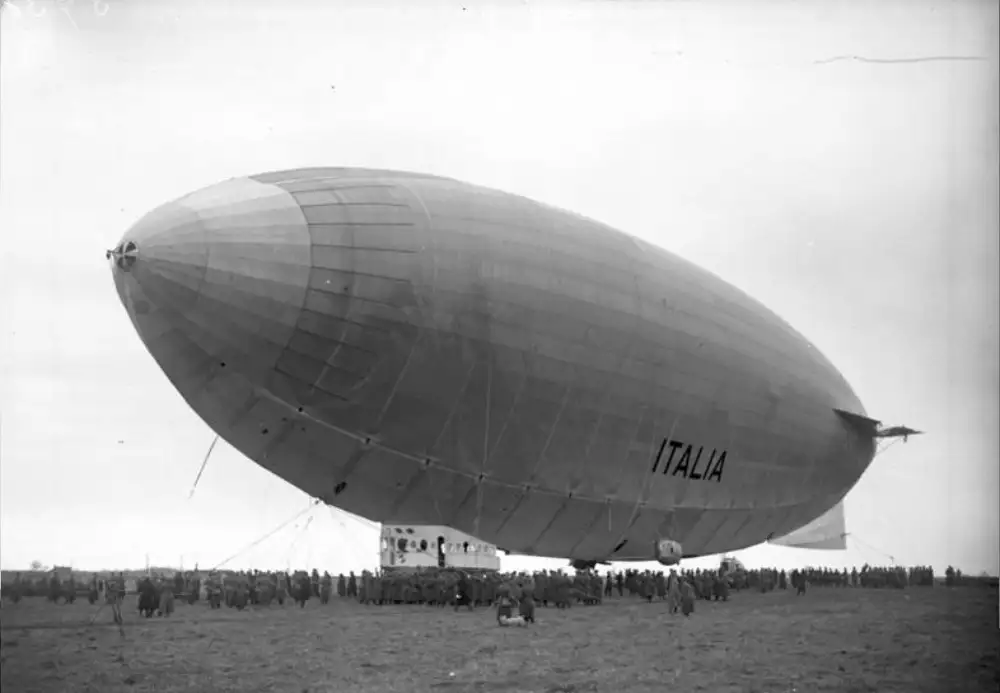

At 10:33 AM on May 25, the Italia crashed onto the pack ice. The command gondola was torn off, throwing ten men onto the ice. The lightened envelope of the airship, with six men still aboard, drifted away and was never seen again.
Aftermath and Rescue Operations
The crash site was approximately 120 km northeast of Nordaustlandet, Svalbard. The survivors found themselves on an ice floe with some equipment and supplies that had fallen from the airship, including a radio transmitter and a red tent that would become known as the “Red Tent.”
Radio operator Giuseppe Biagi managed to set up the radio and began sending SOS signals, but it took until June 9 for the messages to be received due to various technical and procedural issues. This delay sparked an international rescue effort involving ships, planes, and ground teams from Italy, Norway, Sweden, Finland, and the Soviet Union.
The rescue operations were marked by both tragedy and triumph. Notably, Roald Amundsen disappeared along with five others while flying a French seaplane in search of the Italia survivors. Italian pilot Umberto Maddalena successfully located the crash site on June 20, but the controversial rescue of Nobile alone by Swedish pilot Einar Lundborg on June 23, leaving the rest of the survivors behind, sparked criticism. The remaining survivors were ultimately rescued by the Soviet icebreaker Krassin on July 12.
Casualties and Controversies
The expedition resulted in several casualties: six men were lost with the drifting airship envelope, one man died shortly after the crash, Malmgren died during an attempt to reach land on foot, Amundsen and five others were lost during rescue attempts, and three men died in a seaplane crash during the return journey.
The expedition became the subject of significant controversy, particularly regarding Nobile’s decision to be the first person rescued. This led to an official inquiry and Nobile’s temporary fall from grace in Fascist Italy.
Scientific Results and Legacy
Despite the tragic outcome, the expedition did yield some scientific results, including verification of the principle that atmospheric ionization decreases with increasing altitude, confirmation of air sterility in polar regions, and studies on pack ice drift patterns.
The Italia expedition marked the end of the era of airship use in Italian military operations. It remains a significant event in the history of polar exploration, demonstrating both the potential and the risks of using airships in Arctic conditions. The story of the crash and the subsequent rescue efforts captured worldwide attention and has been the subject of numerous books, films, and documentaries.
In recent years, there have been renewed efforts to locate the remains of the Italia and its lost crew members, taking advantage of new technologies and the retreating ice cover due to climate change. These efforts include the PolarQuest 2018 expedition, which conducted the first targeted sonar reconnaissance of one of the possible areas where the airship’s remains might be found.
Featured image: Wikipedia


Weird Italy, Guide to Unusual & Amazing Places to see in Italy. Italy’s news in English: Art, History & Facts