Underground at Trajan’s Baths: The City Painted Before the Empire Built Over It
A restoration project on one of Rome’s most layered archaeological sites brings a first century fresco and a monumental mosaic back into view
Rome rarely gives up its secrets in a single layer. At Colle Oppio, the hill overlooking the Colosseum, a restoration project has just reopened one of the city’s most stratified archaeological complexes: the underground gallery and the southwestern exedra of Trajan’s Baths (Terme di Traiano). The work, carried out under the PNRR programme known as Caput Mundi, has brought back into full view two exceptional works hidden for decades in the darkness beneath the bath complex, and has added new discoveries to a site that already told several centuries of Roman history at once.

A Building Older Than the Baths
The most striking result of the project is the recovery of the so called Città Dipinta, or Painted City, a fresco of roughly ten square metres depicting, in an aerial view, a walled city complete with towers, streets, a port, a theatre, a temple and residential quarters. The painting has been dated to the second half of the first century AD, which places it earlier than the Baths themselves and ties it to a building that stood on the hill before Trajan’s engineers arrived.
That imagined skyline of streets, temples and crowded housing is a useful reminder of how densely Roman cities were actually lived in. The apartment blocks that filled real neighbourhoods of ancient Rome, explored in weirditaly’s look at insula living, life and culture, give a sense of the crowded, vertical urban fabric that a painting like the Città Dipinta was trying to represent in miniature.

Engineering Beneath the Surface
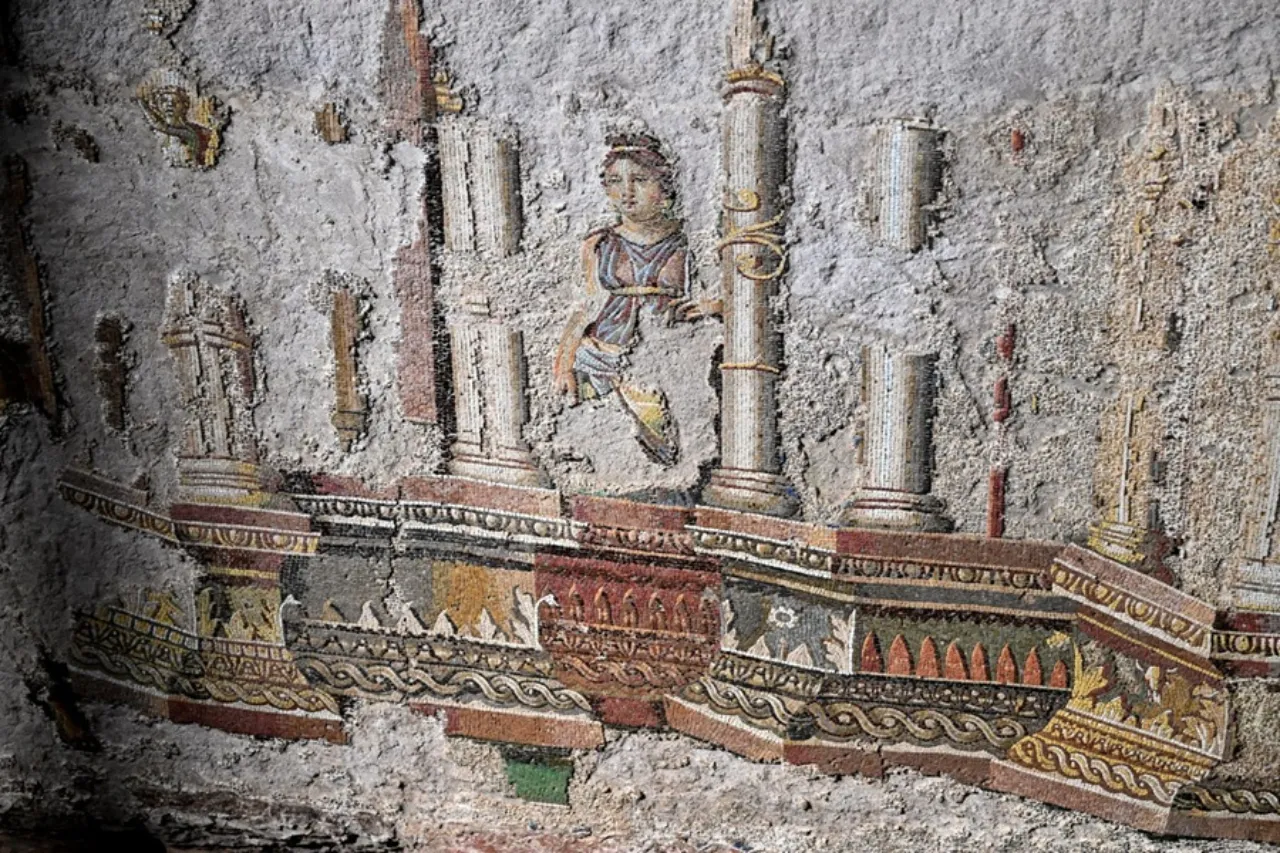
Both the fresco and the site’s second treasure, the Grande Mosaico, sit inside a long underground gallery, part of the substructure built to support the terrace on which the Baths themselves were raised. The mosaic, uncovered along roughly five metres of wall, reproduces a theatrical backdrop known as a scaenae frons, arranged across two registers filled with statues and human figures.
Working underground was second nature to Roman builders, who threaded their cities with galleries, cisterns and drains long before any bathhouse was planned. Rome’s buried infrastructure, from the catacombs to the Cloaca Maxima, is the subject of weirditaly’s piece on the Roman underworld and its hidden routes, and the cryptoporticus at Colle Oppio belongs firmly in that same tradition of building downward as confidently as upward.

The Making of an Imperial Monument
Trajan’s Baths themselves were commissioned by the emperor Trajan and designed by the architect Apollodorus of Damascus, opening to the public in 109 AD. Raising a bathing complex of this scale meant terracing an entire hillside and burying whatever had stood there before, including the older building that held the Painted City.
That combination of ambition and technique, using concrete, vaulting and terracing to reshape an entire hill into a functioning public monument, sits at the heart of how Roman builders turned engineering into an instrument of empire. Weirditaly’s article on Roman Republican architecture, concrete and cultural synthesis traces the roots of exactly this kind of construction, which by Trajan’s time had matured into the engineering behind projects like the Baths at Colle Oppio.

New Discoveries in the Deep Gallery
Excavation carried out during the restoration went further than simply cleaning known surfaces. Below the level of the Grande Mosaico, archaeologists identified an additional decorated band showing a sequence of buildings that appear to rise along a coastline, a motif associated with the maritime villas that featured prominently in Roman decorative taste. Deeper still, workers found the remains of marble slab cladding and a niche standing roughly 2.20 metres high, details that allow the original walls of the room to be estimated at around twelve metres tall.
The restoration itself combined biocide treatment, removal of surface deposits, consolidation and new stucco work, aimed at making both the fresco and the mosaic legible again after centuries underground.
Visiting the Painted City Today
The site is reopening in stages, with numbers deliberately kept small to monitor how visitor traffic affects such fragile surfaces. Free guided tours in Italian began on Saturday 12 and Sunday 13 September, with six daily time slots at 10:00, 11:00, 12:00, 13:00, 14:00 and 15:00, each limited to fifteen participants. Through September, visits run on weekends only; from 2 October, the schedule extends to Friday through Sunday.
Reservations are recommended by calling 060608, daily from 9:00 to 19:00. The entrance is on via del Monte Oppio, at the corner with via delle Terme di Tito. New pedestrian paths, panoramic rest areas and a dedicated lighting system now accompany the exedra above ground, while inside the gallery a walkway connects the two sections of the underground space, passing over the room that holds the Grande Mosaico. A reception area and bookshop have also opened near the entrance, and future plans include tiered seating for concerts and events, a mechanised connection between the upper and lower levels, and new displays for visitors.
Full technical and historical documentation on the site is available through the City of Rome’s announcement on the project.

Weird Italy, Guide to Unusual & Amazing Places to see in Italy. Italy’s news in English: Art, History & Facts