
From Circus Performer to Tomb Raider: How an Italian Barber Became Egypt’s Most Productive Explorer
Giovanni Battista Belzoni (November 5, 1778 – December 3, 1823) was an Italian explorer, engineer, and archaeology pioneer. Born in Padua when it was part of the Republic of Venice, he became one of the principal figures in world Egyptology during the discipline’s early development phase.
Belzoni was born in 1778 in Padua to a family with the surname Bolzon, which was later changed to Belzoni. He began working at a young age as a barber in his father’s shop. At 16, he moved to Rome, where he studied hydraulic engineering and developed an interest in archaeology after being exposed to the capital’s ruins. In Rome, he became a monk, but the arrival of Napoleonic troops convinced him to renounce his vows and pursue his childhood passion for travel.
Related articles: The Roman Expeditions of the Nile River
Early Travels
Belzoni’s first journey took him to Paris, where he had limited success selling religious objects and soon returned to Padua. His second trip was to the Netherlands, where contact with French occupation forces deepened his hydraulic knowledge. Upon returning to Padua, his foreign experiences and exceptional height of 2.01 meters, which earned him the nickname “il gigante padovano” (the giant of Padua), brought him modest success but also aroused jealousy. Entangled in political disorders following the Napoleonic occupation, he faced imprisonment and chose to travel again to avoid it. He departed with his brother, reached Holland, and from there traveled to England in 1803.
Life in England
Belzoni remained in England for nine years, eventually obtaining citizenship of the United Kingdom of Great Britain and Ireland. He married Sarah, who shared his love of travel and would accompany him on most of his adventures. Sarah’s maiden name and birthplace remain uncertain, though Curtis claims she was from Bristol and married quite young.
Belzoni earned his living by exploiting his considerable height and strength, working as a strongman under the name “Patagonian Samson” at Sadler’s Wells theater and Astley’s circus in London. The highlight of his performance came when he would load a type of yoke on his shoulders and support a human pyramid of ten people, carrying them around the stage. Later, he toured the country with this show, accompanied by a fountain system that created water displays powered by a hydraulic machine of his own invention.
In England, he was received into a Masonic lodge and obtained the high degree of “Knight Templar.” The main source of biographical information about him comes from the young Irishman James Curtis, who spent the most time with the Belzonis as a domestic servant and interpreter of oriental languages. Curtis followed Belzoni from his London home to Egypt and Ethiopia, then returned to his homeland.
From 1820 to September 1821, the Belzonis lodged at 4 Downing Street, then 5, where his wife returned to live in June 1824 after Giovanni Battista’s death.
Journey to Egypt
After extensive travel throughout England, Belzoni was seized by nostalgia for great journeys and decided to perform abroad. Following shows in Spain, Portugal, and Sicily, he reached Malta, where he met Ismael Gibraltar, an emissary of Mehmet Ali, the pasha of Egypt, which was then a province of the Ottoman Empire.
Belzoni learned that the African country was about to undertake a new agricultural program involving major irrigation works. He departed immediately, confident of achieving success with his hydraulic projects.
Arrival in Egypt
Belzoni landed in Alexandria on June 9, 1815, accompanied by his wife and an Irish servant, during a plague epidemic. As soon as possible, he reached Cairo, where he was captivated by the archaeological treasures – a passion that had remained with him since his years in Rome. He was also fascinated by the local culture and traditions, so different from European ones.
He met Bernardino Drovetti, a Piedmontese who had become French consul general and was also an explorer and antiquities collector, who facilitated his access to the pasha’s court. He also met the great Swiss explorer Johann Ludwig Burckhardt, whose advice would guide him in subsequent years, and the new British consul general Henry Salt, another Egyptologist who would become Drovetti’s great rival in the race for archaeological discoveries. He befriended another Italian explorer, Giovanni Battista Caviglia from Genoa, who was noted for his excavations and research on the sphinx of Giza.
Belzoni finally managed to be received by the pasha himself, who initially declared interest in his machine project but later refused the offer, not being satisfied with the demonstration that followed.
Related articles: The story of Felice Benuzzi who escaped from a POW camp in WWII to climb Mt Kenya and broke
First Archaeological Journey (June 30, 1816 – December 15, 1816)
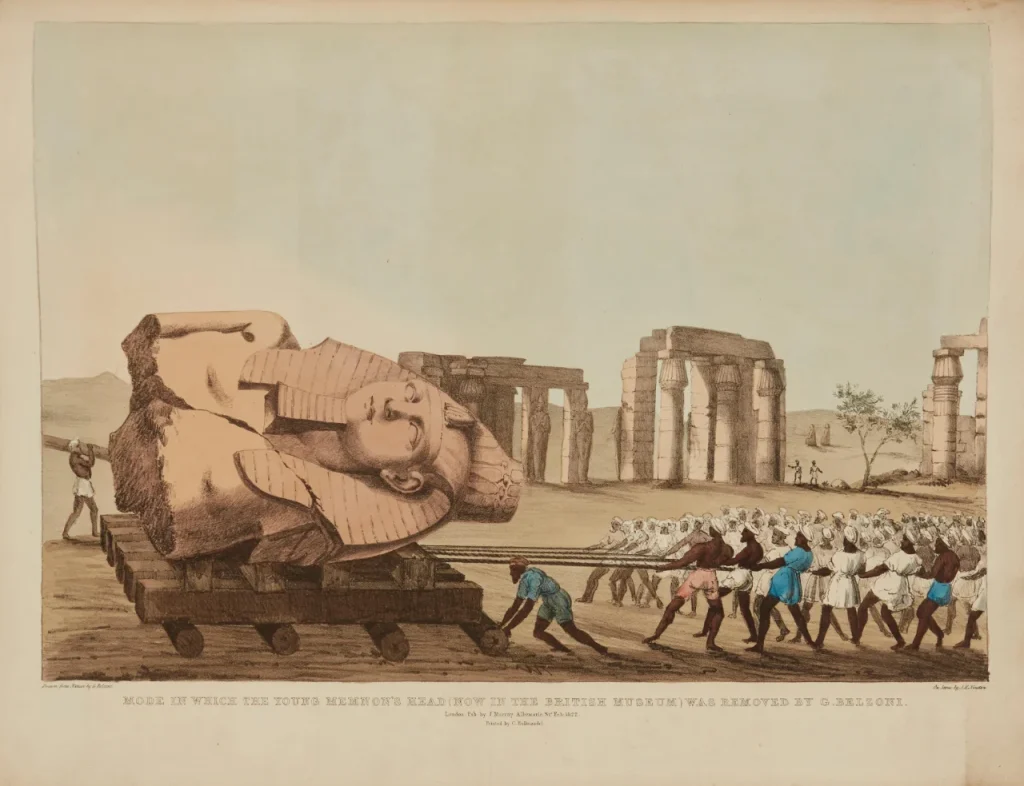
Belzoni was greatly disappointed, as this project had cost him a year of work and considerable money, but he did not lose heart. He had already heard about a major project from Salt and Burckhardt, so he requested and obtained that its execution be entrusted to him. The task involved transporting a colossal stone bust weighing over seven tons and standing more than two and a half meters tall from the Ramesseum in the plain of Deir el-Bahari near ancient Thebes (modern-day Luxor) to the Nile shore, approximately 1,200 meters away.
The bust was erroneously called the Young Memnon (a mythological Ethiopian king, grandson of Trojan king Priam), but was later discovered to depict Pharaoh Ramses II. A boat would then transport it to the British Museum in London. The agreement reached with Salt cost him his friendship with fellow countryman Drovetti.
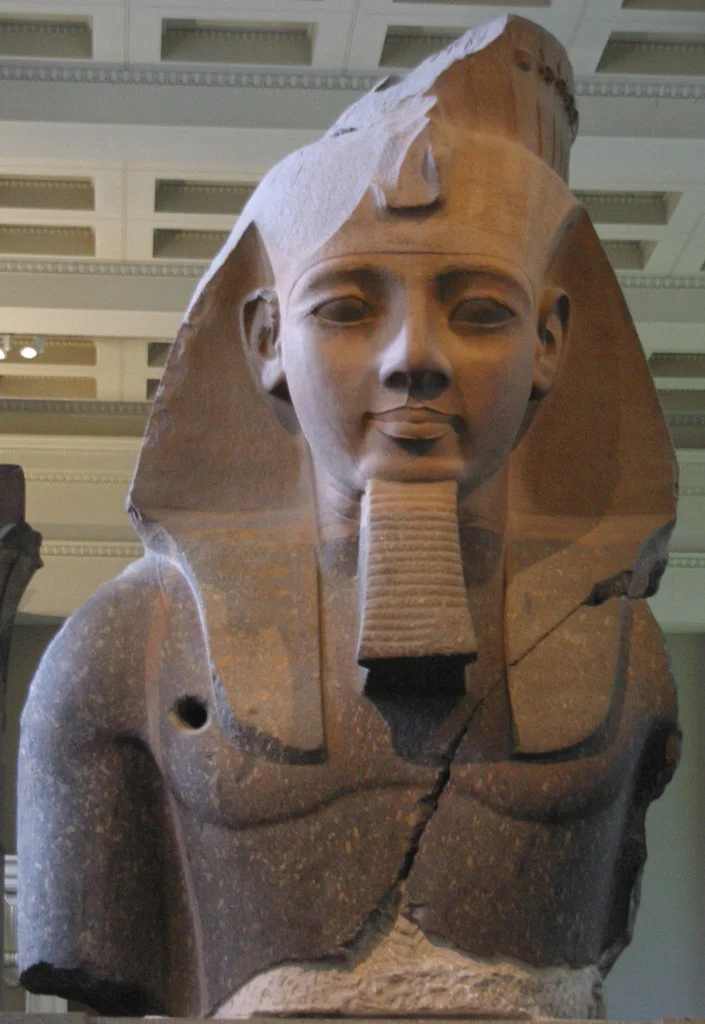

On June 30, 1816, he sailed from Cairo port. After overcoming enormous difficulties, on July 27, 1816, with 80 local men, he began the work. He constructed a rudimentary sledge and, using four levers, managed in just fifteen days to transport the imposing bust to the river bank, succeeding in the enterprise that the French had attempted in vain during the Napoleonic occupation a few years earlier.
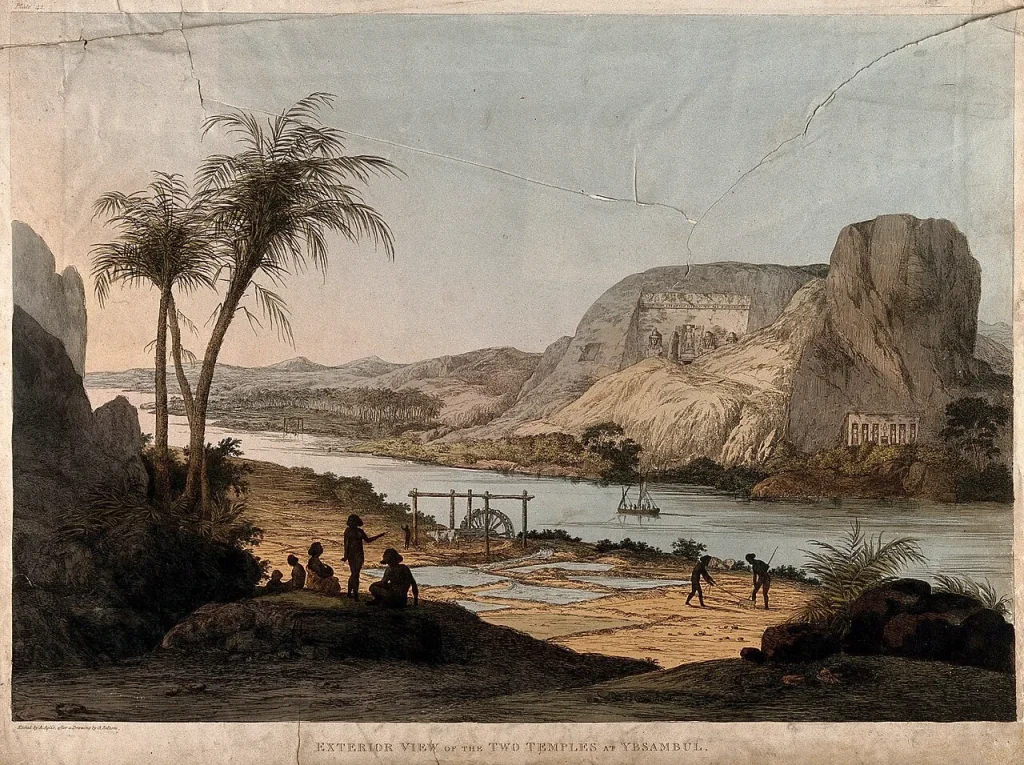
Until that moment, he had been more of a transporter than an archaeologist, but direct proximity to excavations and nights spent in the temple had inflamed his passion. Breaking his hesitation and while waiting for the ship to transport the colossus to arrive, he embarked southward, reaching the Abu Simbel temple, discovered by Burckhardt a few years earlier but which the latter had been unable to access. Belzoni attempted to enter but after seven days of futile attempts, short of provisions and money, he took the return route to Luxor.
He stopped at Philae island at the temple of Isis near Aswan, where he took possession for the British consulate of an obelisk with perfectly preserved inscriptions that would later be important for deciphering hieroglyphic writing. He returned to Luxor, where he had time, before embarking with the colossus, to conduct excavations at Karnak, bringing to light precious statues, and in the Valley of the Kings on the opposite bank of the Nile.
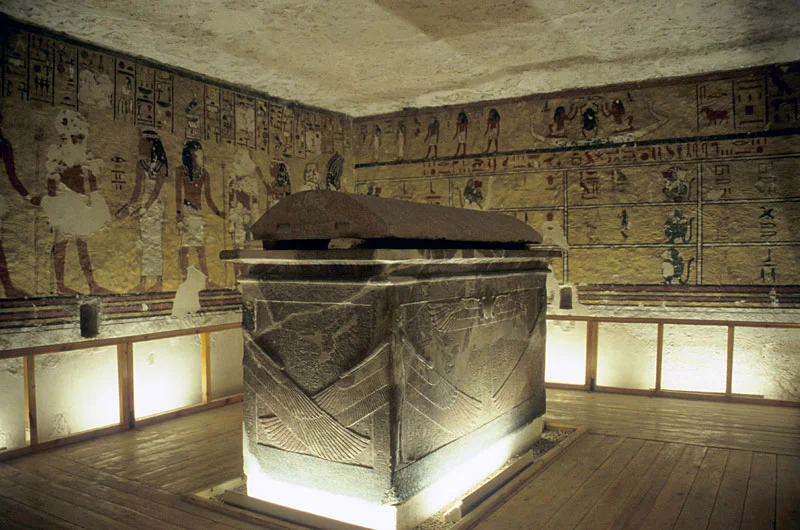

Here he discovered his first tomb, later codified as KV23, that of Pharaoh Ay, on which he carved in English: “discovered by Belzoni-1816.” Starting in 1827, English Egyptologist John Gardner Wilkinson catalogued the tombs discovered in the Valley according to the KV (Valley of the Kings) acronym, a numbering system still in use today. The ship departed accompanied by a second vessel carrying a heavy load of his finds. He arrived in Cairo on December 15, 1816, and immediately prepared for his second journey.
Second Archaeological Journey (February 20, 1817 – December 21, 1817)
On February 20, he departed again for Karnak, where he brought to light a considerable number of artifacts, including the sarcophagus of Pharaoh Ramses III, which Salt would later sell to King Louis XVIII of France and which is now in the Louvre, and a limestone statue of Queen Ahmose Meritamon. At this point, the local governor, instigated by the now-hostile Drovetti, prohibited him from continuing excavations.
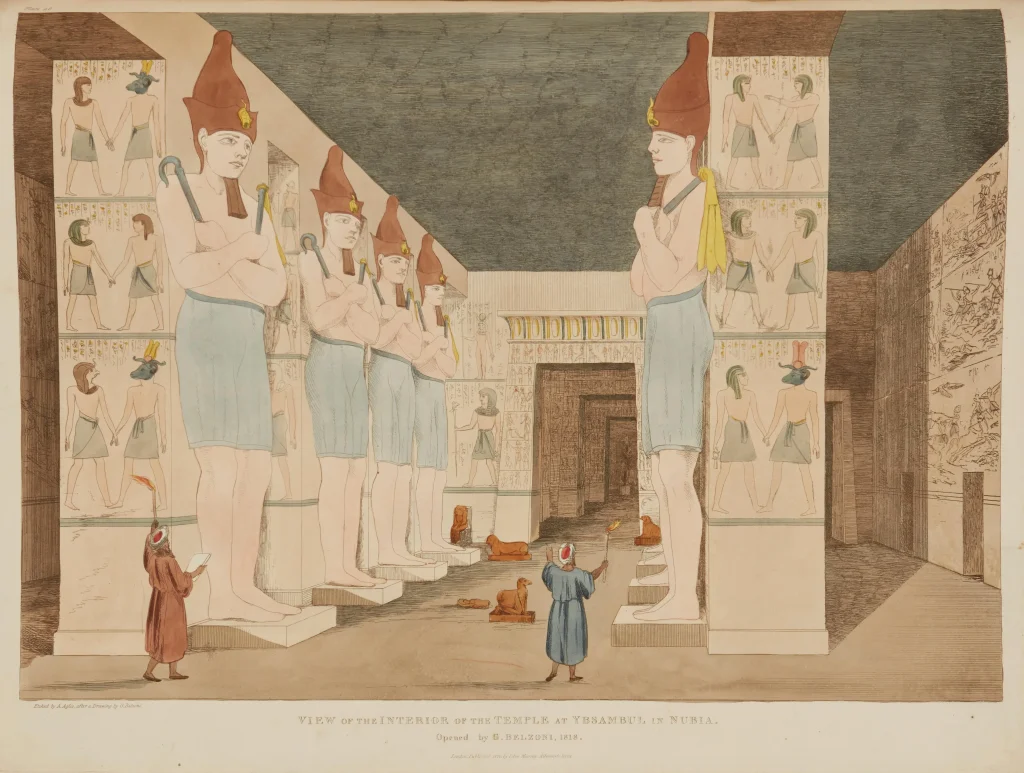
He then decided to return to Abu Simbel, where he finally managed to enter the inviolate temple, though he did not find all the treasures he expected inside. The exceptional historical significance of the discovery therefore had no economic benefit.
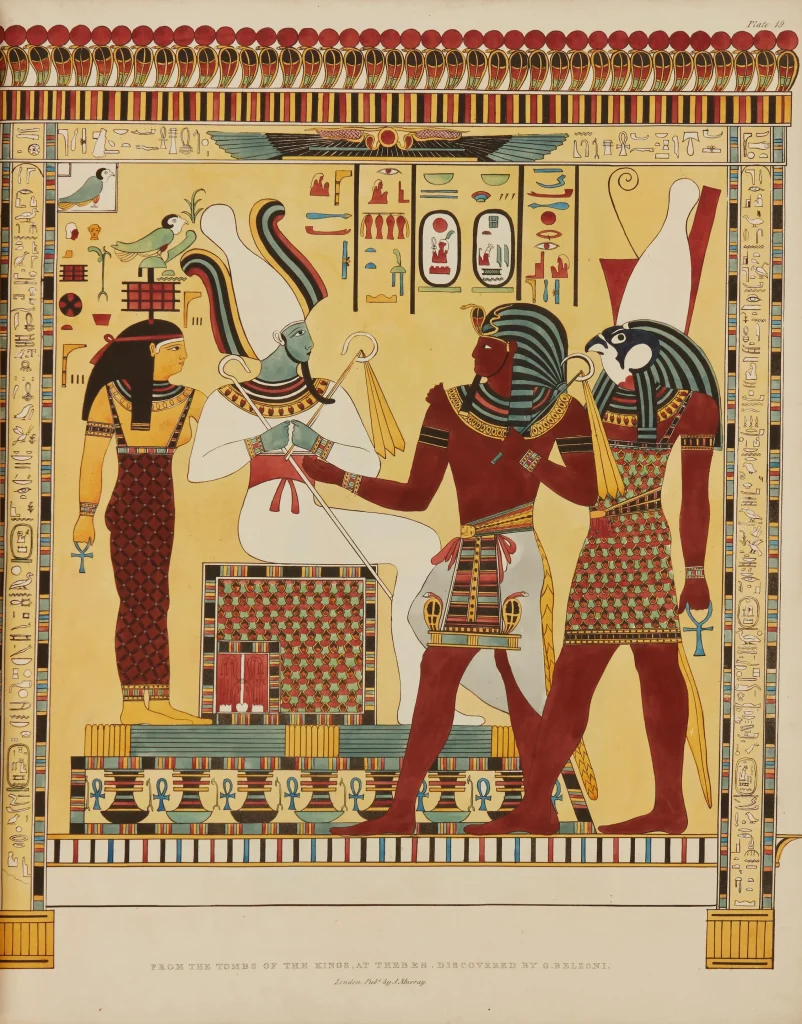
He returned to the Thebes area and conducted excavations in the Valley of the Kings, where he discovered extremely important tombs, including, on October 18, 1817, the tomb of Seti I (KV17), father of Ramses II. This tomb was one of the most beautiful and inviolate in all of Egypt, entirely decorated with splendid bas-reliefs and polychrome frescoes, earning it the designation as the Egyptian Sistine Chapel. The tomb is still called the “Belzoni Tomb” today.
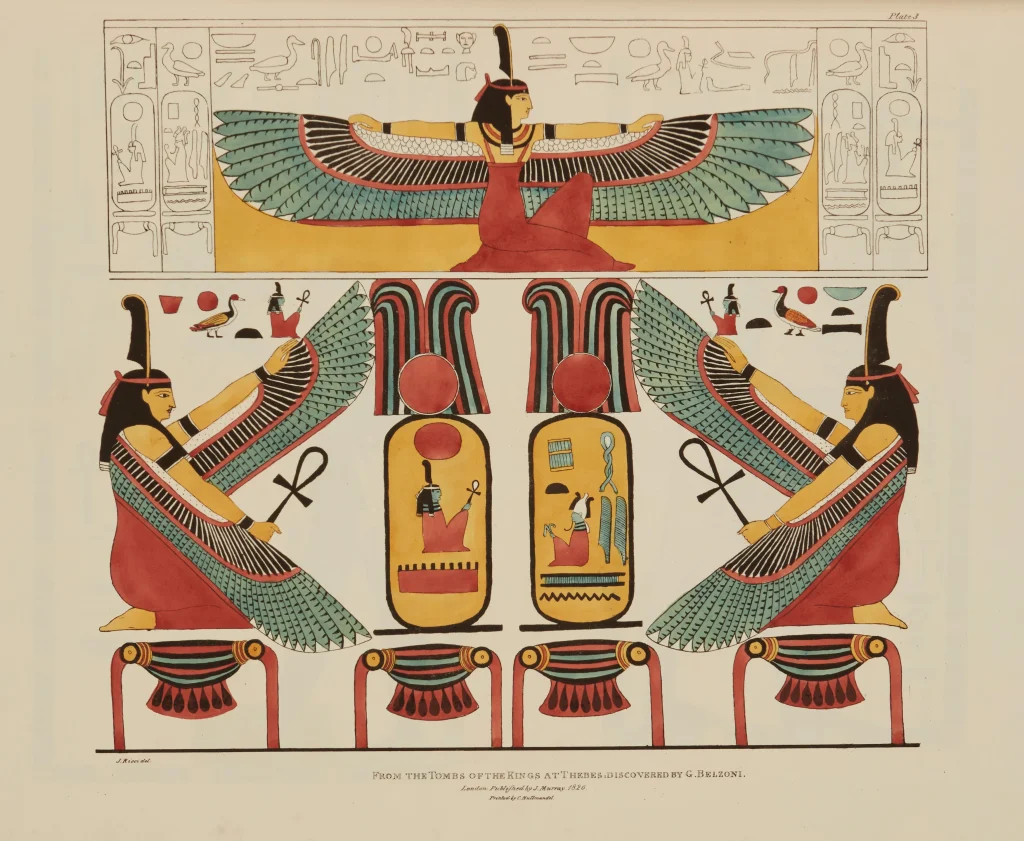
The splendid pharaoh’s sarcophagus, made of translucent alabaster, was offered to the British Museum and to Drovetti, who refused the offer considering the price too high. In 1824, after his death, it would be purchased by architect John Soane, who had it installed in the “crypt” of his house-museum in London, where it remains today.
Before returning, he began mapping the tomb, inventorying its contents, and executing graphic casts of the bas-reliefs that would serve him to recreate the site in an exhibition he organized in London. The tomb has such importance that it is now closed to the public; the damage that occurred after its discovery, such as the removal of bas-reliefs, led the Egyptian government to permit entry only on rare occasions, such as state visits to Egypt.
When he arrived in Cairo in December 1817, he learned of Burckhardt’s death. He had long planned to break away from Salt to manage his own work autonomously and enjoy the full proceeds.
Discovery of Chefren’s Pyramid
During his brief stay, after receiving the necessary borrowed money, he achieved another memorable discovery, finding the entrance to the pyramid of Chefren at Giza, near the capital. This pyramid is the second tallest after that of Cheops. He succeeded in his intent after carefully studying the internal structure of the nearby pyramid of Cheops.
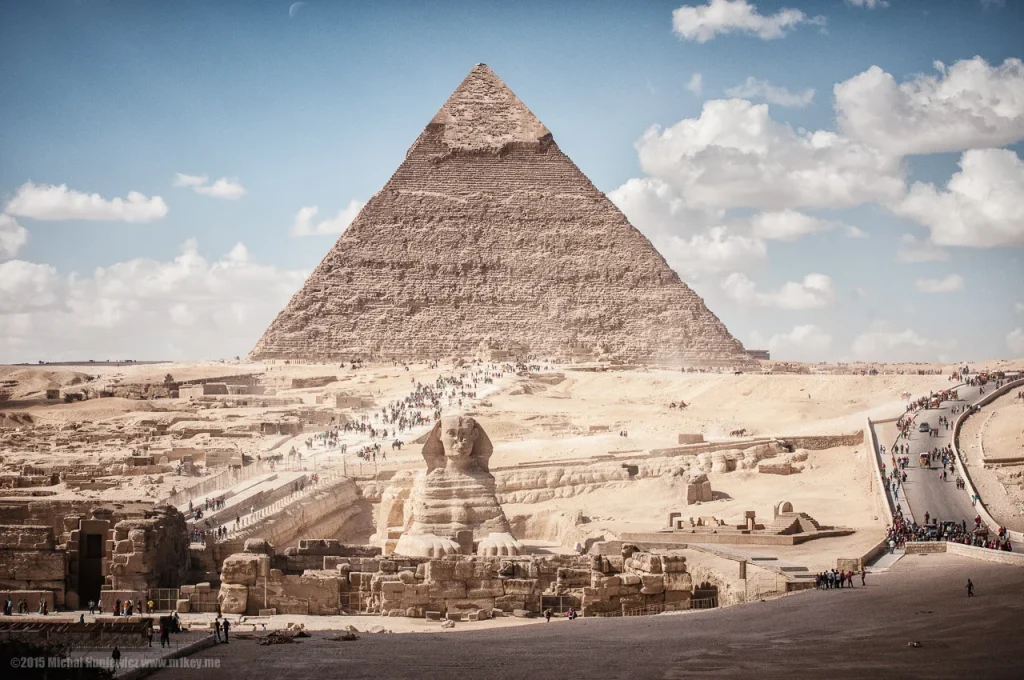

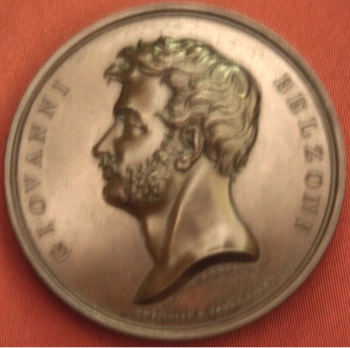
Since others had too often appropriated his discoveries, he left his highly visible signature in Italian inside the burial chamber (“Scoperta da G. Belzoni. 2. mar. 1818.” – “Discovered by G. Belzoni. 2. March 1818.”). This enterprise, like that of Abu Simbel, proved fruitless, as all chambers were stripped of any valuable artifacts. Later, an Arabic inscription found inside would be deciphered, indicating that the pyramid had already been violated 600 years earlier by the son of the famous Saladin. The enterprise nevertheless generated such enthusiasm in England that a bronze coin was minted in his honor, bearing his effigy on one side and the pyramid on the other.

Third Archaeological Journey (April 28, 1818 – February 18, 1819)
He departed again immediately after, accompanied by doctor and artist Alessandro Ricci, whose splendid illustrations of the journey and artifacts would be exhibited in successful shows and included in the book with which Belzoni recounted his explorations. Once he arrived in Thebes, he found that Drovetti and Salt had divided the exclusive rights to excavate the richest archaeological sites between themselves.
Excluded and relegated to a secondary area, he was nevertheless fortunate to find, among other few things, a beautiful statue of Amenhotep III. He then completed the inventory and description of Seti I’s tomb with Ricci and, realizing that nothing remained for him to do in that area, departed for Berenice, an ancient port on the Red Sea recently discovered by a French mineralogist.
He sailed south up the Nile to Edfu and from there crossed the desert. When he arrived at the place described by the Frenchman, he realized that the ruins were nothing more than the remains of an old mining settlement. He therefore proceeded south and was the first to discover the true Berenice. Here, due to lack of provisions, he had to return without being able to conduct thorough excavations. Once again, he had made a great historical discovery from which he could not enjoy the fruits.
The relationship with Ricci was conflictual from the beginning; Ricci poorly tolerated Belzoni’s volcanic character, and once they returned to Thebes, they separated.
The Philae Obelisk
When he reached Thebes again, he met Salt and the great English explorer and Egyptologist William John Bankes, who commissioned him to transport from the temple of Philae to Luxor the obelisk he had taken possession of during his first journey. This obelisk, discovered in 1815 by Bankes himself, bore inscriptions in both hieroglyphs and corresponding phrases in ancient Greek. In 1822, by comparing these inscriptions, French Egyptologist Champollion would have decisive verification of his decipherment of hieroglyphs.
Belzoni managed to transport the monumental artifact to Luxor, and Drovetti, who had planned for years to be the one to bring it to Europe, flew into a rage when he saw it and came to blows with Belzoni. Drovetti was too influential a figure in the region, even serving as the pasha’s military advisor. With this incident, Belzoni realized that his career as an explorer in Egypt was finished.
The resulting legal case was lengthy and, through Salt’s good offices, resolved in a stalemate, but forced Belzoni to remain in Egypt rather than return immediately to Europe as planned. Thus, he set out on another journey, this time searching for the oasis of Siwa, where the temple of the oracle of Amun was located, famous in antiquity for having predicted the future to Alexander the Great. After crossing the desert, he discovered the oasis of Bahariya, convinced it was that of Siwa.
However, here too he found nothing of value, and this proved to be another expedition that severely strained his finances. Excavations conducted in the Bahariya oasis around 1990 would bring to light interesting artifacts.
Valley of the Kings Discoveries
At the end of his Egyptian adventure, in addition to various other discoveries, he had brought to light eight tombs in the Valley of the Kings alone (where a total of 63 have been discovered to date):
- Ay (KV23)
- Amenhotep IV/Akhenaten (KV25)
- Ramses I (KV16)
- Two female mummies (KV21)
- Mentuherkhepeshef (KV19)
- Seti I (KV17)
- Unknown (KV30)
- Unknown (KV31)
Return to Europe
Once the trial concluded and he had completed preparations, he left Egypt in September 1819 and arrived in Padua in early December. Here the reception was enormous. The echo of his enterprises and the two statues he gave to the municipality led the governors to award him great honors, including the minting of a commemorative medal. The statues represent two sphinxes that are still housed in the Palazzo della Ragione in the city today.
He befriended neoclassical architect Giuseppe Jappelli, giving him inspiration for the design of the Egyptian hall in the famous Pedrocchi café. In Padua’s archaeological museum, two Egyptian halls containing some of his artifacts have been dedicated to him. After only two months, he embarked for London, where he arrived on March 31, 1820.
Literary Success and Exhibitions
He immediately began writing a book about his travels in Egypt, which he titled “Narrative of the Operations and Recent Discoveries Within the Pyramids, Temples, Tombs and Excavations in Egypt and Nubia and of a Journey to the Coast of the Red Sea, in search of the ancient Berenice; and another to the Oasis of Jupiter Ammon.” It was published toward the end of 1820 and was accompanied by splendid watercolors and maps, most drawn by Ricci and others by his own hand.
The book was highly successful, new editions were soon printed, and it was translated into French, German, and Italian. He then organized a major exhibition of artifacts he had brought from Egypt and a reproduction of Seti I’s tomb, created using the graphic casts he had taken. In London, he had become famous and gained access to the most exclusive salons. He entered the Royal Arch Masonic lodge, of which the Duke of Sussex was also a member.
In 1822, he was invited to Russia, and in St. Petersburg, he was received with great honors by Tsar Alexander I himself, who gave him a precious ring with a topaz.
Financial Struggles and Final Journey
The sale of artifacts and the success of his book and exhibitions barely covered the large debts he had contracted. Too many sites had brought him glory through their discoveries but, having found nothing precious, had drained his finances. His thirst for adventure and need for money led him to accept the offer that the African Association of London made him in 1823 to undertake an expedition in search of the sources of the Niger River.
This river was virtually unknown to Europeans and had been reached for the first time a few years earlier by the great Scottish explorer Mungo Park, who had found the ancient city of Timbuktu shortly before dying on the river itself. For years, this association had set as primary objectives the discovery of its sources and the legendary Timbuktu. Burckhardt had died on the eve of his departure for an expedition, financed by the association, that aimed to reach it from the east.
Death in Africa
Belzoni departed in April 1823 and headed first to Morocco, from where he planned to cross the desert to reach Timbuktu. He reached Fez, where he met the sovereign, who gave him permission to cross his territories and an escort. But when he undertook the journey, he realized the excessive hostility of the indigenous populations and turned back.
He then decided to reach Timbuktu from the south, sailing from Gibraltar to the equatorial coast of the Gulf of Benin, then traveling overland to the capital of the ancient Kingdom of Benin, present-day Benin City in Nigeria, and requesting from the local sovereign the permits and a boat to sail up the Niger River.
However, shortly after landing in Africa, he died of dysentery on December 3, 1823, in the river port of Gwato (Ughoton, Nigeria), about 40 kilometers before Benin City. Mr. Houtson, who accompanied him on this expedition, had him buried at the foot of a tree on the outskirts of Gwato and had an epitaph placed on the tomb bearing Belzoni’s name and date of death.
He also had the following prayer written: “The gentleman who has placed this epitaph on the tomb of the celebrated and intrepid traveler hopes that every European who visits this place will have the ground cleaned and the fence around it repaired, if necessary.” A European traveler who returned to the place about forty years later found nothing but the tree.
Critical Assessment
Belzoni’s work was subject to controversial judgments. His detractors accused him of using methods that were too harsh in executing his early excavations. Modern archaeological techniques are indeed more attentive to artifact preservation, but the criticisms directed at him actually do not take into account the historical context in which Belzoni operated.
These were the early times when Europeans had access to Egyptian excavations, and the first to execute them were more adventurers willing to do anything to enrich themselves rather than archaeologists. Belzoni was very different and distinguished himself for the order and methodology with which he executed excavations. The celebrated Champollion himself removed part of the bas-reliefs from Seti I’s tomb, whereas Belzoni limited himself to taking graphic casts of them.
He was credited with great scrupulousness in attributing manufacturing dates to artifacts and wrote descriptions of his discoveries, even of those tombs inside which he found nothing, with extreme precision and objectivity.
Relationships with Local Populations
He had earned the respect of local populations, not only because of his character and strength, but also for the consideration he had for local customs and traditions. He learned the language and wore local clothing, growing a long beard in the Arab style. All this helped him convince local laborers to work hard, something they were not accustomed to and that none of his European colleagues of the time had managed to obtain.
His volcanic and independent character led him to break the influential friendships he had made in Egypt (Drovetti, Salt, the Swedish consul general). He wanted to shine with his own light and did not like being considered an agent of European consuls. This brought on one hand the possibility of self-managing his work and enjoying the fame of his discoveries, which otherwise would have been attributed to others, but on the other hand led to his isolation.
While Drovetti and Salt had behind them the powerful means of France and the British Empire, Belzoni, breaking away from them, had to request large personal loans that ruined him financially. Moreover, since excavations guaranteed enormous profits, the two consuls hindered him, forcing him to leave.
Cultural Influence
Despite his numerous and important discoveries, particularly for the British, Belzoni was not particularly celebrated, and his name is remembered in only a few books, although many artifacts housed in the British Museum in London bear his signature. In the field of Egyptian archaeology, he was long considered a model to imitate by the explorers who followed him, and many experts and critics of Egyptology esteemed him and pointed to him as an example.
English poet Percy Bysshe Shelley drew inspiration from the great bust of Ramses II at the British Museum to compose the sonnet “Ozymandias.” Belzoni was also a source of inspiration for George Lucas’s creation of the famous character Indiana Jones, the bold adventurer archaeologist played by Harrison Ford in Steven Spielberg’s films.
Recognition and Memorials
Among various initiatives by the city of Padua to honor Belzoni, his name was given to the street where he was born and, in 1882, to a municipal technical institute for surveyors. In the Palazzo della Ragione, a marble medallion depicting him, executed by local sculptor Rinaldo Rinaldi, has been affixed.
In the Egyptian hall of Padua’s Archaeological Museum, where artifacts donated by Belzoni to the city are located, a multimedia station dedicated to his life has been created. A bronze medal with his portrait is displayed at the British Museum in London.
Various municipalities have streets named after him, including Rome, Mirano, Castelfranco Veneto, Campodarsego, and Monselice, which has also dedicated a plaque to him. A city in Mississippi bears his name. A clay bust depicting him was inaugurated in Luxor in 2017 for the bicentenary of his discovery of the entrance to the Abu Simbel temple.
The 50-minute documentary “The Great Belzoni” about his life was made in 1995 by Atlantic Productions in association with Discovery Channel for the mini-series “Seekers of the Lost Treasure.” The film is in English with narration by Jeremy Irons. Belzoni was portrayed by Matthew Kelly in 2005 for the BBC’s two-hour docu-drama “Egypt.”
Sources

Weird Italy, Guide to Unusual & Amazing Places to see in Italy. Italy’s news in English: Art, History & Facts
Great article on Belzoni, definitely a larger than life Italian!