
Utopian Ideals and the Nine-Pointed Star in Palmanova’s Layout
Palmanova is an extraordinary example of how architecture and urban planning can integrate philosophical and symbolic principles.
Featured image: Ancient map of the Venetian model city Palmanova,
likely dating back to 1600, from Georg Braun & Frantz Hogenberg, source.


Palmanova is a fortified city built during the late Renaissance, located in the current Friuli Venezia Giulia region in northeastern Italy. Designed as an “ideal city,” its nine-pointed star layout integrates military functionality and cosmic symbolism. The city represents one of the most advanced examples of Renaissance urban planning, with a geometric design reflecting ideals of perfection and harmony. Palmanova was conceived to address defensive needs in a historical context marked by the Ottoman Empire’s threat. At the same time, its design symbolizes a spiritual and humanistic vision of society.
The Founding of Palmanova
Palmanova was founded on October 7, 1593, by the Republic of Venice during a period of intense geopolitical tension. The date was deliberately chosen to coincide with the anniversary of the Battle of Lepanto (1571), a Venetian naval victory against the Ottoman Empire. The location was strategically selected: Palmanova lies in a key position to control communication routes between northern Italy and Venice’s eastern borders. The Republic commissioned Vincenzo Scamozzi and Giulio Savorgnan to design the city. The founding also reflected a desire to create a self-sufficient and secure community, modeled on principles of order and symmetry. Despite high expectations, initial settlement efforts struggled, prompting authorities to incentivize colonization through land grants and, in some cases, by populating the area with convicts.
The Nine-Pointed Star Design
Palmanova’s layout is based on a nine-pointed star, a geometric shape chosen for both symbolic and military purposes. Vincenzo Scamozzi, inspired by Renaissance ideals, envisioned the city as a model of architectural perfection. The star’s design ensured optimal defense by allowing an even distribution of fortifications and minimizing blind spots. The nine points also held cosmic and spiritual significance: the number nine was regarded in Renaissance tradition as a symbol of harmony and completeness, echoing the “novenario” found in various esoteric traditions. This number was often associated with the divine order of the universe, reflecting a structured relationship between the human and the celestial.
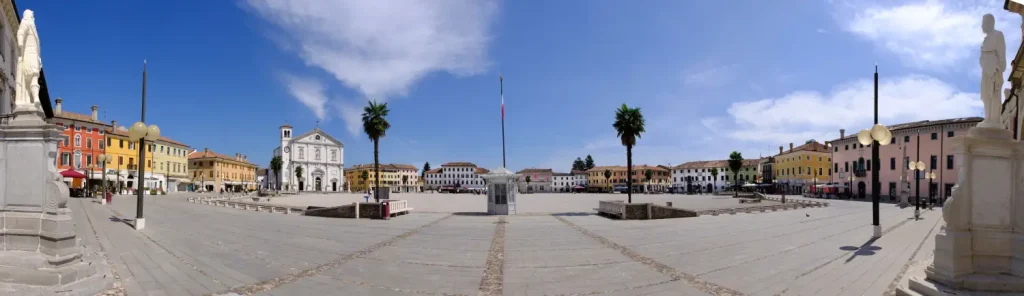
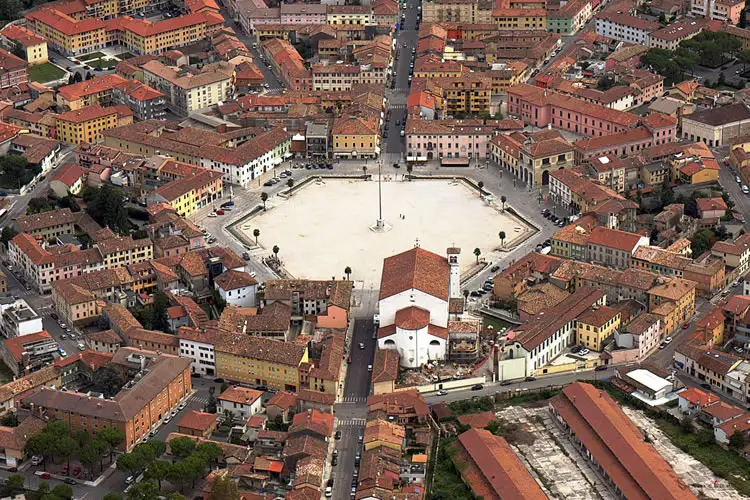
The star-shaped geometry could also be seen as a representation of the microcosm and macrocosm, a principle central to Neoplatonic philosophy. According to Neoplatonic philosophers like Marsilio Ficino and Giovanni Pico della Mirandola, the city’s design symbolized the interconnectedness of all levels of existence—the individual, the community, and the cosmos. These thinkers emphasized that geometric and spatial harmony in urban planning could reflect a divine order, positioning humanity as a central mediator between the earthly and the celestial realms. Palmanova’s layout was not merely functional but deeply imbued with metaphysical meaning, aspiring to align human endeavors with the perceived universal harmony. At the city’s center lies a hexagonal square, from which the main streets radiate in a symmetrical pattern. This centrality reinforced the philosophical vision of unity and order, creating a space where practical needs and spiritual aspirations converged. The radiating streets not only facilitated circulation and communication but also served as a metaphor for the dissemination of ideas and values, further emphasizing the alignment between the earthly and the divine.
_Piazza_Grande_Panorama.jpg)
Architecture and Urban Planning
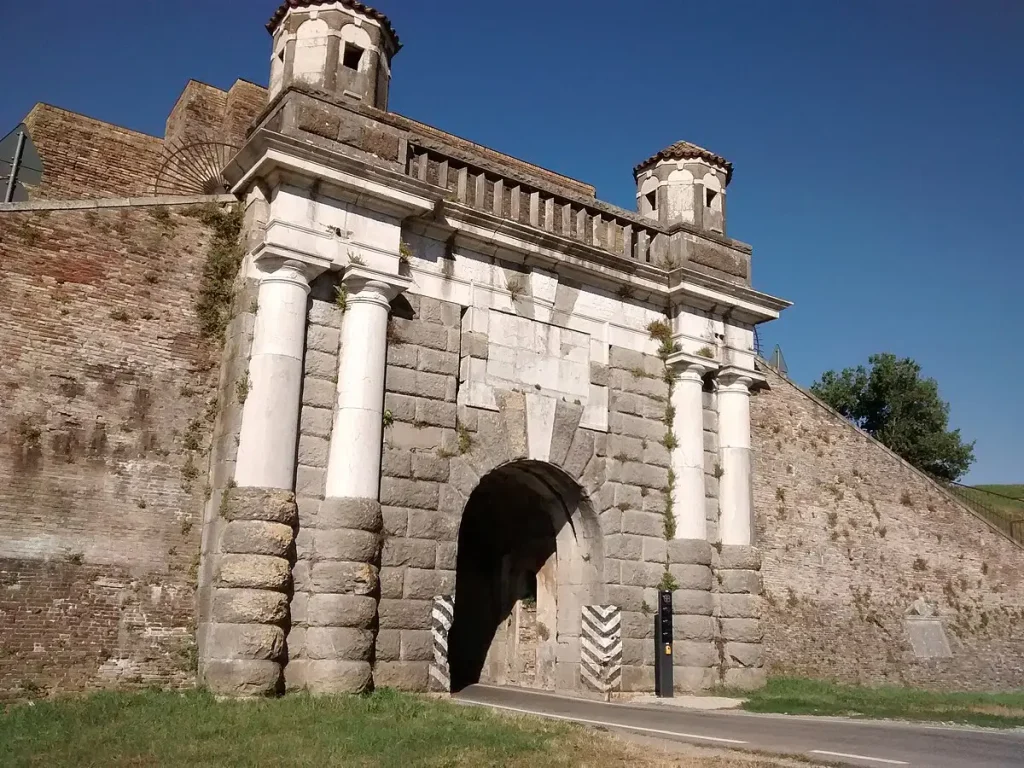
The urban design of Palmanova reflects both Renaissance ideals and practical necessities, following principles of symmetry and functionality. At its core lies Piazza Grande, a vast hexagonal square that served as a meeting and command point, embodying the utopian vision of a centralized and orderly society. Radiating from this hub, main arteries connect the city’s center to its gates: Porta Aquileia, Porta Cividale, and Porta Udine. These monumental gates were designed not only as defensive structures but also as symbolic entry points, projecting the authority and sophistication of the Republic of Venice. Equipped with advanced mechanisms such as drawbridges and portcullises, the gates added layers of security while maintaining aesthetic grandeur.
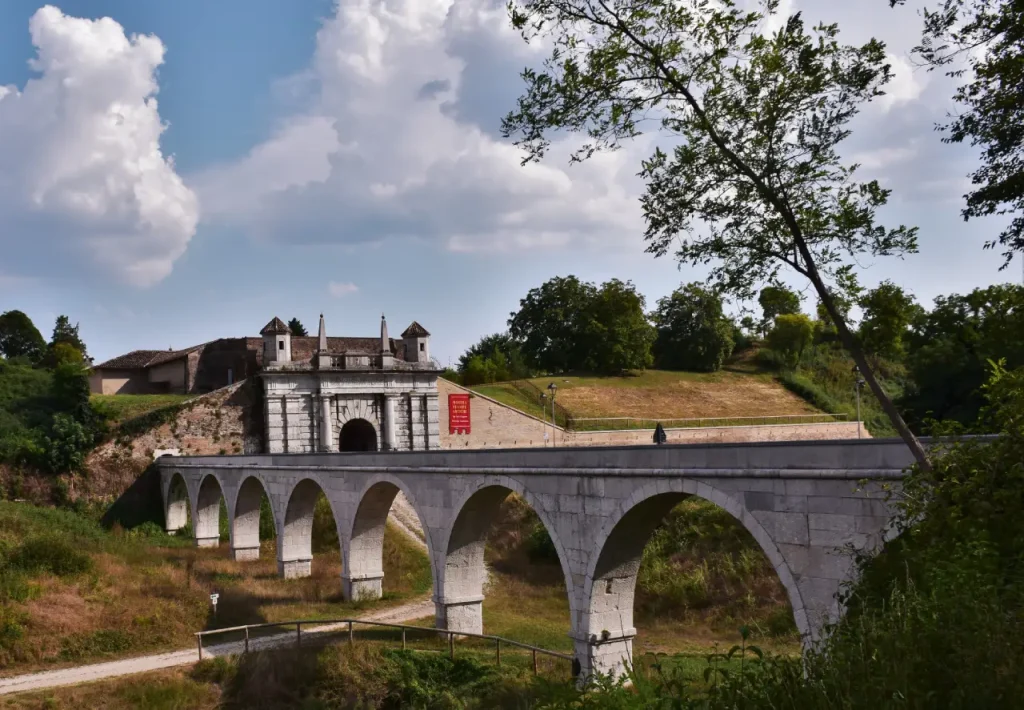

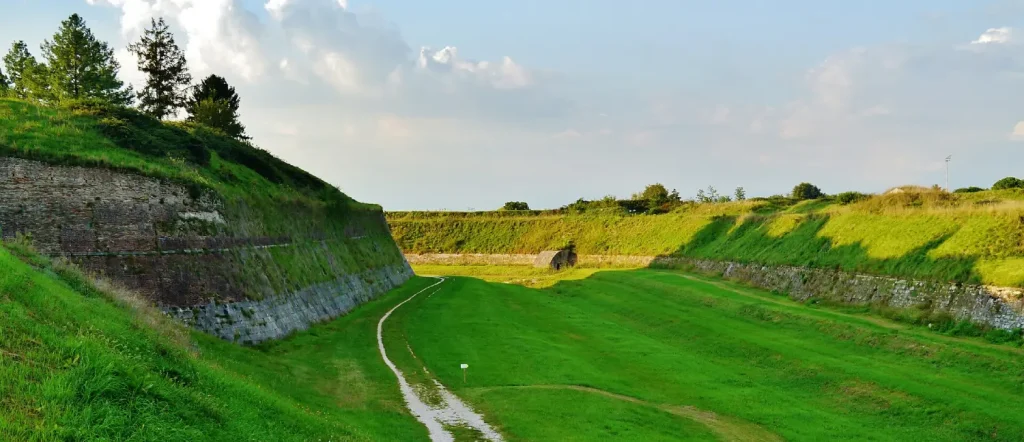
The city is encircled by three concentric walls, each reinforced with bastions and ravelins, illustrating the marriage of military engineering and geometric harmony. These fortifications provided robust protection against artillery, reflecting the Venetian effort to create a fortress capable of enduring modern warfare. Beyond its military function, Palmanova’s layout aimed to manifest an ideal societal order, where each element—from streets to fortifications—was integrated into a coherent system. This harmonious design was deeply rooted in Renaissance humanism, aspiring to create a living space that symbolized balance, security, and the enlightened governance of its creators.

Palmanova as a Fortress
Palmanova is one of the most advanced examples of modern fortresses of its time. Its fortifications were designed to withstand heavy artillery, a growing factor in 16th-century warfare. Bastions at the star’s points provided interconnected defenses, while ravelins and moats added additional layers of protection. The defensive system was completed by an internal network of roads allowing rapid troop movements. However, as military techniques evolved, the fortress gradually lost its strategic importance.
Palmanova endured three sieges, all in the first half of the 19th century. From April 10 to May 13, 1809, the Franco-Italian garrison remained entrenched within the fortress. Austrian troops eventually lifted the blockade and retreated toward Vienna, under serious threat from Napoleon’s advancing forces. Palmanova was subsequently liberated by General Marmont’s vanguard forces. From October 26, 1813, to April 19, 1814, over 3,000 men under the command of General François Valterre (Baron of Sant’Angelo) were besieged by Austrian forces and subjected to heavy bombardments, one of which set the Monte di Pietà ablaze. The garrison surrendered only after the Treaty of Schiarino-Rizzino, allowing French soldiers to return to their homeland while Italians were integrated into the Austrian army.
From March 24 to June 25, 1848, Palmanova revolted alongside Milan and Venice. As the Austrian army advanced to retake the Lombardo-Veneto region, the fortress became isolated. Within its walls, the garrison comprised former imperial soldiers, a Piedmontese artillery unit sent by King Charles Albert, National Guards, and Crusaders—civilian volunteers from Venice. The insurrection was led by General Carlo Zucchi, a former officer of the Kingdom of Italy during the Napoleonic period, who had been serving a sentence in Palmanova for his participation in the anti-Austrian uprisings of 1831. The city endured heavy bombardments and numerous assaults ordered by the besieging Austrian commander, General Ignaz Csivich.

Historical Curiosities
The founding of Palmanova is associated with several little-known events and details. One of the most intriguing aspects involves its initial population. Despite its impressive urban plan, the city struggled to attract new residents. The Republic of Venice resorted to extraordinary measures, including granting free land and using convicts to populate the area. This approach was similar to methods used in other Venetian cities, such as relocating forced populations to Chioggia and other Lagoon islands to strengthen demographic and productive presence. Another noteworthy element is the choice of October 7 as the founding date, emphasizing the symbolic importance of the Lepanto victory in Venetian culture. Finally, during the Napoleonic era, Palmanova was transformed into a military base, undergoing modifications that partially altered its original appearance.
Palmanova Today
Today, Palmanova is a site of historical and cultural significance, recognized as a UNESCO World Heritage Site in 2017. The urban structure has been preserved almost intact, making the city an example of Renaissance urban planning. Palmanova is also an important tourist destination, hosting events such as historical reenactments that portray episodes from its military past. The city offers visitors an opportunity to experience an environment combining architecture, history, and military strategy. Despite the passage of centuries, Palmanova remains a tangible testament to Renaissance ideals applied to urban planning.

Weird Italy, Guide to Unusual & Amazing Places to see in Italy. Italy’s news in English: Art, History & Facts