Horse racing is one of the oldest pastimes, with legendary races such as the Grand National and the Kentucky Derby being two of the oldest sporting events of any description on the international schedule.
The latter forms the opening leg of the U.S. Triple Crown, with the action Stateside being followed by the Preakness Stakes at Pimlico. You can find out how to bet on the 2026 Preakness here.
However, racing is truly one of the most global sports, with iconic events still taking place to this day. However, few are as wild or controversial as Italy’s Palio di Siena.
What is the Palio di Siena?
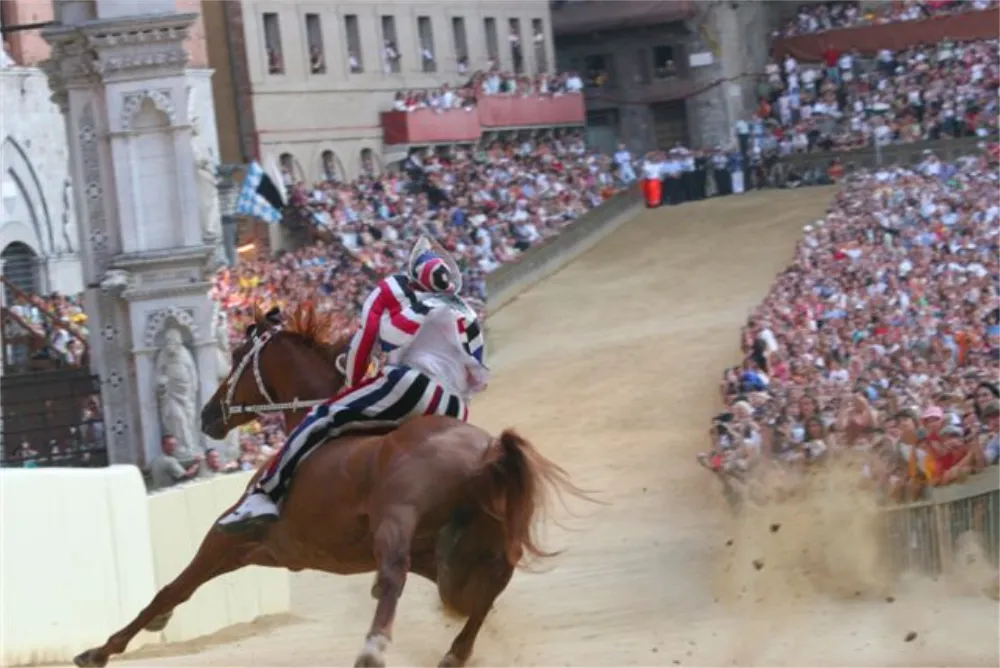
The Palio di Siena is one of the most intense horse races on the global calendar, with the oldest race in Italy being staged twice per year. This race typically blurs the lines between historical re-enactment and extreme sport, and it has become a modern day bucket list event for international visitors.
However, the event has deeper roots in Tuscany heritage, and is in fact a constant reminder of the long-lasting rivalry between Siena’s districts.
When is the Palio di Siena?
Italy’s most famous horse race is staged twice per year, with the first edition coming at the Palio di Provenzano on July 2. The second edition is staged six weeks later, typically in mid-August, at Palio dell’Assunta.
How Does The Race Work?
Siena is divided into 17 neighbourhoods, but only ten are able to compete in a race. Therefore, seven are automatically added to the line up, before the remaining three are selected at random.
Unlike major races held under rules throughout the global racing season, the Palio di Siena is contested in a mixture of terrains, with tuff and dirt being common. Jockeys will be aboard their runner for three laps of the circuit, which will see a distance of 1,000 metres covered.
A race will typically last around 90 seconds. Unlike in major races, the winner is the first horse that crosses the line, regardless of whether their rider is still aboard. Instead of prize money being on offer, the winning rider will receive the Drappellone, which is a hand-painted silk banner.
The winner then keeps this until the next edition of the race.
Why Is The Race So Controversial?
Horse racing is constantly a sport under the microscope by animal activists, meaning it is unsurprising that the Palio di Siena has come under fire since the 1970s. The dangerous layout of the track sees tight corners taken at pace, meaning that injuries for horses and jockeys are incredibly common.
This is echoed by the fact that 50 horses have been put down since the start of the 1970s. It is also controversial due to the fact that riders are able to use their whip on other competitors as well as their own horse. This often causes riders to lose balance on their mounts, resulting in serious injuries.
The race is also incredibly political, with animosity between certain neighbours being as prominent in this modern day as ever before. Therefore, bribes are likely, with certain neighbourhoods joining forces to ensure that another horse doesn’t win the race. This can often see a big number of riders forming a team against another. Backstabbing has also been prominent throughout the race’s history, with riders willing to take bribes in order to help their allies. However, all of this only adds to the historic legacy of the race.
When Did The Race Start?
It is challenging to pinpoint the exact first edition of the Palio di Siena, as it is believed to have taken place in medieval times. During this period, the central piazza was a common site for public games, with boxing, jousting and public races organized on a regular basis.
Racing in the region became more common during the 14th century, and were run across the entire city. Outlawing bullfighting in the 1590s led to racing becoming more popular.
The Contrade would then officially organize the first official Palio di Siena. However, the big difference in the inaugural edition was the fact that riders would be aboard buffalos, before horses were included in 1633.
Attending The Race in the Modern Day
The Palio di Siena is an extremely popular tourist attraction in this modern day, with visitors from across the world travelling to see the race in person. Hospitality packages are common, but they can often be extremely expensive, with the cheapest available options costing £3,000.
However, for those happy enough to sort their own plans, visitors are able to watch the race for free in the city centre, but you may need to arrive hours before the race in order to get the best vantage spot. This is the preferred option for many locals, who opt to spend the day in the city soaking up the atmosphere.

Contributing author to Weird Italy, a platform dedicated to the exploration of unique and unusual aspects of Italian culture, history, and contemporary phenomena.