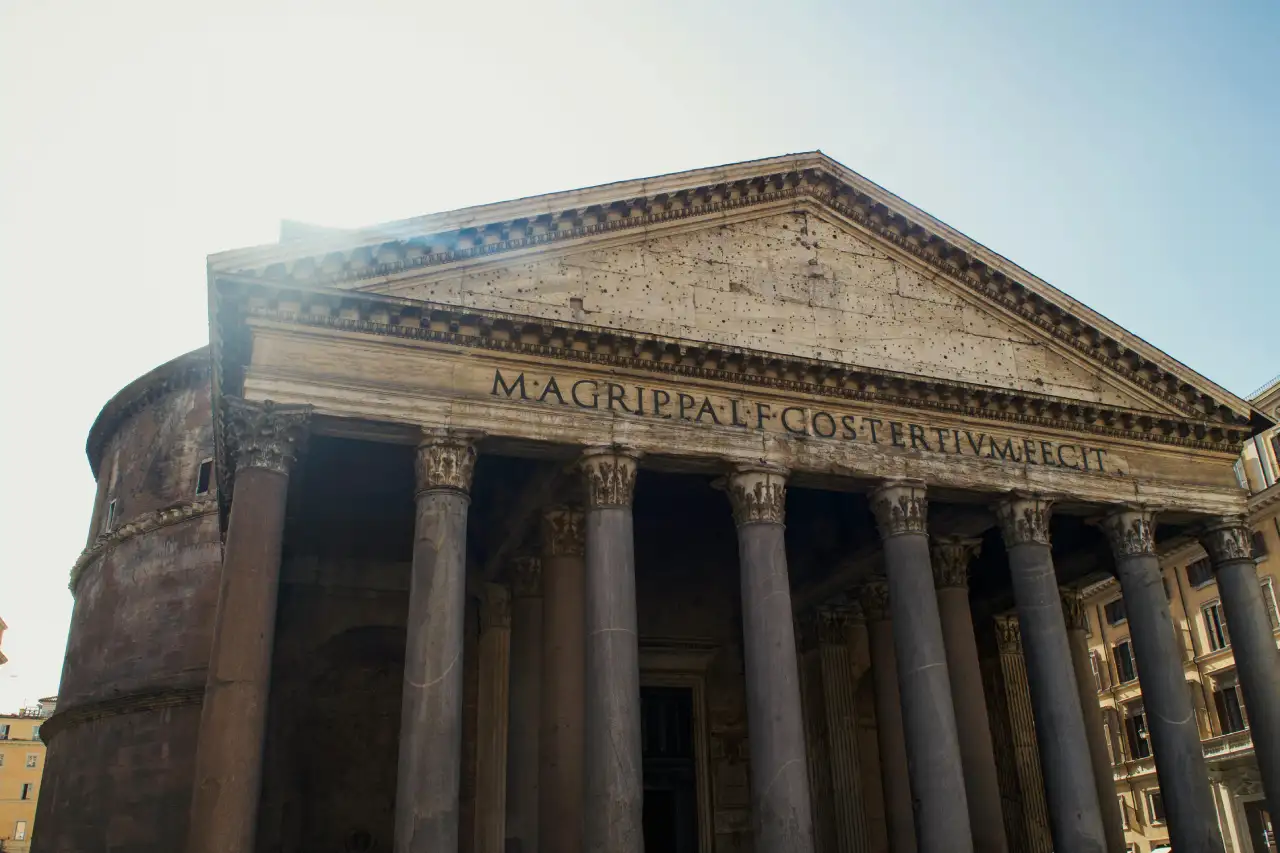
You must have heard about the oldest building in the world that is still in use. Yes, you are right, the Pantheon. This one that you see standing strong in the middle of Rome is the third installation of the structure, built between 125 AD and 128 AD by the Roman Emperor Publius Aelius Hadrianus. Apart from being a famous tourist attraction, the Pantheon is still used as a Catholic church and hosts mass every Sunday and on special occasions.
When you get into this exhilarating piece of architectural genius, and you look up and see the sky, the most probable question that comes to your mind is, how did they do this almost 2000 years ago? But for someone who is visiting pantheon for the first time, what would they expect to see, or what would really capture their attention?
Fontana del Pantheon (The fountain of the Pantheon)
Just before you make your way into the magnificent temple, the fountain standing at the center of Piazza della Rotonda will melt your heart. There is no way that you can look at this beauty of Rome and fail to give it a second glance and even a third and a fourth. It would be an injustice if we did not rank this unique structure among the most beautiful fountains in Rome.
Fontana del Pantheon features a six-meter Egyptian obelisk surrounded by angry-looking dolphins and theatrical masks discharging jets of water. Just so you know, this obelisk is one of the 13 obelisks in the entire of Rome and was made more than 3000 years ago, during the reign of Rameses II. It was erected in 1711 by the order of Pope Clement XI.
Well, the fountain was originally designed by Giacomo della Porta in 1570s, but has undergone a number of changes to the current features is has now. However, let no one lie to you that the fountain has lost a glimpse of its magnificence.
The portico columns
The first thing that will capture your attention when looking at the Pantheon is the 16 gigantic Corinthian columns holding up the portico. Each column stands at almost 40 feet tall, and what is most astounding is that each is monolithic. In simple terms, this is to say that each column was cut from one piece of rock. Shocking, right?
Now, let’s get into the history of where these columns came from. You don’t suppose they were made in Rome, or do you? They were actually quarried in the Mon Claudianus quarries of the eastern desert of Egypt.
You see, the Romans had a liking for the high-grade pink and gray granite that was common in this region. For this reason, most of their construction material was ferried from the region, down the Nile River to Alexandria, across the Mediterranean and then finally up the Tiber River until they reached their final landing point.
Just to imagine that these massive shafts followed the same process is extraordinary by itself. All this engineering was happening without modern-day tech, a feat that is almost impossible to imagine. Standing there almost 2000 years later will make you appreciate the architecture of the Pantheon even more.
The dome
Once you pass through the massive bronze doors, you are ushered into a massive, breathtaking dome that spans 142 feet in diameter. The Pantheon dome is the largest unreinforced concrete dome that has seen the face of the earth to this day. This 4,535-tonne dome elaborates the intellect, skill and genius of the Roman engineers years before modern technology was ever a thing.
The dome’s height and diameter are equal, making it a perfect hemisphere. This has created a balanced interior that showcases how well the Romans understood geometry. The interior is also decorated using 140 coffers that have been subdivided into five rows.
You might think that the coffers are just put in for decoration haphazardly. However, you should know that they have been modeled in such a way that as you go closer to the oculus, the weight of the dome is reduced in a bid to maintain its structural integrity.
The oculus
Right on top of the dome us perhaps the most outstanding feature of the Pantheon, the oculus. It is a circular opening at the roof that allows natural light to enter the building. Actually, it is the only source of light, causes a dramatic effect when the sun rays hit the inside of the Pantheon.
The oculus is not covered, allowing bits of rainfall to get to the floor. In their feats of genius, the Romans put in drains with an incline of 30 cm (12 inches) in the interior floor to promote water runoff. The opening of the oculus is 7.8m wide and it is said that it was left open to be the connector between the temple and the gods.
Conclusion
If you do not visit the Pantheon when in Rome, then be sure that you have missed a great deal of heights of human genius. This massive structure correctly indicates what people have the capability of doing when they engage their minds to the fullest.

Contributing author to Weird Italy, a platform dedicated to the exploration of unique and unusual aspects of Italian culture, history, and contemporary phenomena.