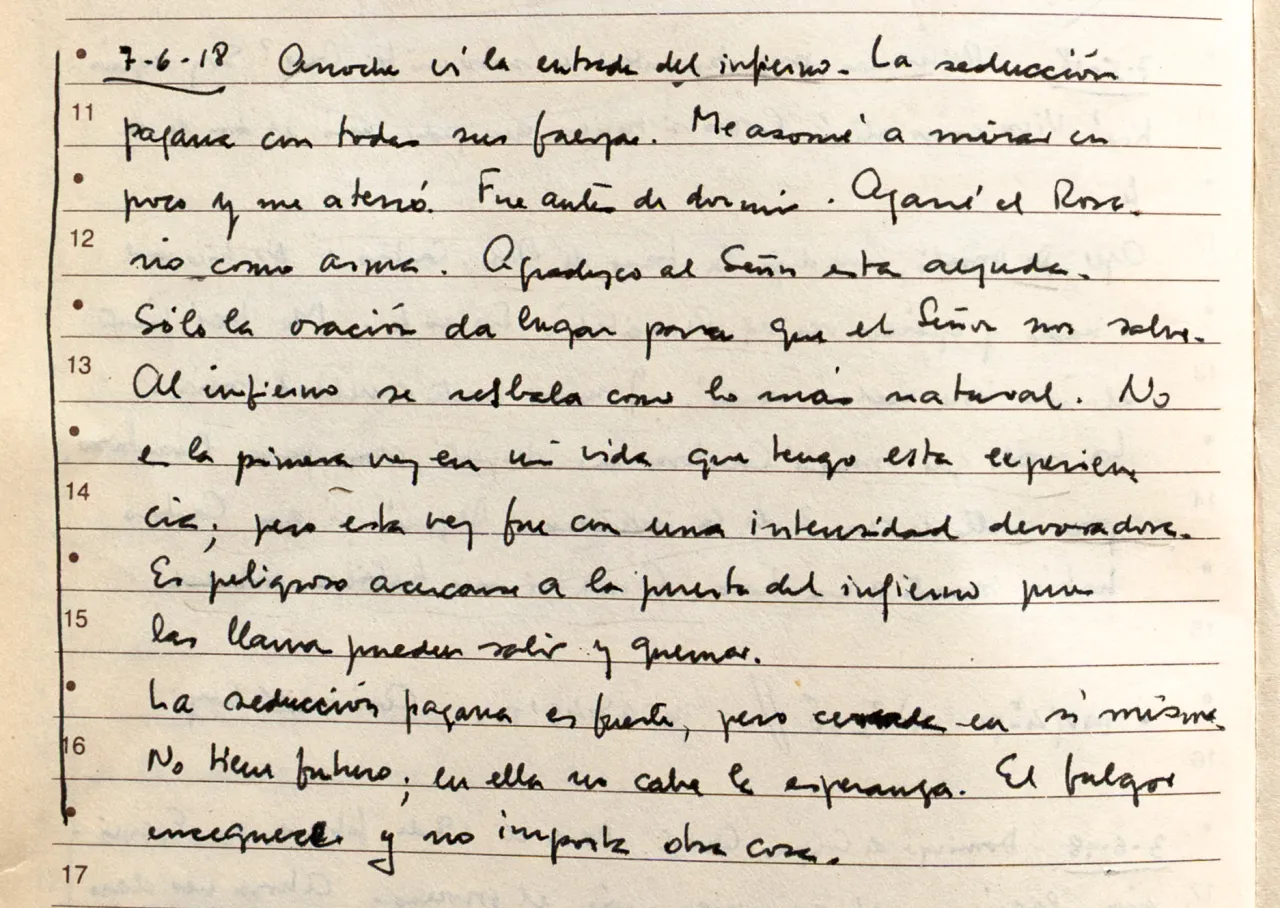
A 1992 agenda, reused for more than thirty years, preserves the nights, vigils and fears of a man who examined himself every day
When a public figure leaves private papers behind, historians and students of culture gain a rare kind of source: the voice nobody was supposed to hear. The Personal Diary of Pope Francis, edited by Cardinal Víctor Manuel Fernández, prefect of the Dicastery for the Doctrine of the Faith, and published by the Libreria Editrice Vaticana (176 pages, 16 euros), belongs to that category. Its subtitle promises “the most authentic Bergoglio from his private papers.”
An agenda that became a diary
The core of the book is a modest object: a 1992 agenda that Bergoglio never used as an agenda. From 20 December of that year he began filling it with thoughts, intermittently, and kept doing so until 18 August 2024. More than thirty years of writing on a single support. For anyone studying private writing the detail matters: no literary project, a notebook within reach, a daily discipline.
That discipline had a schedule and a setting. According to Fernández, who was Bergoglio’s disciple, collaborator and friend, the future Pope rose at four in the morning, while everyone else slept, and took up the Bible he kept on the small table beside his bed, ready in case he woke during the night. When a passage stirred something strong in him, he wrote a short comment. A domestic ritual made of silence, solitude and writing.
A technique of self-observation
To grasp the tone of these pages one has to know the method. Bergoglio was trained in the school of Saint Ignatius of Loyola, and from it came the habit of “discernment of spirits”: examining one’s life and history by sorting what arrives as a gift from God from what comes instead from the “world,” the space in which freedom is exercised among risks, challenges and possibilities. In cultural terms it is a genuine technique of self-observation, with a vocabulary of its own and one essential tool, writing.
The common thread the editor points to is mercy. The biblical passage that stands out most in the diary is chapter 16 of the prophet Ezekiel, where shame over one’s own misery meets a free and overflowing welcome. His motto, Miserando atque eligendo, “having mercy on me, he chose me,” reads his whole biography in that key. An entry of 20 June 1994 condenses it: “Mercy is my true story.”
The night of 7 June 2018
The most striking page is dated 7 June 2018. Bergoglio writes that the night before, just before sleep, he saw the gate of hell. He had leaned over to look for a moment and was terrified. He seized the Rosary as a weapon. It was not the first time it had happened to him, but this time the intensity was “devouring.” He describes the descent as a natural slide, the threshold as a dangerous place because the flames can come out and burn, and a “pagan seduction” that is powerful yet closed in on itself: no future, no room for hope, a brilliance that blinds and makes everything else irrelevant.
It is not for a historical reader to establish what happened that night. What matters is how a man of his time fixes the account and which images he chooses. They are images of the threshold (the gate, the door), of the slope, of fire and blinding light. The adjective “pagan” works as a cultural category: the name given to a fascination that promises everything and leaves no future. The Rosary appears as a concrete object with a defensive function. The language also has a genealogy: attacks of the Devil and the painful surfacing of hell, frequent in the diary and certainly not fashionable, are experiences far from absent in the narratives of the saints’ lives.
The counterweight of trust
The dark pages coexist with entries of the opposite sign: the merciful gaze of Jesus that moves him to prayer (28 April 2019), the pull he feels toward that mercy (5 January 2002), his trust in Saint Thérèse of Lisieux, who by his account never stopped sending roses whenever he asked for them (16 July 2006). Here the imagery changes scale, from grand scenarios to small gestures. It is the “faith of the simple” that Bergoglio always praised, made of the gestures of trust typical of the poorest, who have little to hold on to.
The last entry is dated 18 August 2024: Bergoglio asks the Virgin to take care of him and help him. What emerges is a portrait of rich humanity, with insecurities, fragility and fears, beside a pastor attentive to the primacy of charity and passionate about the cause of justice and peace. For the historian and the anthropologist, a document in which the public figure and the private person can be read together.
Source: Avvenire, sezione Agorà Cultura, «Ho visto l’ingresso dell’inferno. Tra luce e tenebre il Bergoglio intimo del diario personale»

Weird Italy, Guide to Unusual & Amazing Places to see in Italy. Italy’s news in English: Art, History & Facts