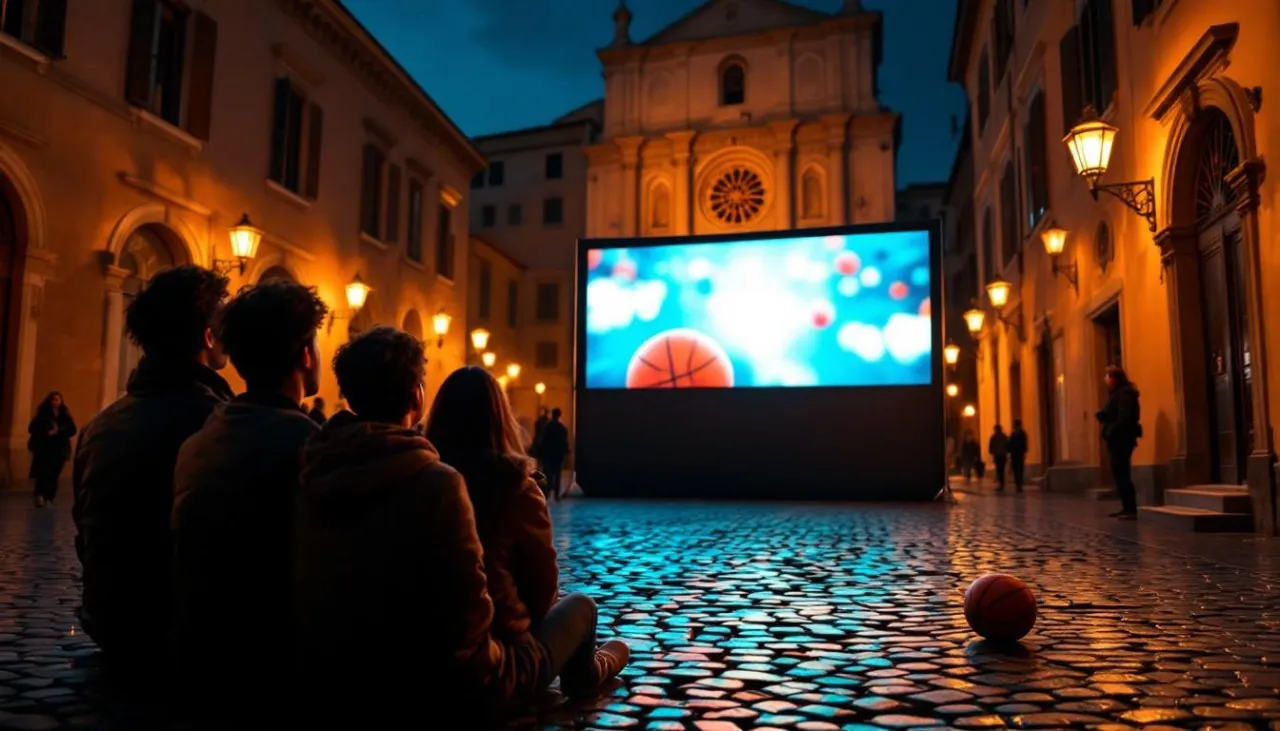
A 7:30 p.m. tip-off in Boston reaches a bar in Rome or Milan at 1:30 in the morning. That has been true since the weekend. Italy set its clocks back on 25 October and the US waited until 1 November, so for one week the gap shrank to five hours and the same game began at 12:30. Now it’s six hours again, and it will stay there until the US moves its clocks forward again.
Plenty of fans set an alarm anyway. Sky Sport and its streaming service, NOW, carry the 2026-27 season in Italy, and any game that tips after 6 p.m. on the East Coast starts after midnight there. Forty-five years ago the wait was far longer. The first game from the American league shown on Italian television went out thirteen days after it was played.
Between that tape and tonight’s live feed, US sport came in by several doors: television first, then players who crossed the ocean, then owners who bought football clubs, and now a proposed league across the continent. Most of it settled in. One piece of the US model stopped at the border, and Italian law is the reason.
The first televised NBA game reached Italians thirteen days late, in 1981
Boston played the Lakers in mid-January 1981, and Italians saw the tape thirteen days later, at six o’clock on a Saturday evening. It went out on a local channel owned by the publisher Rizzoli that had been on the air for little more than a month. La Gazzetta dello Sport, marking the 40th anniversary in 2021, called it the first game from the league ever shown outside the US.
Thirteen days is a long delay for a sports broadcast. Anyone who had seen the box score knew the result before the opening tip. The league wasn’t a global product yet, either. CBS held its rights and still aired some Finals games on tape delay, the paper noted. Ralph Rivera, then in charge of the league’s business in Europe, told Gazzetta that the 1981 broadcast was one of the pillars of its renaissance.
The voice belonged to Dan Peterson, born in 1936 and by then the coach of Olimpia Milano. He ran that bench from 1978 to 1987, won four league titles and signed off with the 1986-87 treble, European Cup included. Il Post, writing on his 90th birthday this year, dates his commentary to 1981, first on a small independent network and then on the Mediaset channels.
Mediaset liked his accent enough to hand him the Oscars and a presidential inauguration in 1985 as well. That year he began appearing in Lipton tea commercials, which made him famous with people who had never sat through a basketball game. Commercial television paid for the US game with advertising, and Peterson became one of its faces. In 2018 a government decree took one category of ads off those screens, the ones for games and bets with cash prizes.
The 1:30 a.m. game keeps its US commentary and answers to local law
What reaches a living room in Bologna at that hour is usually the American feed. Sky’s schedule marks its overnight games “con commento originale” and puts its own commentators on the replays. The channel airing them is Italian, though, and so is the law on what it may advertise.
That law came in the same weeks the NBA went the other way. Decree-Law 87, known as the Decreto Dignità, came out on 12 July 2018, and parliament converted it into Law 96 later that summer. Its Article 9 bans advertising for games with cash prizes and, from the start of 2019, sponsorship too. Deals already signed could run for a year at most, according to a summary by the European Audiovisual Observatory, and AGCOM, the communications authority, fines each breach at least 50,000 euros.
Nineteen days after the decree, the NBA signed a casino company as an official gaming partner for itself and its women’s league. Sports Illustrated reported it that day as the first such deal for a major US league. An Italian club or league signing that kind of deal once the sponsorship ban began would have run straight into Article 9.
Calls to scrap the rule grew louder this year, after the national team failed to reach the World Cup and the football federation’s president, who had pressed for repeal, resigned. A bill filed by opposition deputies over the summer would tighten it instead and raise the minimum fine to 75,000 euros. SiGMA’s report on that bill described Article 9 as still in force when it was filed.
A fan in Rome reads a US odds page for its clock. The nba betting odds page lists a tip-off time beside the games still to come, and that time sets the alarm. It’s a US page, and US sportsbooks take bets only in the states that license them, so its betting side isn’t open to anyone in Italy.
English crept back into Italian sport after the purge, and US owners bought in
Italian sport has fought with English before. The dictatorship purged foreign words, and Weird Italy’s account of the regime’s word purges lists what that did to the playing field: football became calcio, basketball became pallacanestro or palla al cesto, and from 1938 to 1945 Milan had to call itself Milano while Inter played as Ambrosiana.
Pallacanestro survived. The national federation still carries the word in its name. Everyday speech drifted back to “basket”, though, and the US game brought more English with it. Sky’s guide to the new season says the “regular season” has started again and leaves the phrase untranslated.
The clubs the regime renamed now answer to US money. Il Foglio counted nine Serie A clubs with US owners this season, among them Milan, Inter and Fiorentina. RedBird, Gerry Cardinale’s firm, owns the first of them. By the third round, the same piece found, Italians made up under 30 percent of the players fielded.
Some of the owners’ ideas have traveled badly. Il Foglio names a stadium of their own as a priority for every foreign owner, and a sociologist, Pippo Russo, told the paper that Italy is “the worst country in which to build sports facilities, as the events in Rome and Milan demonstrate.” The owners have faced protests too. Russo puts part of that on the stands, since at Fiorentina “one season that fell short of expectations was enough to spark protests.”
Italians reached the league decades before it looked at Italy
Stefano Rusconi went first. He played seven games for Phoenix in 1995-96 and scored eight points in all, according to Sky Sport’s history of Italians in the draft. Vincenzo Esposito debuted three days later in Toronto and became the first Italian to score, in a 30-game season with a career high of 18 points.
The bigger names came in a rush. Toronto took Andrea Bargnani first overall in 2006, the first European ever picked that high, and Marco Belinelli went 18th a year later. Belinelli won the 2014 title with San Antonio, and Sky’s history still called him the only Italian champion in 2025. Danilo Gallinari lasted 16 seasons.
This season’s man is Simone Fontecchio, a forward from Pescara who re-signed with Miami over the summer and is starting his fifth year in the league. The Heat brought in Giannis Antetokounmpo, and before the opener Fontecchio told Eurohoops that after acquiring “a generational talent like Giannis,” the “only goal is to go all the way.”
Miami plays on Eastern time, so his home games reach Pescara in the small hours. Following one countryman is an easy way into a 30-team league, since one name in a box score is easier to track than thirty franchises with their own histories.
Milan and Rome are on the map for a European league from the NBA
Soon the league may come to Italy. The NBA and FIBA plan a 16-team league with 12 permanent franchises, two of them in Milan and Rome, and four places open to qualifiers, AFP reported on 8 October. The Associated Press said the league was aiming to start in October next year.
The established clubs answered first. On 6 October the EuroLeague’s 13 shareholder clubs, Olimpia among them, met at Cernobbio on Lake Como and rejected the merger offer “as it currently stands,” in the words of a Barcelona statement carried by AP. L’Equipe reported an offer of 400 million euros to each future member. Two days later the league said it and FIBA “remain committed” to a new men’s league on the continent.
The capital has the most to gain. Olimpia already holds a permanent EuroLeague place and Rome has none, so the plan would give the capital what Milan already has. The franchise model is less foreign than it sounds, too, because AP noted that the EuroLeague’s shareholder clubs are already immune from relegation.
One US feature would stay behind whichever way the talks go. As the law stands, a franchise in either city would play under Article 9, so the league’s betting-partner deals at home would have no local version.
Following the league from Italy takes a phone and an alarm
In 1981 Italy got one game, on tape, through one voice. Today the coverage arrives directly, in English, from team sites, podcasts and US outlets. A phone in Bari opens LineUps on Facebook, a US sports outlet’s page, over the same connection that carries the game.
The calendar does have a few kinder slots. On Saturday 7 November the Mexico City Game between Denver and Indiana tips at 5 p.m. Eastern, which is 11 p.m. in Rome, according to the league’s television schedule. Sky’s own list has one more: on Sunday 15 November it shows Phoenix against the Lakers live at 10 p.m., with Italian commentary.
Everything else is a trade between sleep and the live game. A rivalry night or a Fontecchio home game is worth the alarm. There’s a middle route as well: sleep through the first half and set the alarm for the fourth quarter. A midweek game between two rebuilding teams probably isn’t worth either, and the morning recap will cover it in five minutes over coffee.

Contributing author to Weird Italy, a platform dedicated to the exploration of unique and unusual aspects of Italian culture, history, and contemporary phenomena.