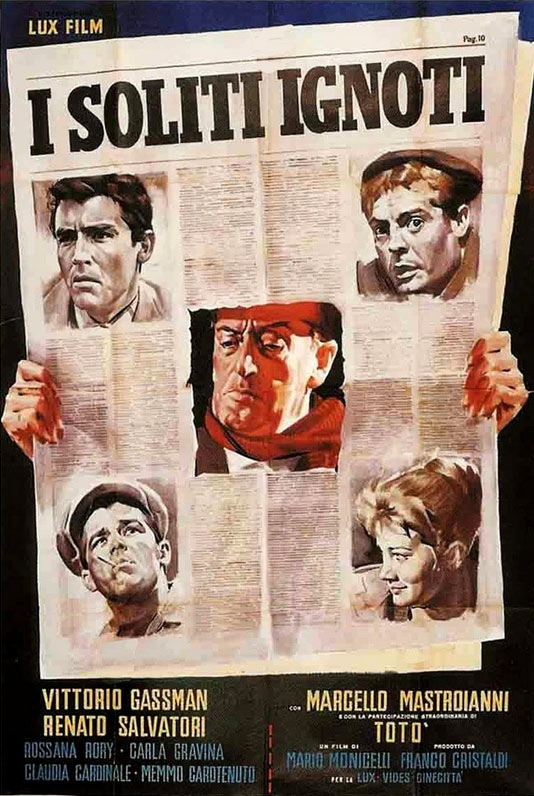
Mario Monicelli’s 1958 Masterpiece of Bungling Thieves and Italian Cinema
In this Italian farce, a motley crew of unskilled small-time robbers attempts to rob a local pawnshop.
Big Deal on Madonna Street (I soliti ignoti, 1958) stands as one of the most beloved and influential films in Italian cinema history. Directed by Mario Monicelli, this comedic caper film follows a motley crew of unskilled small-time robbers as they attempt to rob a local pawnshop in Rome. What unfolds is a brilliant farce that transforms the serious heist thriller into a comedy of errors, establishing the template for countless heist comedies that would follow.
The film is regarded as a defining work of Commedia all’Italiana, the uniquely Italian genre that blended social commentary with humor, and it launched the international careers of several major Italian stars while cementing Monicelli’s reputation as a master filmmaker.
The Title: Lost in Translation
The film’s various international titles reveal an amusing series of mistranslations and adaptations that have become part of its legend:
Original Italian Title
I soliti ignoti literally translates to “the usual unknowns,” which roughly corresponds to the English expression “the usual suspects.” This title perfectly captures the film’s ironic tone—these are habitual criminals so incompetent they remain perpetually unknown to law enforcement.
English Title Confusion
The American release title, Big Deal on Madonna Street, contains a notable mistranslation. The Italian name of the fictional Roman street where the nighttime robbery takes place is Via delle Madonne (The Street of the Madonnas), not the singular “Madonna Street.” The plural form references the multiple religious icons that would typically adorn such a street in Rome, making it a common type of street name in Italian cities.
British Title
In the United Kingdom, the film was released as Persons Unknown, a more literal interpretation that loses the idiomatic flavor of the original Italian title but accurately conveys the criminals’ anonymous status.
The Real Location
Adding another layer to the confusion, the actual Roman street where the robbery scene was filmed is Via delle Tre Cannelle (The Street of the Three Spouts), not Via delle Madonne. This real location served as the stand-in for the fictional street in the film.
Plot and Premise
The comedy revolves around a ragtag group of small-time crooks and ne’er-do-wells in Rome who botch an elaborate scheme to rob a pawnshop. The film opens with a petty thief named Cosimo (Memmo Carotenuto) who, while imprisoned, learns about a supposedly foolproof heist opportunity. When he’s released on bail, he recruits a hapless crew to execute the plan in his absence.
The gang of misfits includes:
- Peppe (Vittorio Gassman): An unemployed boxer with delusions of grandeur who becomes the de facto leader
- Mario (Renato Salvatori): A young, naïve photographer with a pregnant girlfriend
- Tiberio (Tiberio Murgia): A Sicilian immigrant with chronic bad luck
- Ferribotte (Carlo Pisacane): An aging, retired thief brought in for his supposed expertise
- Dante Cruciani (Totò): A master safecracker reduced to stealing from his own family to survive
The plan seems simple: break through the wall of an empty apartment into the adjoining pawnshop and crack the safe. However, nothing goes according to plan. The film chronicles their preparation, practice runs, and the ultimate heist attempt, each phase revealing new levels of incompetence and comic misfortune.
The Cast: A Constellation of Italian Cinema
Vittorio Gassman
The film marked a pivotal turning point in Gassman’s career. Previously regarded as a serious dramatic actor unsuitable for comic roles, his performance as the pompous, self-important Peppe revealed extraordinary comedic timing and range. His portrayal of a man whose ego far exceeds his abilities became iconic, and the role transformed him into one of Italy’s most versatile actors. Gassman would go on to star in numerous comedies and became one of Monicelli’s most frequent collaborators.
Marcello Mastroianni
Playing the sensitive photographer Mario, Mastroianni was still relatively early in his career. His performance showcased the vulnerable, everyman qualities that would make him an international star. The film’s success helped establish him as a leading man in Italian cinema, paving the way for his legendary collaborations with Federico Fellini and his status as one of cinema’s greatest actors.
Renato Salvatori
Salvatori brought authenticity and pathos to the role of Mario, the youngest member of the gang who’s motivated by his desperate need to support his pregnant girlfriend Carmela (played by Claudia Cardinale).
Carlo Pisacane
As the elderly Ferribotte, Pisacane embodied the film’s tragicomic tone—a man whose criminal past has left him with nothing but dubious expertise and failing health.
Tiberio Murgia
The Sardinian actor Murgia played the Sicilian immigrant Tiberio, bringing authentic regional flavor and comic desperation to the role of the gang’s most unlucky member.
Totò (Antonio de Curtis)
The legendary Italian comedian Totò delivered a memorable supporting performance as Dante, the safecracker whose domestic troubles are as complicated as any heist. His scenes provided some of the film’s most poignant moments, balancing comedy with genuine pathos.
Claudia Cardinale
In one of her earliest screen appearances, the 19-year-old Cardinale played Carmela, Mario’s pregnant girlfriend. Though her role was small, her natural beauty and screen presence were evident. She would go on to become one of Italy’s most celebrated international stars, appearing in classics like 8½, The Leopard, and Once Upon a Time in the West.
Themes and Social Commentary
Beneath its comic surface, I soliti ignoti offers sharp social commentary on post-war Italy:
Economic Desperation
The film portrays the economic struggles of working-class Romans in the 1950s. Each character turns to crime not out of inherent wickedness but from financial necessity—unemployment, family obligations, and the desire for social mobility in a rigid class system.
The Italian Dream Deferred
The gang’s elaborate planning represents a distorted version of the Italian economic miracle happening around them. While Italy was experiencing rapid industrialization and growth, these men remain trapped in poverty, their “business plan” a criminal parody of legitimate enterprise.
Anti-Hero Tradition
Monicelli’s thieves are neither romanticized outlaws nor villainous criminals. They’re ordinary people—foolish, shortsighted, often cowardly—making them relatable rather than aspirational. This humanistic approach to criminality was revolutionary for its time.
Critique of Competence
The film satirizes the myth of the professional criminal mastermind. These thieves can’t even execute basic tasks correctly, suggesting that crime, like any profession, requires skills these men don’t possess. It’s a democratic vision of failure—incompetence knows no profession.
Cinematic Innovation and Style
Subverting the Heist Genre
I soliti ignoti brilliantly parodied serious French heist films like Jules Dassin’s Rififi (1955), which featured tense, silent robbery sequences. Where Rififi presented crime as a skilled, dangerous profession, Monicelli’s film exposed the reality of petty crime—chaotic, poorly planned, and doomed to failure. This subversion created an entirely new subgenre: the heist comedy.
Neorealist Influences
The film drew from Italian neorealism’s aesthetic and thematic concerns:
- Location shooting in authentic Roman neighborhoods
- Non-professional actors in supporting roles
- Focus on working-class characters and social issues
- Naturalistic dialogue and performances
- Attention to economic realities of post-war Italy
However, Monicelli transformed neorealism’s tragic sensibility into comedy, proving that humor could address serious social issues without sacrificing impact.
Visual Comedy
Monicelli demonstrated masterful control of physical comedy and visual gags. The film’s most famous sequence—the actual robbery attempt—is a tour de force of comic timing, with each small disaster building to the catastrophic conclusion.
Ensemble Direction
The film showcased Monicelli’s skill at managing ensemble casts, giving each character distinct moments while maintaining narrative momentum. No character overshadows the others; the comedy emerges from their collective incompetence.
The Soundtrack: Jazz Comes to Italian Cinema
Composer Piero Umiliani created one of the most influential film scores in Italian cinema history. His breezy, sophisticated jazz soundtrack was revolutionary for European films of the era:
Musical Innovation
- Light, swinging jazz motifs that contrasted with the characters’ heavy predicaments
- Cool jazz aesthetic influenced by American West Coast jazz
- Use of modern instruments and arrangements unusual for Italian films
- Music that commented ironically on the action rather than reinforcing it dramatically
Cultural Impact
Umiliani’s score helped pioneer the style of jazz soundtracks that became emblematic of European cinema in the 1960s. The approach influenced:
- French New Wave films
- British crime comedies
- Italian giallo films
- The entire aesthetic of “cool” European cinema
The soundtrack achieved independent popularity, becoming a best-selling album and establishing Umiliani as one of Italy’s premier film composers. His work on the film demonstrated that movie music could be both artistically sophisticated and commercially successful.
Critical and Commercial Reception
Initial Release
I soliti ignoti was an immediate critical and commercial success in Italy, becoming one of the highest-grossing Italian films of 1958. Italian critics recognized it as a significant evolution of Italian comedy, praising its sophisticated screenplay, ensemble performances, and Monicelli’s direction.
International Recognition
The film received an Academy Award nomination for Best Foreign Language Film, introducing international audiences to Commedia all’Italiana. It was particularly successful in France, where critics appreciated its subversion of French crime film conventions.
Critical Reassessment
Over the decades, the film’s reputation has only grown. It regularly appears on lists of the greatest Italian films and is considered essential viewing for understanding post-war Italian cinema. Critics have praised:
- The screenplay’s tight construction and memorable dialogue
- The performances, particularly Gassman’s career-defining turn
- Monicelli’s ability to balance comedy with social commentary
- The film’s influence on subsequent heist comedies
Cultural Legacy and Influence
Impact on Cinema
I soliti ignoti influenced countless filmmakers and films:
- The Pink Panther series (1963-): Blake Edwards acknowledged the film’s influence on his comic approach to heist scenarios
- The Coen Brothers: Films like Raising Arizona (1987) and O Brother, Where Art Thou? (2000) echo its combination of criminal incompetence and regional humor
- Wes Anderson: The ensemble dynamics and carefully choreographed mishaps recall Monicelli’s style
- Woody Allen’s Small Time Crooks (2000): A direct homage featuring a similar plot of bungling thieves
- Countless Italian comedies that followed the template of lovable criminal losers
Remakes and Adaptations
The film’s premise proved enduringly popular:
- Welcome to Collinwood (2002): American remake directed by Anthony and Joe Russo, relocating the story to Cleveland
- Crackers (1984): Louis Malle’s San Francisco-set adaptation
- Various television adaptations in Italy and other countries
Italian Cultural Icon
In Italy, the film achieved such cultural penetration that phrases and scenes from it entered everyday language. The characters became archetypes, and the film is regularly broadcast on Italian television, introducing new generations to Monicelli’s masterpiece.
The Film’s Place in Italian Cinema History
I soliti ignoti represents a crucial moment in Italian cinema’s evolution:
Bridge Between Movements
The film connected Italian neorealism’s social concerns with the emerging Commedia all’Italiana, demonstrating that comedy could maintain neorealism’s commitment to depicting ordinary Italians while entertaining audiences.
Commercial and Artistic Success
It proved that Italian films could be both artistically significant and commercially successful, paving the way for the Italian film industry’s golden age in the 1960s.
International Breakthrough
The film helped establish Italian comedy as an export product, showing that humor rooted in specific Italian social conditions could resonate with international audiences.
Technical Achievements
Cinematography
Gianni Di Venanzo, one of Italy’s greatest cinematographers, shot the film in crisp black and white that captured both the gritty reality of Roman streets and the comic precision of the robbery sequences. His work balanced neorealist documentary aesthetics with the controlled lighting necessary for comedy.
Screenplay
Written by Age & Scarpelli (Agenore Incrocci and Furio Scarpelli), along with Monicelli and Suso Cecchi d’Amico, the screenplay is considered one of the finest in Italian cinema. Its dialogue is endlessly quotable, its structure precise, and its character development economical yet complete.
Editing
The film’s pacing, crucial to comedy, was expertly handled by Adriana Novelli, whose editing maintained momentum while giving comic beats room to breathe.
Lasting Relevance
More than six decades after its release, I soliti ignoti remains remarkably fresh and entertaining. Its themes of economic desperation, class mobility, and the gap between aspiration and ability continue to resonate. The film’s humor derives from character and situation rather than topical references, giving it timeless appeal.
The characters’ fundamental incompetence at their chosen profession speaks to universal human experience—the gap between who we think we are and what we can actually accomplish. This existential comedy, wrapped in the specific details of 1950s Rome, gives the film both cultural specificity and universal relatability.