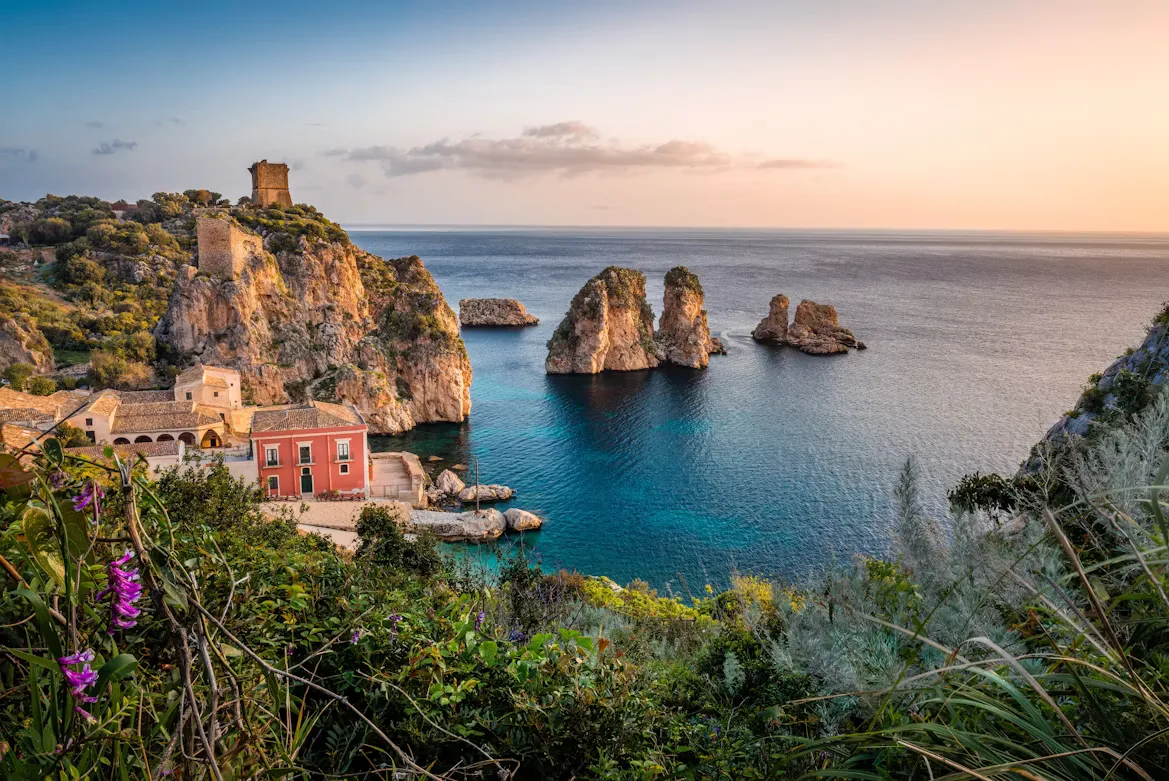
Sicily has always resisted a single historical label. The island sits between Europe and North Africa, between western and eastern Mediterranean routes, and its cities, temples, tombs, markets, and mountain villages still carry traces of the peoples who arrived by sea, settled, ruled, traded, prayed, built, and left fragments behind.

That is why Sicily’s most unusual locations rarely feel like isolated curiosities. A mosaic ceiling, a rock-cut tomb, a volcanic shrine, or a macabre burial chamber can reveal larger stories about power, migration, memory, and survival.
The Island Where Civilizations Left Their Marks
Phoenician sailors established trading points. Greeks founded cities and temples. Romans turned the island into a granary. Byzantines, Arabs, Normans, Swabians, Spanish rulers, and local noble families added new layers of language, architecture, foodways, religion, and political identity.
This mixture makes Sicily especially rewarding for travelers interested in history beyond the obvious landmarks. Palermo, Monreale, Erice, Marsala, Syracuse, Noto, Catania, and Etna each reveal a different part of the island’s story. Visitors trying to connect these scattered histories through local interpretation can explore Sicily guided experiences and turn separate monuments, villages, and traditions into a more coherent cultural journey.
The island rewards a slower approach. A church might contain Arabic inscriptions, Byzantine-style mosaics, and Norman political symbolism. A market may preserve words, ingredients, and habits shaped by centuries of Mediterranean exchange. A remote necropolis may reveal a society older than Sicily’s famous Greek temples.
Palermo’s Hybrid Monuments and the Norman Imagination
Few cities show Sicily’s layered identity more clearly than Palermo. Its historic center opens onto churches, palaces, courtyards, markets, and domes that do not belong neatly to one tradition.
During the Norman period, rulers inherited an island shaped by Arab, Byzantine, Latin, Jewish, and Greek-speaking communities. Norman kings used this mixture to express authority, drawing on local craftsmen, decorative systems, sacred imagery, and architectural forms from different cultural worlds.
Arches, mosaics, inscriptions, gardens, and geometric ornament became part of a visual language that was both political and spiritual. Palermo’s palaces and churches were not simple imitations of foreign styles. They were Sicilian statements made from the island’s mixed vocabulary.
Monreale, Cefalù, and Sacred Power in Stone
The artistic world of Norman Sicily extends beyond Palermo. Monreale and Cefalù add two of its most striking chapters. Their cathedrals show how sacred architecture could serve as royal theater, turning walls, apses, columns, and gold-ground mosaics into declarations of legitimacy.
The wider group of Arab-Norman monuments in Palermo, Cefalù, and Monreale reflects the cultural exchange that shaped the Norman kingdom of Sicily. These places show Latin Christian rule operating within a visual and technical environment shaped by earlier Mediterranean traditions.
Monreale Cathedral can feel almost overwhelming, with biblical scenes covering the walls in shimmering detail. Its cloister offers a quieter kind of wonder, where column capitals hold carved animals, plants, symbols, and stories. Cefalù, facing the sea beneath a dramatic rock, places sacred authority against a landscape that has always shaped Sicilian identity.
Their strangeness does not come from obscurity. It comes from compression: many histories expressed through one architectural language.
Palermo Below Ground: Catacombs, Memory, and Display
Sicily’s hidden histories are not all found in sunlight. In Palermo, burial traditions reached one of their most unusual expressions in underground spaces where the dead were preserved, clothed, arranged, and seen.
The catacombs are often described as macabre, but they also reveal a serious cultural history. Their corridors speak to family, identity, death, religious devotion, and public remembrance. The bodies were not hidden in the modern sense. They occupied a space where grief, status, and memory remained visible.
Modern visitors are used to cemeteries that soften death through stone, names, flowers, and symbolic imagery. Palermo’s preserved dead create a more direct encounter with the past. Clothing, facial features, posture, and arrangement turn historical people into a silent record of class, gender, age, belief, and local custom.
These underground spaces should not be treated as spectacles alone. Their value lies in what they reveal about the people who created and maintained them.
Western Sicily’s Forgotten Crossroads
Western Sicily often feels quieter than Palermo or the eastern coast, but its histories are just as complex. Around Marsala, the salt pans, shallow waters, windmills, and islands recall a long story of trade and movement. This region faces North Africa and the western Mediterranean, and its landscape still carries the atmosphere of crossing.
The ancient island of Motya, associated with Phoenician and Carthaginian history, shows how far Sicily’s connections extended before the rise of the island’s Greek cities. It belonged to a maritime world where merchants, sailors, settlers, and armies moved between coasts. The sea made Sicily central.
Nearby Erice offers a different kind of unusual history. Perched high above the coast, the town feels suspended between myth and stone. Its medieval streets, older sacred associations, and wide sea views create the impression of a place built for watching, worshipping, and remembering.
Western Sicily also shows how geography becomes history. Salt, wind, harbors, high ground, and sea routes shaped settlement patterns and sacred spaces. The region’s unusual locations are tied to practical needs as much as to legends.
Southeastern Sicily and Ancient Tomb Landscapes
Southeastern Sicily contains some of the island’s most powerful ancient landscapes. Near Syracuse, the necropolis of Pantalica preserves thousands of burial chambers cut into limestone cliffs and ravines. These rock-cut tombs belong to a world older than the classical cities that usually dominate conversations about Sicily.
Pantalica’s power comes from repetition, scale, and setting. Tomb after tomb appears in the cliff faces, forming a landscape where death, territory, and community were carved into stone. The site suggests a society deeply connected to the landforms around it.
The surrounding valleys and plateaus make the place feel remote even today. This distance allows visitors to imagine an island before the grand urban identities of Syracuse, Agrigento, or Palermo became dominant. Pantalica reveals a Sicily of fortified settlements, burial rituals, natural defenses, and communities whose traces survive through architecture made for the dead.
In southeastern Sicily, ancient tombs often sit near Baroque towns rebuilt after earthquakes, Greek ruins, rural roads, and coastal settlements. The past appears in fragments, depending on where one looks.
Etna, Rituals, and Histories Still in Motion
Sicily’s unusual locations are not limited to monuments and tombs. Mount Etna gives the island a living, unstable center of gravity. The volcano has shaped settlement, agriculture, mythology, danger, and devotion for centuries. Villages on its slopes live with a landscape that can be fertile and destructive at the same time.
Lava flows can bury roads, alter fields, and redirect human plans, while volcanic soil supports vineyards, orchards, and distinctive local food traditions. The mountain is both a geological force and a cultural presence.
The island’s living traditions add another layer. Festivals dedicated to saints, puppet theater, market rituals, food customs, and local processions preserve history through performance and repetition. In Catania, devotion to Sant’Agata fills the city with collective memory. In Palermo, the feast of Santa Rosalia connects urban identity, plague history, sacred legend, and civic ritual.
These traditions prevent Sicily from becoming an open-air museum. Some histories survive in official monuments. Others remain in gestures, dialect words, routes, recipes, and neighborhood memory.
Featured image: Unsplash

Weird Italy, Guide to Unusual & Amazing Places to see in Italy. Italy’s news in English: Art, History & Facts