The 1969 Milan bombing marked a new phase in political violence
The Piazza Fontana bombing took place on 12 December 1969 at the Banca Nazionale dell’Agricoltura in Milan, causing 17 deaths and 88 injuries. The bombing is often referred to as the “mother of all massacres,” the first and most disruptive act of post-war terrorism in Italy, and a defining moment in what later came to be known as the Years of Lead.
It was part of a series of five coordinated attacks that occurred within 53 minutes in Rome and Milan. In Rome, three bombs exploded, injuring 16 people. These targeted the Banca Nazionale del Lavoro on Via San Basilio, Piazza Venezia, and the Altare della Patria. In Milan, a second bomb was found unexploded in Piazza della Scala. Additional bombs planted in judicial buildings in Turin, Rome, and Milan failed to detonate due to technical malfunctions.
Though not the deadliest attack during the Years of Lead, the Piazza Fontana bombing marked the beginning of a period of stragismo (massacres) connected to the strategy of tension, including the Piazza della Loggia bombing (28 May 1974), the Italicus train bombing (4 August 1974), and the Bologna massacre (2 August 1980).
Long and complex investigations revealed that the attack was carried out by far-right extremists, allegedly with support from deviated sectors of Italian security services and possible international links. In June 2005, Italy’s Court of Cassation concluded that the attack was executed by a subversive group based in Padua, linked to Ordine Nuovo, and led by Franco Freda and Giovanni Ventura. They could not be prosecuted due to double jeopardy (having been definitively acquitted in 1987). The actual perpetrators who placed the bomb remain unidentified.
The Attack
On Friday, 12 December 1969, a bomb exploded inside the Banca Nazionale dell’Agricoltura located in Piazza Fontana, in the centre of Milan, during the busiest hour of the afternoon. The building was crowded, particularly with farmers and agricultural workers from surrounding rural areas who were in the city to receive seasonal loans and subsidies. At 16:37, a device containing approximately 7 kilograms of TNT detonated in the main hall, causing the immediate death of 13 people and wounding 87 others, some seriously. In the following months, the number of fatalities rose to 17 with the death of Carlo Gaiani and Luigi Meloni, who succumbed to injuries sustained in the attack. A third victim, Giovanni Zibecchi, died in 1970 after prolonged hospitalization due to the severity of his wounds.
The explosion caused extensive damage to the interior of the bank, shattering windows and spreading debris across the square. The site was initially treated as a criminal case without immediate recognition of its broader political implications.
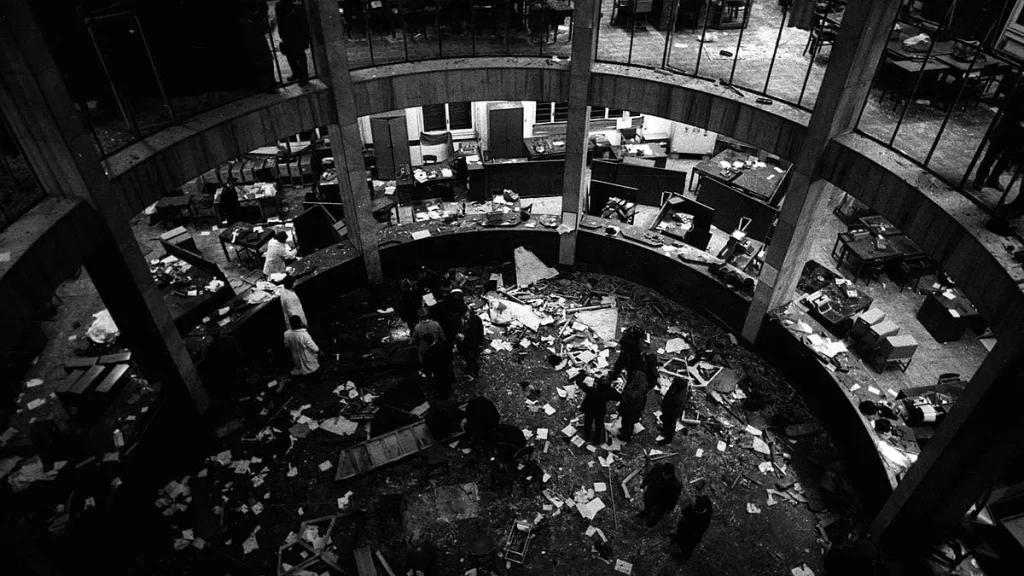
A second bomb, placed at the Banca Commerciale Italiana in Piazza della Scala, was discovered shortly after the Milan explosion. It failed to detonate and was disarmed in the early evening by bomb disposal experts. However, instead of being preserved for forensic analysis, the device was inexplicably destroyed—a decision that later drew criticism for having eliminated potentially decisive evidence.
On the same day, three additional bombings occurred in Rome: the first at 16:55 in the underpass connecting Via Veneto and Via San Basilio, and two more between 17:20 and 17:30 in Piazza Venezia and in front of the Museo Centrale del Risorgimento. These attacks resulted in 16 injuries but no fatalities. Although initially treated as isolated incidents, the synchrony and scale of the events in Milan and Rome revealed a coordinated strategy of terror.
The events of that day marked the beginning of what would later be called the “strategia della tensione” (“strategy of tension”), a period characterised by political violence, bombings, and covert operations involving both far-right groups and sections of the security apparatus, aimed at destabilising Italian democracy.
Political Consequences
On 13 December 1969, the day after the bombing, Interior Minister Franco Restivo addressed the Chamber of Deputies, delivering an initial report on the Milan and Rome attacks. He stated that the investigation would follow all leads and assured the parliament that the state would respond firmly to acts of terrorism. On 16 December, Restivo appeared again, this time before the Senate, reiterating the government’s commitment to identify and punish those responsible. His statements, however, were perceived by some political factions as vague and insufficiently decisive.
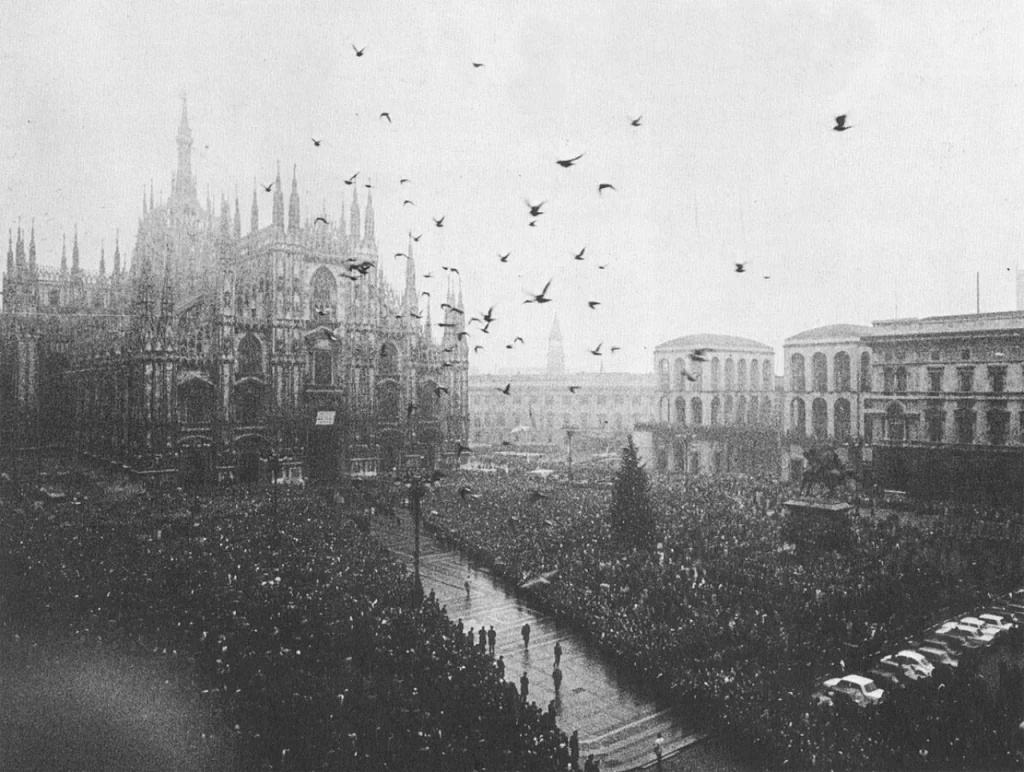
The attack deeply shocked public opinion and political institutions. The funeral of the victims, held on 15 December 1969 in Piazza Duomo, Milan, drew more than 300,000 people, including trade unionists, students, workers, and ordinary citizens. The ceremony was attended by key state officials, including President of the Republic Giuseppe Saragat, Prime Minister Mariano Rumor, and the Mayor of Milan, Aldo Aniasi. The emotional atmosphere was marked by tension and suspicion, especially due to the initial arrests of anarchists, which many perceived as politically motivated.
The attack triggered immediate political repercussions. Prime Minister Mariano Rumor, leader of a Christian Democracy (Democrazia Cristiana) government coalition, held emergency consultations with leaders of the ruling parties: the Italian Socialist Party (PSI), the Italian Democratic Socialist Party (PSDI), and the Italian Republican Party (PRI). Internal notes from these meetings revealed concern over growing public unrest and institutional instability. The scale and nature of the bombing led to discussions about the formation of a government of national solidarity, which could include broader parliamentary support or even an emergency “technocratic” solution, though no such coalition ultimately materialised.
The bombing also accelerated changes in the intelligence and security services. There was an increased focus on countering subversion, which resulted in a heightened repression of leftist movements, particularly anarchist and communist groups. This approach drew criticism from civil rights organisations and segments of the press, especially as the first arrests targeted the anarchist milieu without conclusive evidence. At the same time, segments of the political establishment began to raise the possibility of far-right infiltration or manipulation, especially as new evidence emerged in the following months.
The events surrounding the Piazza Fontana bombing contributed to a broader climate of mistrust between citizens and institutions and marked a turning point in the political history of the Italian First Republic. They also foreshadowed the escalation of political violence that would define the so-called “Years of Lead” (Anni di piombo), a period characterised by attacks from both far-left and far-right armed groups, covert operations, and judicial controversies.
Investigations
In the immediate aftermath of the Piazza Fontana bombing, authorities launched an extensive investigation targeting both left-wing anarchist groups and far-right organisations. Approximately 80 individuals were detained for questioning across Italy. In Rome, attention focused on the Circolo anarchico 22 Marzo, which included Pietro Valpreda, a dancer and member of anarchist circles. In Milan, police questioned members of the Circolo anarchico Ponte della Ghisolfa, among them Giuseppe Pinelli, a railway worker and long-time activist.
The political police, under the direction of Antonino Allegra, head of Milan’s political office, confirmed that arrests were also made within far-right environments. Allegra later claimed that these detentions were partly precautionary, intended to prevent any escalation of violence or street clashes rather than being based on concrete evidence.
However, the investigation quickly narrowed its focus to anarchist groups. On 13 December, the Milan Prefect Libero Mazza, acting on input from Federico Umberto D’Amato, director of the Ufficio Affari Riservati (Office of Special Affairs at the Ministry of the Interior), informed Prime Minister Mariano Rumor that “the most plausible hypothesis” pointed to anarchists as the perpetrators. This assessment was presented as a product of internal intelligence evaluations.
Later documentation and parliamentary inquiries revealed that this claim was part of a coordinated disinformation campaign led by the Ufficio Affari Riservati. Its objective was to steer public opinion and judicial investigations toward left-wing anarchist groups while obscuring the involvement of far-right networks, some of which had ties to neofascist organisations such as Ordine Nuovo. The Italian military intelligence agency SID (Servizio Informazioni Difesa) also became involved, and some of its personnel were later implicated in efforts to sabotage the investigation and cover up key evidence.
This manipulation played a central role in what would later be identified as the “strategy of tension”, in which violent acts were attributed to leftist groups to justify repression and shift the political balance to the right. The coordinated narrative around the involvement of anarchists was contradicted in the following years as judicial inquiries and journalistic investigations uncovered evidence pointing to neofascist groups and elements within the state apparatus.
Giuseppe Pinelli
Giuseppe Pinelli, born in 1928, was a railway worker, former partisan, and anarchist activist affiliated with the Circolo Ponte della Ghisolfa in Milan. He was detained by police on 12 December 1969, shortly after the Piazza Fontana bombing, and held for interrogation at the Milan police headquarters in Piazza della Scala.
On the evening of 15 December, after three days of continuous questioning, Pinelli fell from a fourth-floor window of the police building. He died shortly thereafter. The circumstances surrounding his death sparked national outrage and remain one of the most controversial episodes in Italian postwar history.
Initial accounts from the police, notably Commissioner Luigi Calabresi, stated that Pinelli had committed suicide after learning that his alibi had collapsed. However, it was later confirmed that his alibi was in fact intact and verifiable—he had been at the Circolo anarchico at the time of the bombing, a fact corroborated by multiple witnesses.


The official version released by Milan prosecutor Gerardo D’Ambrosio years later claimed that Pinelli had suffered a sudden illness, became disoriented, and accidentally fell from the window while attempting to get fresh air. This explanation was met with skepticism by the public, intellectuals, and political groups, especially as Pinelli had been held beyond the legal 48-hour limit without formal charges.
The event deeply influenced public opinion and cultural discourse. It was referenced in numerous works of literature, theatre, and film, most notably in Dario Fo’s play Morte accidentale di un anarchico (Accidental Death of an Anarchist), which satirised the inconsistencies in the police account.
No one was ever convicted for Pinelli’s death. Commissioner Calabresi was never formally charged, though he became a symbol of police repression for parts of the radical left. In 1972, Calabresi was assassinated in Milan by members of the Lotta Continua group, an act for which Adriano Sofri, Ovidio Bompressi, and Giorgio Pietrostefani were later tried and convicted decades later after a controversial judicial process.
Pietro Valpreda
On 16 December 1969, Pietro Valpreda was arrested in Rome as a suspect in the Piazza Fontana bombing, following the deposition of a key witness, Cornelio Rolandi, a taxi driver from Milan. Rolandi told investigators that on the afternoon of 12 December, he had transported a man with a limp carrying a suitcase to Piazza Fontana. He later identified Valpreda from a police lineup. The suitcase was presumed to contain the bomb.


Valpreda, a former professional dancer and member of the anarchist Circolo 22 Marzo, was known to suffer from a pronounced limp caused by a blood circulation disorder. Despite this, investigators accepted Rolandi’s statement that Valpreda had exited the taxi and walked approximately 110 metres to the entrance of the bank, leading to doubts about the credibility of the identification. Rolandi was later awarded 50 million lire as a reward for his cooperation.
On the basis of Rolandi’s testimony, prosecutor Vittorio Occorsio charged Valpreda with multiple homicide and conspiracy, accusing him of placing the bomb that killed 14 people—17 with subsequent deaths. In the days following his arrest, the Italian media presented Valpreda as the presumed perpetrator. Several newspapers referred to him as “the monster of Piazza Fontana”, and his image was widely circulated. The presumption of guilt was reinforced at the institutional level: President of the Republic Giuseppe Saragat publicly praised the work of the police and the judiciary, indirectly validating the hypothesis of anarchist responsibility.
As doubts emerged, several inconsistencies in the official version came to light. Witnesses claimed Valpreda had been seen elsewhere at the presumed time of the bombing, and the reliability of Rolandi’s identification was called into question. A theory was circulated that the man in the taxi may have been Antonio Sottosanti, also known as “Nino il fascista”, a far-right militant who had infiltrated anarchist circles in Rome. However, this hypothesis was never substantiated by judicial evidence.
Valpreda remained in prison for over three years without trial, until he was released in 1972 pending further proceedings. His case became symbolic of state repression against the extra-parliamentary left, and the slogan “Valpreda è innocente” gained wide traction in activist and cultural circles. Public opinion gradually shifted as competing theories pointed toward far-right involvement and state cover-ups.
Trials
The first trial relating to the Piazza Fontana bombing formally began on 23 February 1972 in Rome but was soon moved for reasons of public order to Milan, and then to Catanzaro. The proceedings were long and fragmented, reflecting the complexity of the case and its political implications.
The investigation eventually shifted toward the neofascist group Ordine Nuovo, based on emerging evidence and testimonies. In 1974, magistrates charged Franco Freda, Giovanni Ventura, and Guido Giannettini, the latter an agent of Italian military intelligence (SID). The charges were based in part on forensic similarities between the unexploded Rome bombs and those linked to Freda. Pietro Valpreda and Mario Merlino were also tried but were no longer accused of planting the bomb. They were convicted only for criminal association.

The Corte d’Assise di Catanzaro handed down life sentences for Freda and Ventura. However, on appeal, the convictions were overturned due to procedural irregularities and evidentiary doubts. Merlino and Valpreda were acquitted of all charges related to the bombing. A new second-degree trial began in Bari in 1984 and concluded in 1985, again with acquittals. In 1987, the Corte di Cassazione confirmed these decisions, though it convicted two officers of the SID, Gianadelio Maletti and Antonio Labruna, for obstruction of justice, having misled the investigations and withheld evidence.
In the 1990s, Judge Guido Salvini in Milan reopened the investigation. His inquiry relied on the statements of Martino Siciliano, a former Ordine Nuovo militant, and Carlo Digilio, a technician and explosives expert with ties to neofascist and intelligence networks. Both claimed that Freda, Ventura, and others from the Veneto section of Ordine Nuovo had orchestrated the attack. Digilio, classified as a collaboratore di giustizia, received immunity in exchange for cooperation.
The new trial led to indictments in 2000 against Delfo Zorzi (who had by then acquired Japanese citizenship and refused extradition), Carlo Maria Maggi, and Giancarlo Rognoni. In 2001, the Corte d’Assise of Milan sentenced them to life imprisonment. However, the Court of Appeal overturned the verdicts in 2004, citing insufficient evidence. In 2005, the Italian Supreme Court (Corte di Cassazione) definitively acquitted all defendants but stated in its ruling that the Piazza Fontana bombing was carried out by Ordine Nuovo members, specifically identifying Freda and Ventura as responsible. Nevertheless, no individual was convicted as the direct material perpetrator, due in part to prior acquittals which legally precluded retrial under ne bis in idem.
Public and Political Reactions
In the immediate aftermath of the Piazza Fontana bombing, Italian public opinion was deeply divided and increasingly distrustful of the official narrative. The government’s prompt attribution of the attack to anarchist circles was met with skepticism in various quarters, including among journalists, political leaders, and segments of civil society.
Indro Montanelli, one of Italy’s most prominent journalists, voiced early doubts about anarchist involvement. In a televised interview in December 1969, Montanelli questioned the logic of blaming anarchists, arguing that their actions had historically been symbolic, demonstrative, and aimed at institutions of power, not mass civilian targets. He noted that such a massacre, carried out anonymously and without immediate claim of responsibility, was more consistent with methods previously employed by fascist groups.
The Italian Left also reacted with increasing suspicion. The Italian Socialist Party (Partito Socialista Italiano, PSI) and the Italian Communist Party (Partito Comunista Italiano, PCI) expressed concerns about the investigative direction. The PSI’s daily newspaper Avanti! explicitly connected the bombing to historical fascist terrorism, citing the 1928 Milan Trade Fair bombing as a precedent. The editorial stance of Avanti! suggested that the attack fit into a pattern of reactionary violence aimed at disrupting democratic institutions and provoking authoritarian responses.
Pietro Nenni, long-time leader of the PSI and former Deputy Prime Minister, praised the mass participation at the victims’ funeral in Piazza Duomo, describing it as a reflection of civic resistance and democratic cohesion. Nenni’s statements positioned the bombing as an attack not only on individuals but on the political and moral fabric of the Republic.
Within the PCI, the initial response was more cautious. Some party leaders initially accepted the anarchist hypothesis, in line with the judiciary’s early conclusions. However, doubts emerged over time. Luigi Longo, then secretary of the PCI, maintained a public position of waiting for judicial clarity, while others within the party—particularly those involved in legal and press offices—questioned the credibility of the testimony of Cornelio Rolandi, which was the primary basis for Pietro Valpreda’s arrest.
Further scrutiny emerged when it was revealed that Mario Merlino, one of Valpreda’s close associates in the Circolo 22 Marzo, had longstanding ties with the neofascist organisation Avanguardia Nazionale and had acted as a provocateur within anarchist circles. Merlino’s dual affiliation raised alarms about possible infiltration and manipulation of anarchist groups by far-right militants or intelligence operatives. The Circolo 22 Marzo, founded in Rome by Valpreda, included individuals with eclectic and contradictory political backgrounds, increasing the confusion surrounding the investigation.
Valpreda, who had previously been active in the Circolo Bakunin, saw his name become synonymous with the bombing across headlines and political discourse, despite the absence of conclusive evidence. Although he was eventually fully acquitted after more than three years in pretrial detention, the public stigma attached to his name remained. His case became emblematic of judicial miscarriage and the dangers of politically motivated accusations during a period of widespread institutional distrust.
The unfolding of the Piazza Fontana case contributed to a broader atmosphere of political polarization. It intensified debates over state accountability, media manipulation, and the role of covert structures within the security services. For many Italians, the bombing marked the beginning of a period in which the boundaries between legality and illegality, state power and subversion, became increasingly blurred.

Counter-Investigations and the Stragi Commission
As institutional investigations into the Piazza Fontana bombing stalled and increasingly appeared compromised, alternative inquiries emerged from extra-parliamentary groups, journalists, and later from within the Italian Parliament itself.
In 1970, a group of young militants affiliated with the Lotta Continua and Potere Operaio movements published the pamphlet La strage di Stato (The State Massacre), which presented a counter-investigation challenging the official version of events. The text accused neo-fascist groups, particularly Ordine Nuovo and Avanguardia Nazionale, of planning and executing the bombing, while also implicating sections of the Italian secret services and NATO-aligned intelligence structures. The document specifically mentioned figures such as Junio Valerio Borghese, former commander of the Decima MAS and founder of the Fronte Nazionale, and Stefano Delle Chiaie, founder of Avanguardia Nazionale and later linked to several international far-right networks.
The pamphlet was one of the first attempts to publicly articulate the concept of the “strategy of tension“, arguing that the bombing was not an isolated act of extremism, but part of a coordinated attempt to destabilise democratic institutions through fear, thereby justifying authoritarian shifts.
In parallel, the Brigate Rosse, a far-left armed group that emerged in the early 1970s, conducted their own clandestine inquiries. During a 1974 police raid, authorities recovered documents including reports and interviews allegedly gathered by the group about the Piazza Fontana bombing and its perpetrators. However, these materials were largely lost or destroyed in the following years, particularly during the collapse of the armed left and a shift in investigative focus in the early 1990s.
One of the few surviving testimonies connected to these unofficial inquiries came from Michele Galati, a former member of the Brigate Rosse, who claimed in later years that the bombing was originally intended as a symbolic action by anarchists, aimed at drawing attention without causing casualties. According to Galati, the explosion occurred during business hours due to deliberate misinformation, and the explosives had been provided by far-right intermediaries, who manipulated the situation to ensure a mass-casualty event. This version of events was never confirmed in court and remains speculative, lacking corroborating documentation.
Meanwhile, the Italian Parliament initiated its own inquiry into political violence and institutional collusion. In 1988, the Parliamentary Commission of Inquiry into the Terrorist Massacres in Italy, commonly referred to as the Stragi Commission, was established. The commission sought to clarify the circumstances surrounding a series of unsolved bombings and political murders, including Piazza Fontana, the Brescia bombing of 1974, and the Bologna train station massacre of 1980.
The Stragi Commission, presided over in different phases by members of both centre-left and centre-right parties, reviewed classified documents, interviewed intelligence officers, and accessed archives previously restricted to magistrates. While it did not have judicial authority, it was able to establish patterns of obstruction, particularly from military intelligence agencies such as SID and SISMI, and confirmed the existence of covert paramilitary structures linked to NATO’s stay-behind network, known in Italy as Gladio.
In its various reports, the commission reaffirmed that Ordine Nuovo was responsible for the Piazza Fontana bombing and noted the active role of intelligence operatives in steering investigations away from the neofascist network. It highlighted the deliberate destruction of evidence, such as the disarming and disposal of the unexploded bomb in Piazza della Scala, and the fabrication of false leads.
Luigi Calabresi
Luigi Calabresi, commissioner of the Milan Political Office, became a central figure in the aftermath of the Piazza Fontana bombing, despite not being physically present when Giuseppe Pinelli fell from the fourth-floor window of the Milan police headquarters on 15 December 1969. As the officer in charge of political investigations, Calabresi was publicly identified by many on the left as bearing moral and institutional responsibility for Pinelli’s death.
Beginning in 1970, Calabresi was subjected to a prolonged campaign of criticism and personal attacks by extra-parliamentary groups, intellectuals, and sectors of the radical press. Petitions, posters, and newspaper articles—most notably one published in Lotta Continua in 1971, signed by prominent cultural figures—accused him of involvement in or knowledge of Pinelli’s fall, although no judicial evidence ever substantiated these claims.
On 17 May 1972, Calabresi was assassinated near his home in Milan, shot in the back while walking to his car. The murder remained unsolved for over two decades. In the 1990s, during a judicial reassessment of left-wing terrorism, former Lotta Continua militant Ovidio Bompressi was arrested and accused of carrying out the killing. The case reopened broader inquiries into the role of former leaders of the organisation.
In 1997, Bompressi, Adriano Sofri (then a journalist and former national leader of Lotta Continua), and Giorgio Pietrostefani were convicted of conspiracy and complicity in the murder of Calabresi. The conviction was based largely on the testimony of Leonardo Marino, a former Lotta Continua member who came forward in 1988 claiming direct knowledge of the crime. The verdict was highly controversial, generating extensive debate across the political and intellectual spectrum in Italy. Appeals were filed over the years, but the convictions were ultimately upheld. Pietrostefani, who had moved to France, remains there, protected by the Mitterrand Doctrine against extradition.
Antonio Sottosanti (“Nino il fascista”)
Antonio Sottosanti, also referred to as “Nino il fascista”, was a Sicilian militant associated with Avanguardia Nazionale and various far-right environments in Rome during the 1960s. Known for his involvement in political infiltration, he was allegedly active within anarchist circles as well.
Sottosanti was suspected by some of being the actual passenger in the taxi driven by Cornelio Rolandi on 12 December 1969, raising the possibility that he may have impersonated Pietro Valpreda. His alleged physical resemblance to Valpreda, combined with his documented activities in overlapping political networks, led certain investigators and journalists to view him as a potential decoy used to frame the anarchist.
Sottosanti denied any involvement, presented an alibi, and was never formally charged in connection with the Piazza Fontana bombing. His role remains speculative. He died in 2004, and no definitive evidence ever emerged confirming his alleged role in the events surrounding the bombing.
Agent Zeta (Guido Giannettini)
Guido Giannettini, codenamed “Agent Zeta”, was an Italian journalist, intelligence operative, and former member of Fronte Nazionale. He maintained links with both neo-fascist organisations and elements of the Italian military intelligence agency SID (Servizio Informazioni Difesa). In the early 1970s, documents found in a safety deposit box belonging to relatives of Giovanni Ventura contained correspondence and materials suggesting Giannettini’s involvement in coordinating subversive operations.
Further searches uncovered military documents bearing NATO classifications in Giannettini’s home, reinforcing suspicions of his connection to international intelligence structures. These findings indicated potential links between domestic terrorism, right-wing extremism, and segments of the security apparatus.


Following these revelations, Giannettini fled to France, reportedly with the assistance of SID officials. In 1974, Giulio Andreotti, then Minister of Defence, publicly confirmed that Giannettini had collaborated with SID, acknowledging his role in state-sponsored operations, though denying direct involvement in the Piazza Fontana bombing.
Giannettini was tried in 1979, along with Freda and Ventura, in the first major judicial proceeding related to the bombing. He was convicted but later acquitted on appeal in 1981, due in part to insufficient evidence directly linking him to the bombing.
Aldo Moro
In the Moro Memorial (Memoriale Moro)—a series of political reflections written during his 1978 captivity by the Brigate Rosse—Aldo Moro, former Prime Minister and president of the Christian Democracy, offered an internal analysis of key events in the Republic’s recent history. Among these, he addressed the Piazza Fontana bombing and the broader strategy of tension.
Moro speculated that the attack was the result of coordinated actions by deviant sectors of the Italian intelligence services, potentially operating under the influence of foreign actors, particularly Atlantic allies. He also mentioned the use of far-right activists as operational instruments, suggesting that violence attributed to anarchists was in fact the work of neofascist groups, protected or manipulated by state elements.
Although Moro’s observations were not part of formal judicial evidence, they later gained historical relevance. The Moro Memorial offered insight into the mindset of a senior statesman who had firsthand experience with the opaque interplay between intelligence services, foreign policy, and domestic political control during one of the most turbulent phases of the Italian Republic.
Victims
The victims of the bombing were:
- Giovanni Arnoldi (42)
- Giulio China (57)
- Eugenio Corsini (71)
- Pietro Dendena (45)
- Carlo Gaiani (56)
- Calogero Galatioto (71)
- Carlo Garavaglia (67)
- Paolo Gerli (77)
- Luigi Meloni (57)
- Vittorio Mocchi (33)
- Gerolamo Papetti (79)
- Mario Pasi (50)
- Carlo Perego (74)
- Oreste Sangalli (49)
- Angelo Scaglia (61)
- Carlo Silva (71)
- Attilio Valè (52)
Commemorations and Cultural Impact
Annual commemorative events for the Piazza Fontana bombing are held every 12 December in Milan, attended by survivors, families of the victims, civic associations, and representatives of local and national institutions. The official ceremony takes place near the Banca Nazionale dell’Agricoltura, where a memorial plaque lists the names of the 17 victims. These events serve as a public reaffirmation of opposition to political violence and institutional silence.
A separate commemoration is held each year on 15 December to mark the death of Giuseppe Pinelli. It typically includes gatherings at the Ponte della Ghisolfa anarchist circle and in front of the Milan police headquarters, where Pinelli died during police interrogation.
In 1970, during a demonstration in Milan marking the first anniversary of the bombing and Pinelli’s death, Saverio Saltarelli, a 23-year-old student and activist, was killed by a tear gas canister fired at close range by police during a clash. His death became another point of contention in the broader debate over state repression during the period.
In 2009, to mark the 40th anniversary of the bombing, President of the Republic Giorgio Napolitano received members of the victims’ families at the Quirinale Palace, publicly acknowledging their decades-long commitment to preserving the memory of the events and pressing for judicial truth. This gesture was widely interpreted as a symbolic act of institutional recognition after years of silence and delayed justice.
Film
The Piazza Fontana bombing and its aftermath have been the subject of multiple Italian films that reconstruct the events or reflect on their political implications:
- 12 dicembre by Pier Paolo Pasolini and Giovanni Bonfanti (1972)
- La pista nera by Giuseppe Ferrara (1972)
- Romanzo di una strage by Marco Tullio Giordana (2012)
- 12/12 – Piazza Fontana by Matteo Bennati and Maurizio Scarcella (2019)
Literature
The bombing has appeared in both poetic and narrative forms in Italian literature:
- Trasumanar e organizzar by Pier Paolo Pasolini (1971)
- La Strage. Il Romanzo di Piazza Fontana by Vito Bruschini (2012)
Comics
- Cani sciolti n.8 – La strage by Gianfranco Manfredi and Roberto Rinaldi (2019)
Music
Songs referencing the bombing include works by Enzo Jannacci, Francesco De Gregori, Pierangelo Bertoli, Giorgio Gaber, Isola Posse All Stars, Fratelli di Soledad, Modena City Ramblers, Yu Kung, Banda Bassotti, Litfiba, 99 Posse, Club Dogo, Valerio Sanzotta, Kalamu, Claudio Lolli, and Jake la Furia.
Theatre
- Morte accidentale di un anarchico by Dario Fo (1970)
- Piazza Fontana, il giorno dell’innocenza perduta by Daniele Biacchessi (2009)
- Il rumore del silenzio by Renato Sarti (2019)
Sources
Topics: Piazza Fontana bombing 1969 Milan, Valpreda and Pinelli false accusations, Ordine Nuovo far-right terrorism Italy, strategy of tension political violence Italy, Banca Nazionale dell’Agricoltura explosion Milan, Luigi Calabresi and anarchist movement, Italian state disinformation and repression, Franco Freda Giovanni Ventura court trials, Giuseppe Pinelli death police headquarters Milan, coordinated attacks Rome and Milan December 1969

Weird Italy, Guide to Unusual & Amazing Places to see in Italy. Italy’s news in English: Art, History & Facts