From Galgano’s Vision in 1180 to John Hawkwood’s Raid and Abandonment in 1474
- A Real Artifact: Unlike the Arthurian legend, Tuscany’s “Sword in the Stone” is a physical 12th-century relic visible to visitors today.
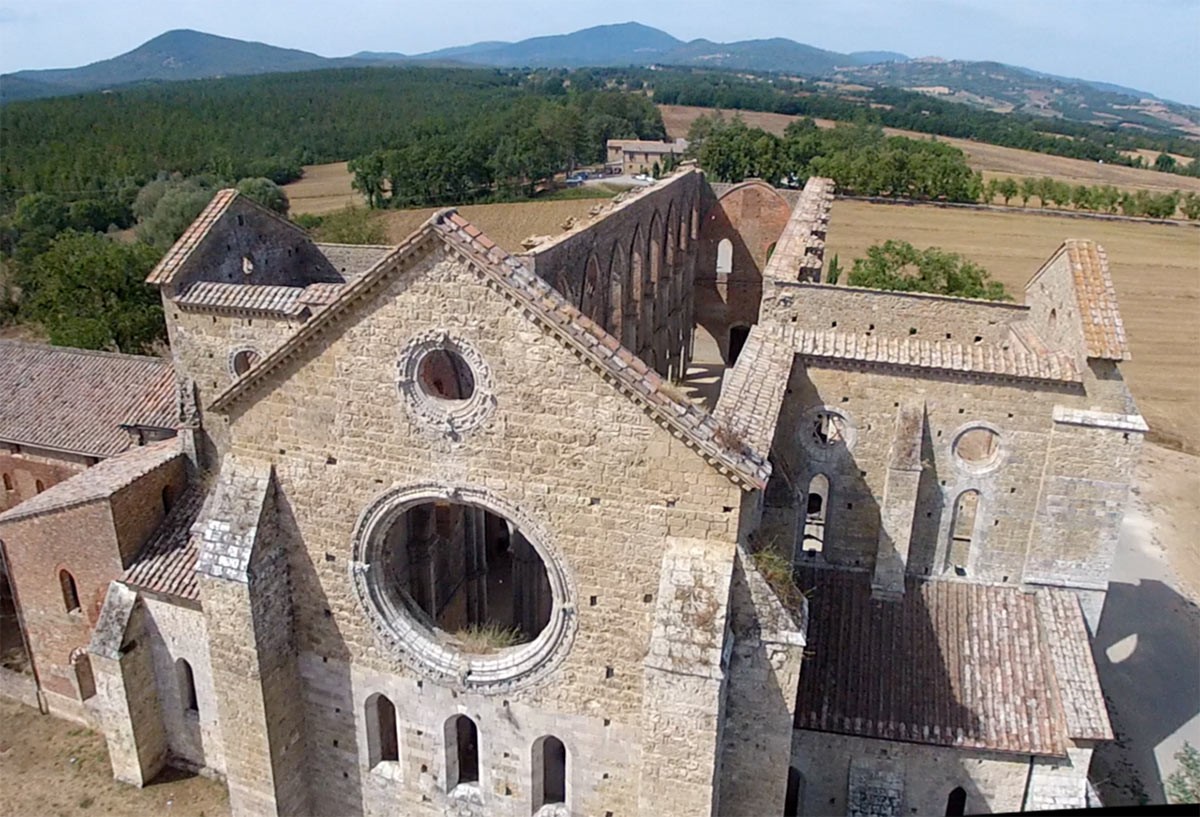
- Architectural Contrast: The site features two distinct areas: the roofless, Gothic Great Abbey and the circular Romanesque Hermitage.
- Mercenary History: The decline of the powerful Cistercian complex was accelerated by 14th-century raids from famous mercenary “Compagnie di Ventura.”
The Abbey of San Galgano is a Cistercian complex located near Siena, in the Chiusdino area. The site is composed of the large abbey, now in ruins, and the Hermitage (Rotonda di Montesiepi), a religious retreat.

Preserved inside the Hermitage is the “sword in the stone” of Galgano Guidotti, a noble knight who withdrew from the world and died here in 1181. Galgano lost his taste for worldly life following his conversion. His epiphany occurred on Christmas night in 1180, when he had a vision of the Archangel Michael. Galgano arrived at the hill of Montesiepi and plunged his sword into the stone—where it remains to this day, resembling a cross (the rusty hilt is still clearly visible).
| Category | Details |
| Location | Chiusdino (near Siena), Tuscany, Italy |
| Key Figure | Galgano Guidotti (Knight turned Saint) |
| Date of Miracle | Christmas Night, 1180 |
| Key Structures | San Galgano Abbey (Ruins) & Montesiepi Hermitage |
| Famous Invader | Sir John Hawkwood (Giovanni Acuto) |
| Status Today | Publicly accessible religious and historical site |

There are many hypotheses regarding the link between the two myths, as the legends of Arthur and Galgano are contemporary. However, the most plausible theory is that the sword was planted there under the influence of Arthurian tales. In this scenario, Galgano didn’t plant the sword himself; instead, it was likely placed by the Cistercian monks who took possession of the Rotunda in 1218 to help spread the myth of Galgano.

A chapel was built at the site of Galgano’s death by the will of the Bishop of Volterra, Ugo Saladini, and completed around 1185. In his final years, Galgano had been in contact with the Cistercians, and by 1201, the first community of monks was established and construction on the great Abbey began.

By the 13th century, San Galgano had become the most powerful Cistercian foundation in Tuscany, with the Abbey finally completed in 1288. However, after the famine of 1328 and the plague of 1348, the monks were decimated. The abbey was subsequently sacked by Compagnie di Ventura (mercenary companies), including the forces of Sir John Hawkwood (known in Italy as Giovanni Acuto). Hawkwood was an English condottiere active in 14th-century Italy who served the Pope and various factions for over 30 years, amassing a fortune. Eventually, in 1474, the remaining monks built the San Galgano Palace in Siena and moved there, abandoning the monastery for good.


John Hawkwood
Common Questions About the Sword in the Stone of San Galgano
Is the Sword in the Stone in Italy real?
Yes, a real medieval sword is preserved inside the Hermitage of Montesiepi in Tuscany. Scientific analysis confirms the sword dates back to the 12th century, the era of Saint Galgano Guidotti.
Where is the real Sword in the Stone located?
The sword is located at the Rotonda di Montesiepi, part of the Abbey of San Galgano complex near Siena. It remains embedded in the rock where Galgano Guidotti is said to have plunged it in 1180.
Who was San Galgano and why did he plunge the sword?
Galgano Guidotti was a knight who renounced his noble life after a vision of the Archangel Michael. He plunged his sword into the stone to symbolize his conversion, turning a weapon of war into a cross for prayer.
Is San Galgano linked to the King Arthur legend?
The legends of King Arthur and San Galgano are contemporary, dating to the late 12th century. Some historians suggest Cistercian monks may have used Arthurian imagery to help spread the local cult of Galgano.
Images: Thudufushi [Wikipedia] , Janex [Wikipedia] , Zyance [Wikipedia] , Giorces [Wikipedia]
Sources: Wikipedia 1, Wikipedia 2, Condottieri di Ventura

Weird Italy, Guide to Unusual & Amazing Places to see in Italy. Italy’s news in English: Art, History & Facts
1 thought on “San Galgano Abbey: A Gothic Skeleton in the Chiusdino Valley”